



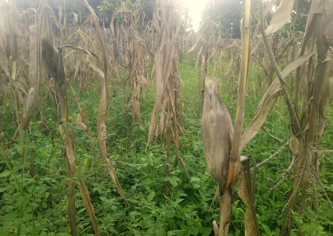
Farmers and cooperative groups in Yei River County in Central Equatoria State have reported a poor harvest during the first farming season, blaming prolonged dry spells triggered by changing climatic conditions that severely affected crop production and reduced yields across the county.
In an interview with Radio Tamazuj on Tuesday, Fatuma Kiden, a member of Tomore Farmers’ Cooperative Group in Yei Town Payam, confirmed that this year’s harvest was significantly lower compared to previous seasons and that despite cultivating six acres of maize, she harvested only two sacks of maize due to the prolonged dry conditions.
“The harvest of this season is really challenging. We cultivated 6 acres, and we managed to get only two sacks of maize because of the delayed rainfall. Last year we got about 20 sacks of maize from six acres, but this year we got only two, which has really affected us as a cooperative group,” she lamented. “The sun was too much; there are new people who also joined us who know nothing about farming, so I am calling upon the agriculture partners to take us through training, especially with new methods.”
Alex Ayume, a farmer from Lasu Payam, also attributed the poor harvest to the extended dry spell, saying he managed to harvest only half a sack of maize from two feddans of farmland.
“Last year, I worked on two acres and was able to harvest five sacks of maize, and compared to this year, I managed to harvest only half a sack from two acres,” he said. “This is due to climate change, which has affected our agro-business. We are unable to feed our kids at home. This is an indication that the whole county is going to experience hunger”.
Meanwhile, Gama Joseph, Commissioner for Environment in Yei River County, acknowledged that the prolonged dry spell had greatly affected this year’s agricultural production and further urged farmers to embrace agroforestry and climate-smart agriculture, among other adaptive farming practices, to improve resilience against the effects of climate change.
“We discovered that there was a prolonged dry spell which resulted in poor yields at the end of the first season. Most farmers suffered, especially those who are dealing in cereals,” he said. “Total yields have reduced, and the quality is poor because of climate change.”
“However, we are advising farmers to look into this strategy of agroforestry; then we are also talking about the issue of climate-smart agriculture where farmers are supposed to practice things to do with mulching,” Gama added.
On his part, Isaac Asiki, Director of the County Agricultural Department, appealed to farmers to regularly engage with the department and report the challenges they face. He said this would enable the department to provide continuous training and technical support to help farmers adapt to changing climatic conditions and improve future harvests.
“You need to bring your reports to us because there are very many farmers, and if you don’t bring your report to us, we will not know,” he said. “We will look into the second season. For instance, when there is too much rainfall, come to us because here in the agriculture department, we will look into what farmers can plant during too much rain and sunshine so that we do not incur losses.”
Recurrent, destructive floods and dry spells have heavily disrupted planting cycles and destroyed standing crops.
South Sudan’s 2026 agricultural production faces severe failure driven by recurrent climate shocks, localized conflict, and economic crisis, leaving approximately 7.8 million people (55% of the population) facing crisis or worse acute food insecurity.

 and then