



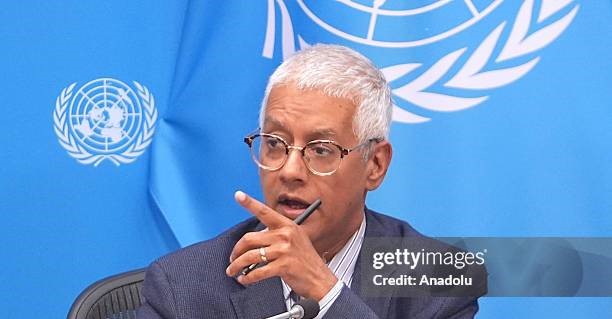
The United Nations said on Tuesday it was deeply alarmed by continued drone attacks in Sudan’s Darfur region that have killed civilians, as the U.N. stepped up efforts to support de-escalation and a future Sudanese-led political process.
Speaking at a daily briefing in New York, Deputy U.N. Spokesman Farhan Haq said Secretary-General António Guterres’ Personal Envoy for Sudan, Pekka Haavisto, was continuing engagements with parties to the conflict to support de-escalation efforts and measures aimed at protecting civilians.
Haq said Haavisto recently visited Gulf states including Doha, Abu Dhabi and Riyadh, where he met a range of interlocutors.
He said Haavisto was also working with the Quintet — made up of the African Union, Intergovernmental Authority on Development, League of Arab States, European Union and the United Nations — to support progress toward a Sudanese-owned political process.
According to the U.N., the Quintet has in recent months consulted political groups, civil society actors, women, youth and displaced communities to help shape the parameters and priorities of a future inter-Sudanese civilian dialogue.
“The Quintet expects to facilitate concrete discussions around modalities for preparing an inter-Sudanese dialogue in the coming weeks,” Haq said.
The U.N. meanwhile expressed concern over escalating drone strikes in Darfur.
In North Darfur, at least 12 people were reportedly killed in multiple drone attacks on two towns near the Sudan-Chad border, Haq said.
Local sources also reported several deaths on Monday in the town of Al Tina following another strike that came after an earlier attack this week that killed seven people and injured 11 others, according to the U.N.
On Sunday, multiple deaths were reported after a drone strike on Kornoi town in North Darfur. The U.N. said another attack on the same town last Friday killed five people and injured four.
The United Nations renewed its call on all parties to protect civilians and civilian infrastructure and to facilitate humanitarian access in line with international humanitarian law.
“We urgently need additional funding to deliver critical assistance to millions of people in need across Sudan,” Haq said.

 and then