



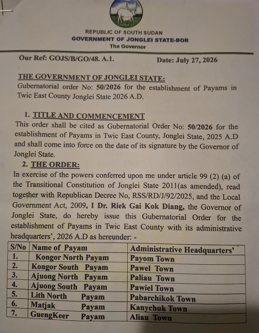
Residents of Twic East County in Jonglei State have expressed mixed reactions following the creation of 10 new payams by Governor Dr. Riek Gai Kok Diang, with some welcoming the move as a step toward bringing government services closer to communities while others question its timing, consultation process, and priorities.
The new administrative units were established through Gubernatorial Order No. 50/2026 for the Establishment of Payams in Twic East County, which took effect immediately after being signed by the governor. According to the order, the creation of the payams is intended to strengthen local administration, improve governance, and enhance the delivery of public services by bringing government structures closer to residents.
However, the decision has sparked debate among community members, with critics arguing that the government should focus first on addressing urgent challenges such as poor roads, limited healthcare access, inadequate education facilities, flooding, and economic hardship.
Manyuon Mayen Manyuon, a member of the Twic East community, said residents are facing more immediate concerns that require government attention.
“Our priority should be better schools, functioning health facilities, improved roads, and economic opportunities—not the creation of more administrative units,” he said.
He questioned why the state government was expanding administrative structures while many existing communities continued to struggle with limited public services.
Manyuon urged Governor Gai to engage community leaders, legal experts, and residents before implementing further administrative changes.
Similar concerns were raised by Garang Abraham Malaak, who acknowledged that some traditional and community leaders welcomed the creation of new payams but questioned whether the government had enough resources to make them operational.
“The paramount chiefs and community leaders may see the creation of more payams as positive because it gives them autonomy to manage themselves. However, how do you manage yourself without resources?” Malaak asked. He argued that the government should prioritize strengthening existing payams before establishing new ones.
“You cannot be creating payams in a flooded area where people are already struggling. What the governor should be thinking about is how to provide services to the already existing payams—not creating more,” he added.
Malaak further alleged that each newly created payam was required to contribute about $5,000 to the governor, an allegation for which he provided no evidence.
“If that is true, this should not become a business. State resources should be used for service delivery, not creating more payams,” Malaak said.
The Jonglei State Government has not publicly responded to the allegation.
Despite the criticism, some residents have welcomed the decision, saying the new payams could improve local representation and make government services more accessible.
Majok Deng Bul, a youth leader from Twic East, said the creation of the new payams was a positive step that could benefit communities if properly supported.
“I appreciate the governor for creating these payams because they will bring services closer to the people,” he said. “When government structures are closer, communities can access services more easily.”
He, however, noted that some members of the wider community felt consultations should have been conducted before the decision was announced.
“Some people believe it would have been better if the government had first consulted the communities before creating the new payams,” he stated. “Consultation helps people understand the reasons behind decisions and gives them a chance to contribute.”
Majok added that the success of the new administrative units would depend on whether they receive the necessary resources, personnel, and infrastructure.
Other residents said they would judge the new payams based on whether they lead to tangible improvements in their daily lives.
As debate continues, residents of Twic East say the effectiveness of the new payams will depend on transparency, community involvement, and the government’s ability to provide the resources needed to make the new administrative units functional.

 and then