



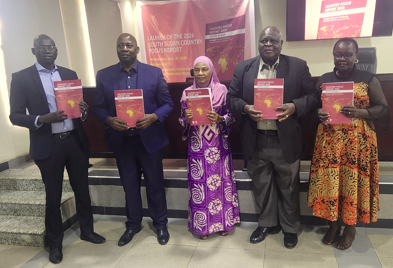
The African Development Bank (AfDB) has urged South Sudan to accelerate efforts to diversify its economy beyond oil, warning that continued dependence on crude exports leaves the country highly vulnerable to regional conflicts, climate shocks and fluctuations in global oil markets.
The call came on Wednesday during the launch of the 2026 South Sudan Country Focus Report in Juba, where the bank said investments in agriculture, mining, livestock, tourism, manufacturing and renewable energy are critical to building a more resilient and sustainable economy.
The report also recommends reforms to strengthen public financial management, improve domestic revenue collection and attract private investment.
“Our projection is that GDP growth will increase by 22 percent in 2026 and stabilize at around 4.8 percent in 2027, assuming stability prevails in South Sudan, Sudan and the wider Red Sea region so that the country can continue exporting oil and restore macroeconomic stability,” said Hoth Chany, the AfDB’s country economist for South Sudan.
He warned that renewed disruptions to oil exports caused by the conflict in Sudan, instability in the Red Sea region, climate shocks and weak global oil demand remain key risks to the country’s recovery.
Chany said South Sudan should strengthen tax administration and compliance, improve transparency in oil revenue management, build foreign exchange reserves and transform agriculture into an engine of economic growth to reduce dependence on imports.
He added that investments in transport, energy and digital infrastructure, alongside the development of mining, livestock and tourism, would help diversify the economy over the long term.
For his part, Prof. Kevin Chika Urama, the AfDB’s Chief Economist and Vice President for Economic Governance and Knowledge Management, said African countries are operating in an increasingly uncertain global environment marked by geopolitical tensions, disrupted supply chains and declining concessional financing.
“The global economic order is fragmenting, and geopolitical dynamics are reshaping trade, global supply chains and capital flows,” Urama said.
“The imperatives for strengthening regional economic integration and home-grown development financing options and national sovereignty have become even more urgent today than ever before.”
Urama said the report provides country-specific policy recommendations to help governments respond to these challenges, arguing that African countries can mobilise more domestic resources through stronger tax systems, better public expenditure management and reforms that unlock private and institutional investment.
Meanwhile, Fauzia Haji, Acting Country Manager for the AfDB’s South Sudan Country Office, said the report comes at a critical time as the country seeks to rebuild its economy following the resumption of oil exports while addressing long-standing structural weaknesses.
“The central message for this report is clear. South Sudan must broaden and diversify its sources of development financing to build a more resilient, inclusive and sustainable economy,” Haji said.
She added that this requires stronger domestic revenue mobilisation, an enabling environment for private investment and strategic partnerships to unlock new sources of capital.
Haji said the AfDB currently has an active portfolio of 26 projects worth more than 300 million U.S. dollars in South Sudan, focusing on agriculture, energy, water and sanitation, governance, social services and financial sector development.
She said the investments are intended to strengthen resilience, support livelihoods and lay the foundation for long-term economic transformation.

 and then