



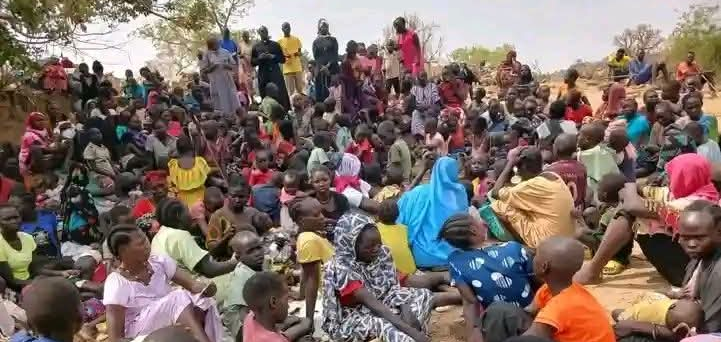
Families displaced by recent attacks in Sudan’s South Kordofan state are still sheltering in remote areas of the Nuba Mountains weeks later, with survivors describing shortages of food, water and medical care, according to residents and footage shared with journalists.
Under the shade of a large tree high in the mountains, women hold babies while barefoot children sit silently on the dry ground, according to a mobile phone video filmed by residents.
Cooking pots, plastic containers and bundles of clothing are piled against a low stone wall — the few belongings families managed to carry after fleeing their homes during the violence.
The video shows exhausted women staring into the camera as children lean against one another in silence. A man filming the scene can be heard saying in Arabic: “These are some of the people displaced by the conflict. Their houses were burned. Some lost relatives. Others lost their children and others lost their mother.”
Weeks after the attacks, residents from Kudi and surrounding villages say they remain in the mountains without adequate food, medicine or clean water.
“We ask our government, especially Abdelaziz [al-Hilu], to help us. The situation is getting worse. There are people who lost their families and do not know where they are,” the man says, referring to Sudan People’s Liberation Movement-North (SPLM-N) leader Abdelaziz al-Hilu.
For many families, the mountains have become both refuge and hardship.
Women sleep in the open air at night while children cry from hunger and cold, residents said. During the day, they search for water from streams running through rocky hillsides.
“The reason we are here is because our homes were burned,” said Socia Hussin, one of the displaced women sheltering in the mountains.
“They burned our houses, and if they saw movement, they would shoot at people. That is why we came to the mountain for the children to find a place to sleep,” she said.
She added that some children became separated from their families during the chaos. “Some children got lost. We don’t know where they are,” she said. “Why are people killing us and burning our houses and our food?”
A Nuba man living outside the region, who asked to be identified only as Musa for fear of reprisals, told Radio Tamazuj that the violence was linked to tensions around a land demarcation process launched in 2022 in areas controlled by SPLM-North.
He said some communities opposed the process, arguing that land disputes should be handled after the conflict and through civilian authorities rather than military structures.
“Land demarcation cannot be done by military means. That is where the problem started,” Musa said.
He said tensions escalated in March when clashes erupted in Dubi, where about 45 people were reportedly killed, including children and elderly residents.
He said some victims were burned inside their homes after attackers stormed the town before dawn.
“They attacked the whole village of Kudi. Properties were looted. All houses were burned,” he said.
Three elderly people died after being trapped in burning homes, he added.
“People were chased and they ran to the mountain. Up to now they are still in the mountain,” Musa said.
He said displaced families are now surviving on wild leaves and water collected from mountain streams.
“The current situation is extremely horrible. Children are dying every day because of lack of medicine,” he said.
He added that humanitarian access remains limited, leaving many families beyond the reach of aid organisations.
“Women are really suffering. Elderly people are suffering because there is no food,” he said.
The Nuba Mountains area, part of Sudan’s South Kordofan state, was a major frontline during Sudan’s north-south civil war. The region has experienced repeated cycles of conflict, displacement and food insecurity over decades.
“We have about 40 years in war,” Musa said. “Women, children and older people are facing a lot of challenges.”
He called for an end to violence and greater protection for civilians.
“We are one people. We are not enemies. There is no need to kill one another,” he said.

 and then