



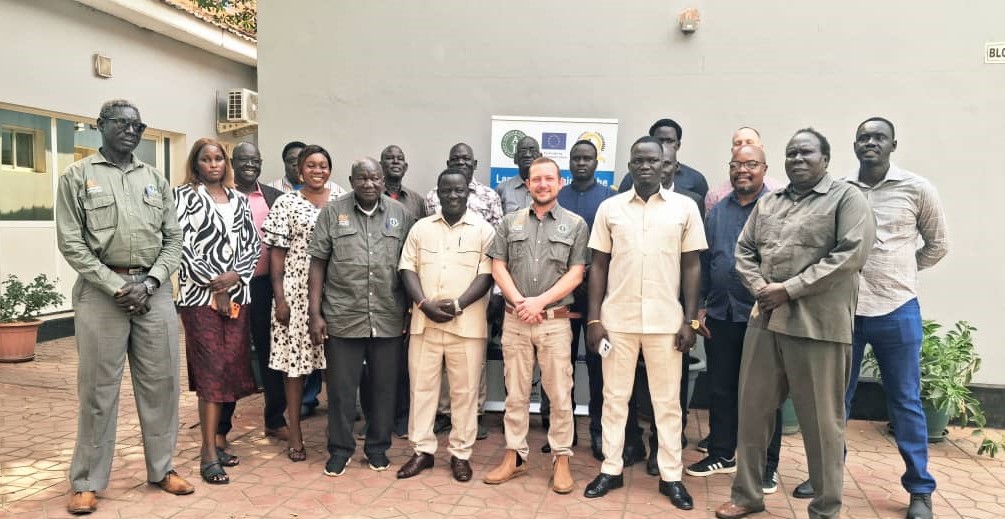
South Sudan will negotiate with communities living inside protected national parks before considering their relocation, the Ministry of Wildlife Conservation and Tourism said, ruling out forced evictions under a proposed plan to establish park boundaries.
The government is developing guidelines to address the expansion of settlements into the country’s six national parks. The proposed framework provides for community consultations, negotiations and possible relocation.
Martin Ring Malek, the ministry’s assistant director general for administration and finance and deputy chairperson of the Land Use Planning Committee, said on Tuesday that authorities would involve affected communities in finding solutions to settlements that had expanded into protected areas during years of conflict.
“We are not going to force them but at least we have to make an agreement of how we can relocate them,” Malek told journalists after a two-day validation workshop on the proposed National Protected Area Demarcation Guidance in Juba.
He said authorities would first establish the boundaries of protected areas and verify whether communities occupying the land had legitimate historical claims.
Residents claiming to have inherited land before the establishment of national parks would be required to provide evidence to support their claims, he said.
“And if we see that there are evidences and boundaries, including them, we shall say, OK, now you have been here. There are areas where we think we can remove, relocate you. Leave this place for the wildlife,” Malek said.
He added that authorities could consider adjusting park boundaries where evidence showed that communities had legitimately occupied certain areas before they were gazetted.
The government has yet to establish how many people live inside the six national parks, Malek said, adding that encroachment had occurred in several locations within individual parks.
The verification exercise will involve the ministries of Wildlife Conservation and Tourism, Lands, Housing and Urban Development, and Environment and Forestry, as well as the Land Commission.
The Land Commission will provide land ownership documents and maps to help determine whether disputed areas are public, private or community land before decisions are made, he said.
Land management
David Geng Kech, coordinator of the Land Reform Unit at the Ministry of Lands, Housing and Urban Development, said wildlife conservation is an important component of national land use planning because protected areas contributed to the economy.
He said cooperation between the ministries of Lands and Wildlife Conservation and Tourism was necessary to improve land use management.
“We all know that wildlife, they are very important that contribute to the national economy when we talk about the resources in terms of tourism, in terms of fishing tourism, in terms of the captive wildlife animals with watching animals’ tourism,” Kech said.
He welcomed the validation workshop, saying it provided an opportunity for government institutions to coordinate their efforts on the proposed guidelines.
Joseph Kulang Akech, director of research and planning at the Ministry of Environment and Forestry, also welcomed the initiative, describing protected areas as important ecological sites that required stronger conservation measures.
He said the parks supported diverse biological species, including plants, animals and insects, and that protecting them would help preserve South Sudan’s natural and cultural heritage for future generations.
“For demarcation, it doesn’t mean that you want to displace or you want to send somebody away but you want to secure the future of that person or those citizens who might have been crossed into the parks,” Akech said.
He urged communities expected to participate in consultations to support the initiative, saying conservation efforts would also benefit people living around protected areas.
Conservation framework
The officials spoke on Tuesday during a validation workshop in Juba, where the ministry’s Land Use Planning Committee reviewed the proposed National Protected Area Demarcation Guidance.
The two-day workshop, supported by African Parks, brought together government experts, regional practitioners and other stakeholders to review the proposed guidelines.
Discussions focused on stakeholder engagement and institutional coordination, physical demarcation procedures, and mechanisms for addressing community grievances and resolving disputes.
The proposed guidance is intended to strengthen the management and protection of gazetted national parks and reserves across South Sudan.
The country has six national parks: Badingilo, Boma, Lantoto, Nimule, Shambe and Southern National Park. They are complemented by a network of game reserves that protect the country’s savannahs, wetlands and wildlife migration routes.

 and then