



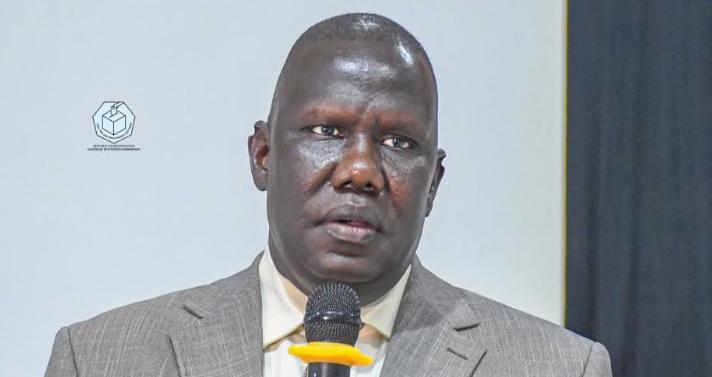
The chairperson of the National Elections Commission (NEC), Gabriel Bol Deng, has defended the decision to move the general election from December 22, 2026, to February 11, 2027, saying the original timetable did not allow sufficient time to complete the legally required electoral activities.
Bol made the remarks on Tuesday during the final stages of the National Inter-Party Political Dialogue in Juba, where political parties raised objections to the revised timetable.
Several parties, including one led by Kornelio Kon, rejected the adjustment. Kon filed a court case on Monday challenging the NEC’s decision.
Bol said the commission had reviewed the electoral law and consulted political, religious and community leaders before concluding that holding the election on December 22 was no longer practically feasible.
“When we budgeted our activities based on the law, we needed an additional 150 days. So, for us at the National Elections Commission, we were at a crossroads,” Bol told the parties.
He said the commission had considered the legal requirements and the time remaining before the scheduled election, concluding that completing all the necessary activities within the available period was impractical.
Bol cited provisions of the National Elections Act, including a 2026 amendment, which he said empowered the commission to adjust the electoral timetable where circumstances threatened its ability to conduct a proper, transparent, inclusive and credible election.
He identified three circumstances provided for under the law: a state of emergency, a natural disaster and other circumstances that the commission considers likely to prevent it from conducting a credible election.
Bol said the first two conditions did not apply to South Sudan but argued that the third provided a legal basis for adjusting the timetable.
“We have adjusted the timeline based on the activities,” he said, rejecting suggestions that the commission had simply postponed the election or extended the transitional period.
He said the time remaining under the original schedule was insufficient to complete voter registration, candidate nominations, campaigning and other preparations required for the election.
According to Bol, the commission needed 58 days for registration-related activities, while only 40 days remained before the scheduled election.
He said the nomination process required 51 days and campaigning another 45 days, making it impossible to complete all the activities within the remaining period.
“In 40 days, we cannot produce valid ballot papers,” Bol said, explaining that the commission still needed the names of political parties, their candidates and their respective symbols before printing the ballot papers.
He also cited the production of ballot boxes as another logistical challenge, saying South African counterparts had agreed to assist in producing more than 100,000 transparent ballot boxes, a process that would require additional time.
Bol said the commission was unwilling to risk holding an election without completing the necessary preparations.
“You cannot fit 115 days into 40 days. Our country needs a soft landing,” he said.
He added that the commission had consulted electoral partners, the African Union and other stakeholders before reaching its decision.
Party funding dispute
Meanwhile, the chairperson of the Political Parties Council, James Akol Zakayo, said the law provides for funding to political parties after elections but does not provide for financing their pre-election activities.
He said the council was engaging the caretaker government to explore alternative funding from the national treasury, acknowledging that political parties lack the resources needed to organise and prepare for the elections.
“The funding is supposed to be for post-election activities, not pre-election activities,” Akol told the parties.
“However, we are asking the government to provide funding from the treasury because this is the first election and the parties do not have the necessary resources to conduct their activities,” he added.
The funding question emerged as another point of disagreement during the dialogue, with participants raising concerns about the financial capacity of political parties to prepare for the elections.
Dialogue resumes
The inter-party dialogue resumed at the Parliament Buildings on Monday to finalise resolutions arising from discussions that began on September 24 and were initially expected to conclude in October.
However, Monday’s session was adjourned after disagreements emerged following an announcement that funding would not be available for distribution to registered political parties to support their election preparations.
The inter-party dialogue leadership subsequently adjourned the session until Tuesday to allow further discussions.
Political parties were also presented with two documents for consideration: a draft joint communiqué on the conduct of general elections and draft consolidated resolutions addressing election-related matters.
The draft communiqué, dated November 23, 2026, refers to the NEC’s decision to move the general election from December 22, 2026, to February 11, 2027.
It also recalls the 2018 Revitalised Agreement on the Resolution of the Conflict in South Sudan (R-ARCSS) and its extended roadmap, which provide for elections at the end of the transitional period.
The second document, titled Draft Consolidated Resolutions of the Inter-Party Political Dialogue on Elections-Related Matters, outlines issues discussed by political parties and stakeholders since the dialogue began on September 24.
The discussions come as South Sudan faces mounting pressure to demonstrate progress towards elections after years of transitional arrangements and repeated delays.
 and then