



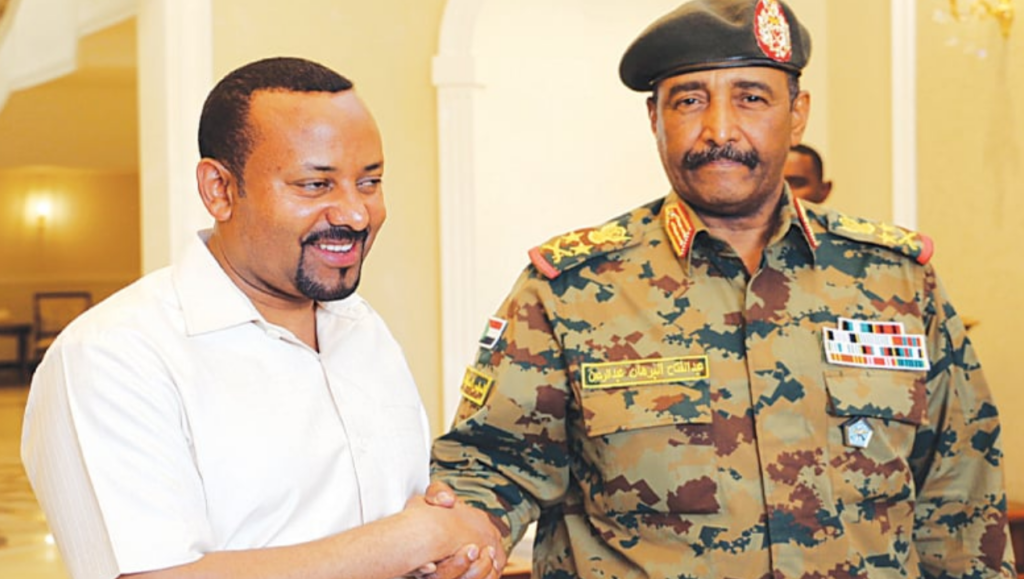
Sudan’s government has rejected Ethiopia’s offer to host talks to end the country’s war, while an administration aligned with the paramilitary Rapid Support Forces (RSF) and a civilian coalition have welcomed the initiative, highlighting divisions over Addis Ababa’s proposed mediation role.
Ethiopian Prime Minister Abiy Ahmed on Tuesday invited Sudanese military, political and civilian groups to participate in an inclusive dialogue hosted and facilitated by Ethiopia, aimed at ending the conflict and paving the way for a broadly accepted national unity government.
The army-aligned government on Wednesday rejected the proposal, accusing Ethiopia of supporting the RSF and allowing drones to be launched from its territory to attack Sudan.
In a statement carried by the state-run Sudan News Agency (SUNA), the government said Ethiopia doesn’t meet the neutrality requirements needed to host or facilitate the dialogue.
It said neutrality and respect for Sudan’s sovereignty are essential conditions for accepting any country’s involvement in the process.
Khartoum reiterated its allegations of Ethiopian support for the RSF and the use of Ethiopian territory to launch drone attacks against Sudan. It called for an independent investigation to establish the facts and determine responsibility, saying it reserves the right to take diplomatic and legal measures to protect its sovereignty.
The government also urged the African Union and other regional and international actors to exclude Ethiopia from any arrangements to host or facilitate the talks.
It said the choice of venue, agenda and facilitator should be determined by Sudanese parties through consensus and their own free will.
Contrasting response
In contrast, the Transitional Peace Government established by the RSF-led Tasis alliance welcomed Abiy’s invitation, saying it offers an opportunity to end the war and alleviate the suffering of Sudanese people.
Khalid Ahmed Danaa, the administration’s information minister, told Radio Tamazuj that his government is ready to engage constructively with the proposed dialogue.
He praised Ethiopia’s government and people for their solidarity with Sudan and said the initiative demonstrates their commitment to the country’s unity, sovereignty and stability.
Danaa said his administration remains committed to comprehensive, fair and sustainable peace and is prepared to discuss the initiative as part of efforts to end the war and address its root causes.
The civilian coalition, the Civil Democratic Alliance of Revolutionary Forces (Somoud), led by former Sudanese Prime Minister Abdalla Hamdok, also welcomed Abiy’s proposal, describing it as a positive contribution to efforts to end the conflict.
In a statement issued on Tuesday, the coalition praised Ethiopia’s emphasis on Sudanese ownership of the peace process and called for coordinated regional and international efforts to support a comprehensive political settlement.
Somoud also commended Ethiopia’s previous role in supporting Sudan’s aspirations for peace and democratic transition following the December 2018 revolution that led to the ousting of former president Omar al-Bashir.
The coalition said peace and stability in Sudan and Ethiopia are essential to stability across the Horn of Africa.
Strained relations
The dispute over Ethiopia’s proposed mediation role comes amid worsening relations between the two neighbours, which have exchanged accusations of supporting armed groups operating in each other’s territories.
Sudan accuses Ethiopia of providing support to the RSF and allowing its territory to be used for drone attacks, allegations Addis Ababa denies. Ethiopia has, in turn, accused Sudan of supporting armed groups fighting its government, a charge Khartoum rejects.
The two countries closed each other’s consulates near their shared border earlier this month, further escalating diplomatic tensions.
The war between Sudan’s army and the RSF erupted in April 2023 over a dispute about integrating the paramilitary force into the regular military. The conflict has killed tens of thousands of people, displaced millions and triggered one of the world’s worst humanitarian crises.

 and then