



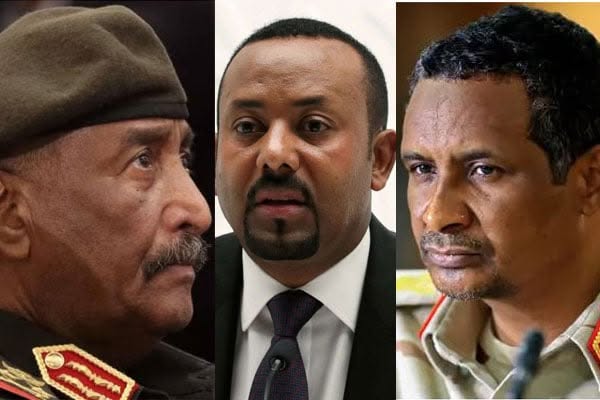
Ethiopian Prime Minister Abiy Ahmed has invited Sudan’s warring military, political and civilian parties to participate in an inclusive national dialogue hosted by Ethiopia, proposing a diplomatic initiative to end a conflict that has fuelled tensions between the two neighbouring countries.
There was no immediate response from Sudan’s army or the paramilitary Rapid Support Forces (RSF) to Abiy’s invitation.
In a statement issued on Tuesday, Abiy said Ethiopia is offering to host and facilitate comprehensive talks involving all Sudanese stakeholders, with the aim of ending hostilities and establishing a Sudanese-led process for lasting peace.
“At this critical historical juncture, the Ethiopian government is putting forward a sincere and genuine initiative calling on all Sudanese parties, across their military, political and civilian components, to participate in a comprehensive and open Sudanese dialogue to be hosted and facilitated by Ethiopia,” he said.
Abiy described Sudan as a brotherly neighbour with deep historical, cultural and people-to-people ties to Ethiopia, saying the suffering caused by the war resonated deeply with the Ethiopian people.
The conflict, which erupted on April 15, 2023, between Sudan’s army and the RSF, has developed into a major humanitarian crisis, with consequences extending beyond the country’s borders, he said.
He reaffirmed Ethiopia’s commitment to Sudan’s unity, sovereignty and territorial integrity, saying the country’s stability is closely linked to security across the Horn of Africa.
Strained relations
The proposed initiative comes amid deteriorating relations between Ethiopia and Sudan, with Khartoum accusing Addis Ababa of supporting the RSF and allowing its territory to be used as a launchpad for drone attacks against targets inside Sudan.
In a letter to the United Nations Security Council dated Oct. 30, Sudan accused Ethiopia of allowing drones launched from its territory to strike Khartoum, Gezira, Sennar, North Kordofan, South Kordofan, Gedaref, Blue Nile and White Nile states.
The Sudanese government said the attacks targeted power stations, civilian facilities and other vital infrastructure, causing casualties and material damage.
Khartoum has described the alleged drone operations as violations of its sovereignty and territorial integrity and submitted complaints to the Security Council and the African Union’s Peace and Security Council.
Ethiopia has denied supporting the RSF. It has, in turn, accused Sudan, Egypt and Eritrea of supporting Tigrayan rebels fighting Ethiopian government forces. The countries have rejected the allegations.
Tensions escalated in early November when Ethiopia closed Sudan’s consulate in the border town of Assosa and ordered six Sudanese diplomats to leave. Sudan retaliated by closing Ethiopia’s consulate in the eastern city of Gedaref and expelling its staff.
The mutual accusations have raised concerns that the conflicts in both countries could spill across their shared border and further destabilise the Horn of Africa.
Ethiopia’s mediation offer
Abiy cited Ethiopia’s diplomatic involvement in Sudan’s 2019 political transition, when Addis Ababa engaged civilian and military stakeholders in efforts to support an agreement towards civilian rule following the ousting of longtime president Omar al-Bashir.
He said the proposed initiative would provide a neutral platform for Sudanese parties to address their differences through dialogue and political consensus.
The talks would seek to end hostilities, overcome political and military divisions and lay the groundwork for an inclusive national political process, including agreement on transitional arrangements and the formation of a broadly accepted national unity government, he said.
Abiy said Ethiopia doesn’t intend to advance a political agenda or favour any particular faction, adding that it is prepared to maintain an equal distance from all parties and facilitate an open and credible dialogue.
“No externally imposed solution can deliver sustainable peace,” he said, stressing that Sudan’s future must be determined by its people through an inclusive political process.
He urged the international community, regional organisations and friendly countries to support humanitarian assistance and diplomatic efforts to end the war. Ethiopia, he added, is ready to mobilise its diplomatic relationships and regional partnerships to encourage Sudanese parties to participate.
Abiy called on all Sudanese stakeholders to put national interests ahead of political and military calculations, saying the objective should be the restoration of a peaceful, united and stable country rather than the victory of one faction over another.
“Sudan’s peace is Ethiopia’s peace, its security is Ethiopia’s security, and its stability is a cornerstone of stability in the Horn of Africa,” he said.

 and then