



A University of Juba academician has proposed establishing a China-South Sudan governance research centre to help address institutional weaknesses, improve public administration and strengthen policymaking in the country.
Dr. Jackline Benjamin Libo Warille, a lecturer at the university’s School of Social and Economic Studies, made the proposal during a China-South Sudan Governance Roundtable in Juba on Tuesday. She said the proposed center would bring together South Sudanese and Chinese universities to conduct research and provide policy recommendations to government institutions.
She said the center would focus on public administration, public financial management, economic development, trade, industrialisation, gender inclusion and human development.
“Most importantly, this should not be only on academic data, Dr. Warille said. “It should produce policy research that serves South Sudanese ministries, parliament and state governments.”
She proposed that the initiative should also support professional training for public servants, independent policy dialogue and monitoring of government reforms.
“South Sudan does not need to copy China’s development model,” Warille stated. “We need to learn from China’s experience, understand the institutions and policies that contributed to this transformation, and adapt relevant lessons to our own history, aspirations and national priorities.”
She said stronger institutions, a professional civil service, credible electoral bodies, independent courts and transparent management of public revenues were essential for the country’s development.
The academic also called for greater investment in women’s political participation, saying the implementation of the 35 percent affirmative action provision remained inadequate.
She said women had struggled to secure representation during the inter-party dialogue and called for their increased participation in political parties, legislative institutions, electoral bodies and peace processes.
Professor Nelson Moro, a development studies lecturer at the University of Juba and director of the Centre for Refugee and Migration Studies, said South Sudan needed to strengthen its institutions and improve the implementation of national development plans.
“We have Vision 2040, we have strategic plans, but we also know that we have a serious problem in implementing these plans and policies,” he said.
He argued that South Sudan needed stronger institutional capacity, political commitment and determination to implement its development priorities, drawing lessons from China’s experience.
“Some of the conflicts we have are because of poverty; so when you begin to put money in people’s pockets, people will begin to forget to shoot each other,” Prof. Moro said.
He added that peace and security were essential foundations for development and urged the country to strengthen its capacity to deliver public services.
For his part, Chinese Ambassador Ma Qiang said China was ready to deepen exchanges with South Sudan on governance and national development as the country prepares for its first general elections since independence.
“China will, as always, support South Sudan in steadily advancing its political transition process, oppose external interference in South Sudan’s internal affairs, and support the South Sudanese people in taking their future and destiny into their own hands,” he said.
The ambassador highlighted China’s governance experience, attributing the country’s development to the leadership of the Communist Party of China, long-term planning and a people-centred approach.
He also said the two countries should deepen cooperation in governance and modernization.
Meanwhile, Dr. Lawrence Kamilo, a senior official in the Ministry of Justice and Constitutional Affairs, called for continued cooperation with China, particularly in human rights and the development of governance systems.
“Human rights is the same, but how you implement it is a different methodology,” he said. “I believe we can benefit from other experiences, not copying and pasting, but taking the content based on our situation.’
He also acknowledged China’s support for South Sudan in international human rights forums, saying continued engagement with international partners was important for strengthening the country’s governance system.
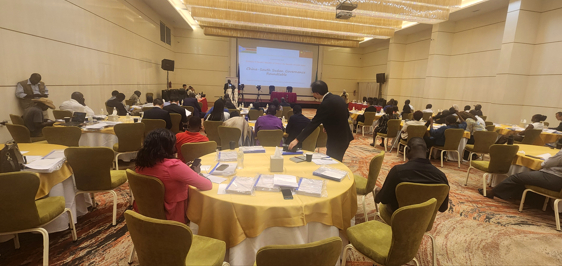
The China-South Sudan Governance Roundtable brought together Chinese diplomats, academics and South Sudanese government officials to discuss governance, institutional development and bilateral cooperation.
The discussions focused on how South Sudan could draw lessons from China’s development experience while strengthening its own institutions and pursuing a development path suited to its national priorities.

 and then