



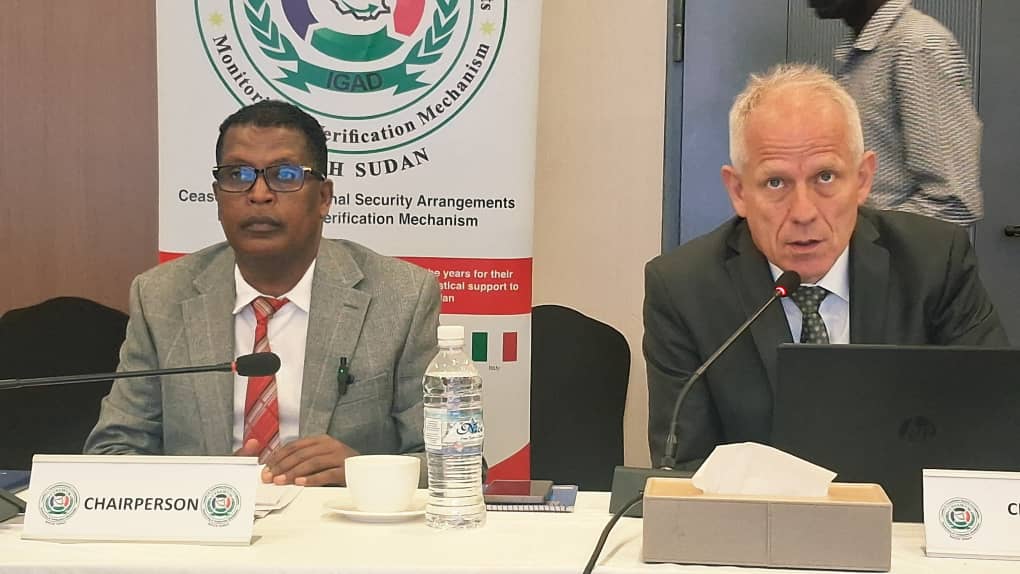
South Sudan’s revised electoral timetable has raised uncertainty over the future of the country’s ceasefire monitoring mechanism, with its chairperson urging the regional bloc IGAD to clarify the body’s mandate, funding and operations beyond the previously anticipated end of the transitional period.
The National Elections Commission recently announced that elections would be postponed from Dec. 22, 2026, to Feb. 11, 2027, citing insufficient time to prepare for the polls.
Maj. Gen. Dr. Hailu Endashaw Atomsa, chairperson of the Ceasefire and Transitional Security Arrangements Monitoring and Verification Mechanism (CTSAMVM), said on Tuesday that the revised timetable had raised fresh questions about the duration of the transitional period and the implementation of outstanding provisions of the 2018 peace agreement.
He said the changes had significant operational and financial implications for the monitoring body, which faces uncertainty over the resources needed to sustain its activities.
“The Mission continues to face uncertainty regarding the availability of resources necessary to sustain its monitoring, verification and reporting activities, particularly in the absence of confirmed donor commitments beyond the previously anticipated timeframe,” Atomsa said.
He called on international partners to provide financial support and urged the Intergovernmental Authority on Development (IGAD) to issue clear strategic guidance to align the mission’s mandate and operations with the revised electoral timetable.
Atomsa warned that the mechanism could suspend its activities if additional funding is not secured.
“Should they fail to secure the necessary financial commitments, this could regrettably be the last meeting of the Technical Committee,” he said.
Rising insecurity
Atomsa also expressed concern over insecurity in several parts of the country, citing clashes between the South Sudan People’s Defence Forces (SSPDF) and the Sudan People’s Liberation Army-in-Opposition (SPLA-IO) in Western Bahr el Ghazal, Jonglei, Upper Nile, and Western and Central Equatoria states.
Retaliatory attacks and intercommunal clashes had also been reported in Eastern Equatoria and Warrap state, alongside incidents of looting and arbitrary arrests, he said.
He further cited highway robberies, abductions and ambushes, including attacks involving humanitarian workers, warning that insecurity had forced several aid organisations to scale back their operations outside major towns.
The deteriorating security situation risks undermining confidence among the parties to the peace agreement, while civilians continue to face displacement and restrictions on movement, he said.
Parties urged to uphold peace deal
Meanwhile, Maj. Gen. Wuoi Mayom Deng, the senior representative of the parties to the Revitalized Transitional Government of National Unity (RTGoNU), urged CTSAMVM and all signatories to remain committed to implementing the revitalized peace agreement despite challenges facing the peace process.
He cautioned against interpreting the absence of widespread fighting as evidence of lasting peace, saying sustainable stability requires mutual trust, respect for commitments and faithful implementation of the agreement.
“The absence of widespread hostilities does not necessarily constitute sustainable peace. Genuine peace must rest upon mutual trust, respect for commitment, and faithful implementation of the agreement,” Deng said.
He described preparations for the anticipated national elections as an opportunity to consolidate progress, strengthen national reconciliation and move the country towards a stable and democratic future.
Deng also urged CTSAMVM to continue carrying out its responsibilities professionally, impartially and with determination, saying its role extended beyond documenting violations.
“It lies equally in building confidence among the parties, encouraging compliance with agreed security arrangements, and preventing a return to conflict,” he said.
Reports of violations
The meeting was expected to consider two reports. The first detailed armed confrontations, the capture of Lankien, the destruction of civilian property and displacement in Nyirol County.
The second concerned the alleged use of live ammunition and arrest operations at the Bentiu internally displaced persons’ camp on Aug. 19, 2026.
CTSAMVM is mandated to monitor, verify and report on compliance with the permanent ceasefire and transitional security arrangements under the 2018 Revitalized Agreement on the Resolution of the Conflict in South Sudan (R-ARCSS).

 and then