



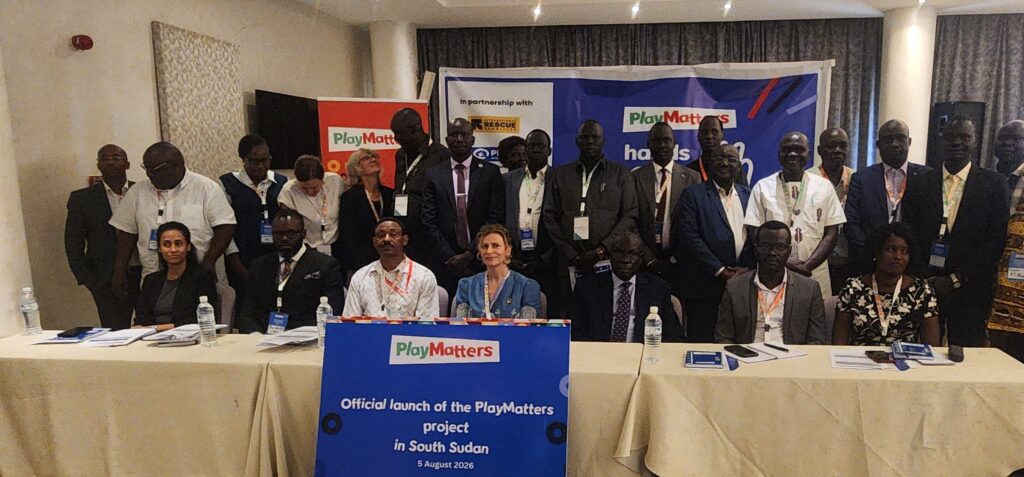
South Sudan on Wednesday launched a four-year education programme aimed at improving learning outcomes for children affected by conflict, displacement and other crises through play-based teaching and psychosocial support.
The Play Matters Phase Two programme, backed by a $14.5 million grant from the LEGO Foundation, will be implemented by a consortium comprising the International Rescue Committee (IRC), Plan International and the War Child Alliance, in partnership with six national organisations and the Ministry of General Education and Instruction.
Running from July 2026 to June 2030, the programme will support 420 schools across 12 counties in seven states, benefiting more than 160,000 children, teachers, caregivers, community leaders and education officials.
Speaking at the launch in Juba, the undersecretary in the Ministry of General Education and Instruction, Olok Omot Okony, said the initiative comes as South Sudan continues to face severe education challenges, including poor foundational learning and one of the world’s highest numbers of out-of-school children.
“We have a very great challenge because we have 2.8 million children out of school,” Okony said. “Those who are enrolled are still not achieving foundational learning in literacy and numeracy.”
Okony said the government would work with the implementing partners to integrate play-based learning into teacher training institutions and the country’s continuous professional development system to ensure the approach continues after donor funding ends.
“The Ministry is fully committed to this partnership. We will help embed these methods within our teacher training institutions and our continuous professional development system so that it becomes ours,” he said.
He urged the government to sustain and expand the programme nationwide once donor funding expires, warning that limiting implementation to seven states could widen disparities in learning outcomes.
“When the funding finishes, it is now we who must take over and cascade this programme across South Sudan,” he said.
The programme prioritises children living in areas affected by conflict, displacement, flooding and food insecurity.
War Child Alliance Country Director Zerihun Yohannes said addressing children’s emotional well-being is essential to improving learning in crisis settings.
“A child who is frightened, angry, or grieving doesn’t learn either what the lesson plan is. A teacher living under the same pressures cannot teach well. Well-being is not a soft addition to this programme. It is the condition under which the pedagogy works at all,” Yohannes said.
He said teachers would be trained to recognise signs of distress among learners and use structured play to support recovery from trauma while improving classroom participation.
The programme also includes an emergency response mechanism that will allow partners to respond rapidly to crises such as flooding and conflict by pre-positioning learning materials and psychosocial support packages.
Despite the investment, consortium members said the programme addresses only a small portion of South Sudan’s education needs.
IRC South Sudan Country Director Richard Oriengo said the 420 targeted schools represent only a fraction of those requiring support and called on donors to expand funding for an approach that has already produced encouraging results.
“The training cascade, the materials, the coaching model and the measurement systems in Play Matters are needed by many more schools than the budget we have. The cost of adding schools to the platform that already works is lower than the cost of building a new one,” Oriengo said.
He said the programme supports teachers to deliver South Sudan’s existing curriculum through structured play rather than introducing a new curriculum.
Project Director Martin Omukaba said the play-based approach has already been implemented in Uganda, Ethiopia and Tanzania, reaching nearly 934,000 children and contributing to improvements in literacy, numeracy, learner engagement and teacher well-being.
“We are not here to change your curriculum,” Omukaba said. “We are here to help teachers deliver that curriculum so that children learn.”
He cited an example from northern Uganda where school enrolment reportedly doubled after the introduction of play-based learning materials, with children encouraging their peers to attend because lessons had become more engaging.
The consortium said the programme will also promote inclusive education by supporting girls, children with disabilities and those affected by displacement, while strengthening collaboration with teacher training institutions and local education authorities to improve learning outcomes across South Sudan.

 and then