



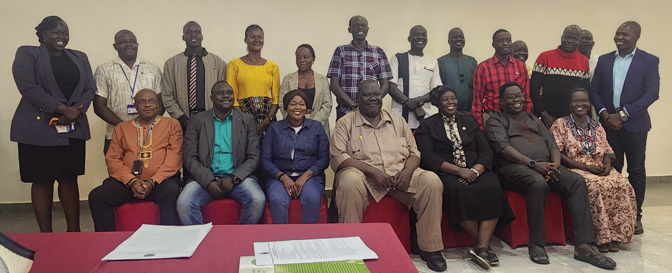
Politics and weak enforcement of land laws are fueling land grabbing across South Sudan, with some politicians accused of shielding individuals who illegally acquire community land, according to findings presented by the Institute of Social Policy and Research (ISPR).
Speaking during a presentation of a civil society review of the draft National Land Policy in Juba, ISPR Chief Executive Officer Boboya James Edimond said political interference has undermined legal procedures governing land acquisition, contributing to rising disputes in several parts of the country.
“Politics has entered into policymaking,” he stated. “Because of the nature of tribalism in South Sudan, some politicians are protecting others from not following due process.”
He said the study found that legal requirements such as prior consultation and consent from communities are frequently ignored, allowing individuals to seize land before seeking official recognition.
“People grab huge chunks of land from communities, demarcate it for themselves, redistribute it, and later ask the government to formalize the process,” he said, likening the practice to money laundering, where illegally acquired assets are later legitimized.
According to Edimond, land grabbing has become increasingly common in areas where land values have risen, including Juba, Nimule, and Mangala. He cited cases in which internally displaced persons settled in new areas and later redistributed land without following legal procedures.
He warned that continued delays in passing the National Land Policy were allowing such practices to continue unchecked.
The draft National Land Policy has been before the Transitional National Legislative Assembly since 2023 after passing its first and second readings.
Edimond said civil society organizations intend to submit recommendations to parliament following consultations across Bahr el Ghazal, Upper Nile, and Equatoria before the proposed law proceeds to its next legislative stage.
Among the recommendations are the introduction of a digital land registration system, establishment of specialized land courts, and stronger oversight of land administration institutions.
He argued that digitizing land records would reduce fraudulent allocations, prevent multiple ownership claims, and improve investor confidence, although he acknowledged resistance from vested interests benefiting from the current system.
“Digitalization is the only way to go,” he said. “But because there are cartels within the land management system, they are not interested.”
The researchers also called for the creation of specialized courts to expedite land dispute cases and for police and judicial officers to receive training on land governance.
Responding to the findings, George Ritti Richard, Director for Lands at the Ministry of Lands, Housing and Urban Development, welcomed the report, describing it as an important contribution toward advancing the National Land Policy. He said the executive had completed its work on the policy and submitted it to Parliament in 2023.
“As an executive, we finished our part,” he said. “It is now for the members of the assembly.”
He added that once adopted, the policy would provide the basis for additional legislation, including laws on community land, land registration, land surveys, and the National Land Commission.
South Sudan Land Commission Chairperson Robert Ladu Benjamin also supported the adoption of the policy, saying stronger legislation is needed to combat illegal land transactions.
He alleged that brokers, some chiefs, armed individuals, and officials have contributed to illegal land sales, particularly in urban areas.
“The land policy first, then from there other laws will follow,” Benjamin said. “Without law, we cannot do anything.”
Civil society groups say they will continue engaging lawmakers and raising public awareness in a bid to secure the passage of the National Land Policy, which they argue is essential for strengthening land governance and curbing politically driven land grabbing in South Sudan.

 and then