



I am not a politician, but politics is part and parcel of my life, as my veins express their thirst for political contribution. As a member of the global community, I believe that no person can live entirely outside politics, just as politics cannot exist without personal beliefs, values, and interests (Fleming, 1988). Whether we participate directly or remain silent as observers, politics influences nearly every aspect of our lives, from the food we eat, the education we receive, to the security we enjoy, and the future we hope to build (Androshchuk et al., 2023).
In South Sudan, however, politics has become more than a system of malpractice or a means of disorganizing society. For ordinary citizens, it has become an unbreakable shackle, a burden that holds the nation hostage to recurring political rivalries, broken promises, delayed democratic transitions, and the persistent struggle for power (Osie, 2022). The question that confronts us today is this: Why does a nation that fought so hard for political independence continue to struggle for political freedom? The onus is yours to answer.
On July 9, 2011, South Sudan emerged as an independent nation after decades of struggle, sacrifice, and suffering (Nyong’o, 2013). Independence represented a historic victory and the fulfillment of a dream cherished by generations of South Sudanese. The people hoped to replace oppression with freedom, conflict with peace, and marginalization with dignity. Above all, they expected a government that would serve the people rather than demand that the people serve those in power (Nyong’o, 2013). Yet independence, though essential, was never meant to be the final destination. It was supposed to be the beginning of a new national journey. Unfortunately, the country descended into civil war on December 15, 2013, followed by renewed fighting in 2016.
These conflicts exposed the fragility of national institutions and the destructive consequences of political mistrust and competition for power (Nyong’o, 2013). According to the World Bank (2026), political contestation, recurring conflict, and weak management of public resources have significantly hindered South Sudan’s development and intensified humanitarian needs.
This is the painful contradiction of our national experience. We achieved sovereignty as a country, but we continue to struggle to make that sovereignty meaningful in the everyday lives of our citizens. What is the value of a national flag if citizens cannot live beneath it in peace? What is the meaning of independence if millions remain trapped in poverty, displacement, insecurity, and uncertainty? And what does political freedom mean when the ordinary citizen has little influence over the decisions that determine their future? These questions are not intended to diminish the sacrifices made for independence. Rather, they challenge us to protect those sacrifices from being wasted by political figures who accepted failure over success, such as Salva Kiir and his ruling elites.
At the heart of South Sudan’s political predicament lies the struggle over power between those who possess it, who share it, who control its resources, and who ultimately benefit from it, and those struggling civilians (Gemechu, 2023). Politics, in its proper sense, should be an instrument for managing public affairs, resolving differences, distributing resources fairly, and advancing the common good. It should provide a peaceful mechanism through which competing interests can coexist without threatening the unity of the young nation. But when political leadership becomes primarily concerned with preserving positions, defending personal interests, or consolidating the influence of particular groups, politics loses its public purpose (Gemechu, 2023).
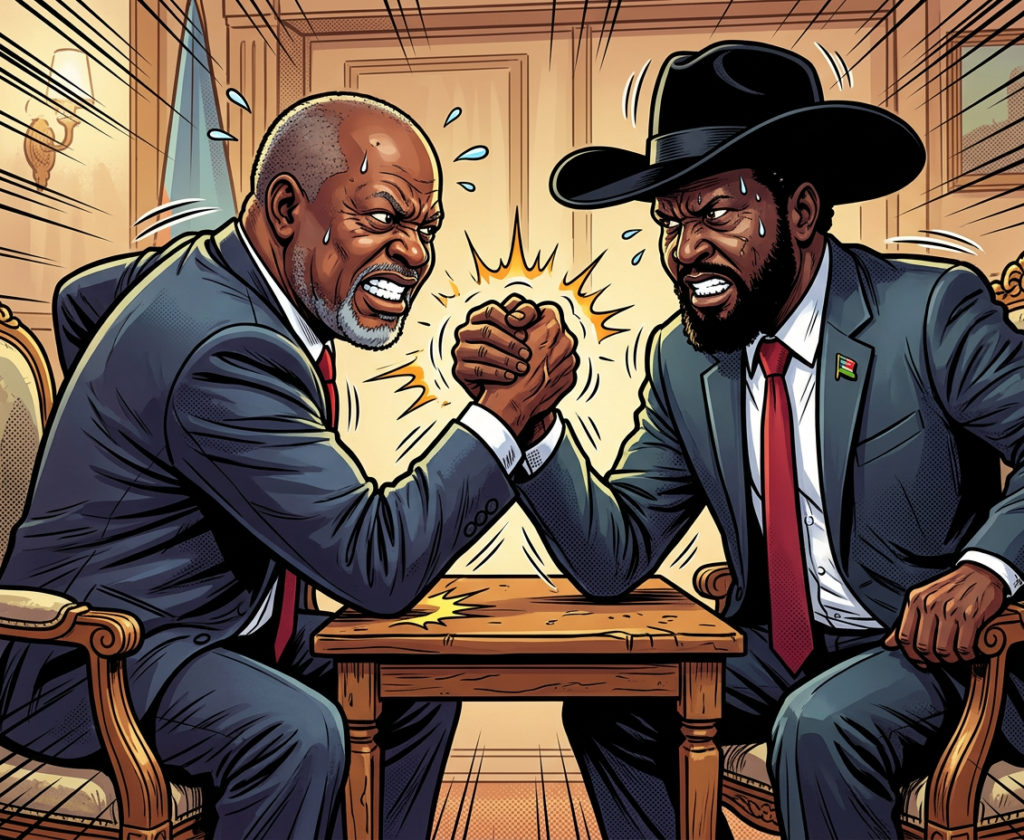
It becomes a contest for survival among political elites, while the population bears the cost of their disagreements. South Sudan’s experience with peace agreements illustrates this dilemma. The Revitalized Agreement on the Resolution of the Conflict in the Republic of South Sudan (R-ARCSS), signed on September 12, 2018, by Dr. Riek Machar, Chairman of SPLM-IO, and Salva Kiir Mayardit, Chairman of SPLM-IG, offered a framework for ending conflict, establishing transitional governance, reforming security institutions, and preparing the country for democratic elections (Stamnes & de Coning, 2022).
Yet implementation has repeatedly fallen behind schedule, resulting in the abrogation of such peace by detaining Dr. Machar in March 2026. In September 2024, the African Union Mission in South Sudan, the Intergovernmental Authority on Development (IGAD), and the United Nations Mission in South Sudan expressed concern that previous extensions of the transitional period had failed to achieve their intended objectives. The organizations urged political leaders to rebuild public trust, complete outstanding commitments, and create the conditions necessary for credible elections (UNMISS, 2024; Osei, 2024). The transitional period was subsequently extended to February 2027. As such, the implication emerged more so than ever that when political agreements repeatedly promise transitions but fail to deliver them, citizens begin to question whether those agreements are instruments of national transformation or arrangements for prolonging the political status quo meant to accommodate Salva Kiir in power (UNCHR, 2026). Peace agreements are necessary, but signatures alone cannot produce peace.
A document can establish obligations, but without political will, institutional accountability, and practical implementation can make those obligations unreal. As such, a peace agreement that remains largely unimplemented risks becoming a political shelter for the very system it was designed to transform (Stamnes & de Coning, 2022).
One of the most troubling aspects of South Sudan’s political journey is the repeated postponement of democratic elections. Elections are not a magical solution to every political problem, nor can they independently guarantee good governance. Nevertheless, credible elections provide citizens with an opportunity to choose their representatives, evaluate political leadership, and peacefully transfer public authority. When a transitional government remains in office beyond its original timetable, the justification for its continued existence must be accompanied by demonstrable progress toward fulfilling its mandate. South Sudan’s repeated extensions raise difficult questions about accountability. How long must citizens wait before their political choices are expressed through the ballot? How many transitional arrangements must be negotiated before the country establishes a stable constitutional order? And how many promises must remain unfulfilled before political leaders recognize that public patience is not an unlimited resource? The concern is not simply that elections have been delayed or prematurely arranged. The problem is that prolonged transitions risk normalizing temporary governance as a permanent political culture.
Regarding many of the agreements signed, the transition continues to face challenges involving the unification of armed forces, the preparation of a permanent constitution, and the implementation of the peace agreement (Stamnes & de Coning, 2022). These are substantial obstacles that require serious attention. However, they must not become permanent excuses for postponing democratic accountability (World Bank, 2026). The solution is neither to rush elections without the necessary safeguards nor to delay them indefinitely in pursuit of perfect conditions. It is to establish a credible, transparent, and publicly accountable roadmap, with clear benchmarks, adequate resources, independent oversight, and consequences for persistent non-compliance. Democracy cannot grow where the destination is constantly moved beyond the reach of the South Sudanese citizens.
Another dimension of South Sudan’s political challenge is the relationship between ethnic identity and political competition (Gemechu, 2023). Ethnic diversity is not a national weakness. It is part of the country’s social and cultural richness. Different communities possess distinct histories, languages, traditions, and experiences that deserve recognition and respect. The danger emerges when political actors (e.g., Salva Kiir and his cronies) exploit these identities to mobilize support, deepen mistrust, or portray political competition as a struggle between entire communities. When a political disagreement is transformed into an ethnic confrontation, the consequences extend far beyond the individuals responsible for the disagreement (Gemechu, 2023).
This means that ordinary citizens may become victims of suspicion, discrimination, displacement, or violence because of identities they did not choose. South Sudan must therefore distinguish between legitimate representation and the manipulation of ethnic identity for political advantage. Every community deserves a voice in national affairs, but no community should be treated as the exclusive owner of this country called the Republic of South Sudan. Government institutions must serve all citizens, regardless of ethnicity, political affiliation, region, or social status. National unity does not require citizens to abandon their identities; rather, it requires them to recognize that their identities coexist within a common political culture that accommodates dissenting voices.
The challenge before South Sudanese leaders is to cultivate a political culture in which disagreement does not become hostility, opposition does not become treason like what Salva has done to Dr. Machar and other opposing political figures, and political victory does not become an opportunity for revenge (Nyong’o, 2013). A nation cannot achieve lasting peace if every political contest is interpreted as a battle for the survival of one community against another.
Further, political instability does not remain confined to government offices, party headquarters, or conference rooms. It travels into markets, schools, hospitals, farms, and South Sudanese families’ homes. When governance is weak and insecurity persists, economic activity suffers. Investors become cautious, public resources may be mismanaged, essential services deteriorate, and ordinary citizens struggle to meet their basic needs (Stamnes & de Coning, 2022). The consequences are especially severe in a country whose population has already endured prolonged conflict and displacement.
The World Bank’s country overview identifies weak public-resource management, economic instability, and humanitarian emergencies among the major challenges facing South Sudan. Subsequent reporting, which was written on challenges facing the Republic of South Sudan, also highlighted widespread poverty, food insecurity, and pressure on essential services (World Bank, 2026). Behind these economic indicators are human lives. There is a civil servant who works without receiving a salary on time. There is a student whose education is interrupted by poverty. There is a farmer whose harvest is threatened by insecurity or flooding. There is a mother who struggles to provide food for her children. There is a young person who has completed an education but sees few opportunities to build an independent future. These citizens may never sit at a negotiating table, yet they pay the price when political negotiations fail. This is why political leadership must be judged not merely by the number of agreements signed, positions distributed, or meaningless speeches delivered, but by the tangible improvements it brings to people’s lives. The ultimate measure of governance is not how comfortably political leaders occupy their offices. It is whether citizens can live safely, earn a livelihood, educate their children, access healthcare, and trust the institutions established in their name.
If the political shackle is to be broken, South Sudanese society must move beyond the assumption that national transformation is the exclusive responsibility of politicians. Political leaders bear a special responsibility because they possess public authority and control institutions that shape the nation’s direction. They must demonstrate restraint, respect constitutional processes, implement the peace agreement, protect civil liberties, and place national interests above personal ambition (Gemechu, 2023). But citizens such as intellectuals, religious leaders, civil society organizations, journalists, traditional authorities, young people, and women must contribute to a political culture grounded in accountability, tolerance, and peaceful participation.
Public criticism should be made constructive to reflect the challenges facing the country, while political disagreement should be expressed with the goal of accommodating those dissenting voices, which is what media should work toward helping the citizens distinguish between facts and propaganda. Civil society must demand transparency with the help of educational institutions to nurture critical thinking and civic responsibility (Gemechu, 2023). Political parties must develop policies that address national problems rather than depend exclusively on personalities or communal loyalties. Above all, citizens must resist the temptation to excuse wrongdoing simply because the person responsible belongs to their political party, ethnic community, or social circle (Stamness & de Coning, 2022).
Accountability loses its meaning when it is applied only to political opponents. Breaking the shackles also requires stronger public institutions. The country needs transparent public financial management, an independent and credible electoral process, a permanent constitution developed through an inclusive process, an accountable security sector, and an effective justice system that does not report to the president. Such institutions would help ensure that the stability of the country does not depend entirely on personal relationships among political leaders. The objective must be to build a state in which institutions are stronger than individuals and laws are more enduring than political alliances.
South Sudan’s young people deserve particular attention because they will inherit the consequences of today’s political decisions. They should not be condemned to inherit an endless cycle of political rivalry, economic hardship, and uncertainty. Their ambitions must extend beyond surviving conflict or waiting for the next political settlement. They deserve opportunities to learn, work, innovate, participate in public affairs, and contribute to national development (Androshchuk et al., 2023).
Young people should be encouraged to engage in politics, but political participation must not mean unquestioning loyalty to powerful individuals. It should mean the courage to ask questions, evaluate policies, challenge injustice peacefully, and demand measurable results. The future of South Sudan cannot be built by treating its youth merely as instruments of political mobilization. They must be recognized as citizens with independent voices and legitimate claims to leadership and opportunity. A country that neglects its youth weakens its own future; however, a country that educates, empowers, and includes them to expand the possibilities of national renewal experiences growth.
South Sudan needs more than another declaration of unity. It needs a new understanding of political responsibility. Political office must be treated as a public trust rather than a personal possession. Opposition must be recognized as a legitimate component of democratic governance rather than an enemy to be eliminated (Gemechu, 2023). Public resources must be managed for the benefit of citizens rather than diverted to sustain private interests. Peace agreements must be implemented in good faith, and democratic transitions must be pursued through credible, inclusive, and transparent processes. South Sudanese diasporans, with the help of international partners, can support peacebuilding, humanitarian relief, institutional reform, and democratic development.
However, external assistance cannot substitute for the political will of South Sudanese leaders or the collective responsibility of South Sudanese citizens (Gemechu, 2023). The country’s leaders must understand that history will not judge them solely by their participation in the liberation struggle or their ability to maintain political influence. It will also judge them by the country they leave behind; whether its people live in peace, institutions function, children access opportunities, and political figures can change hands without violence. South Sudan has already paid an enormous price for its independence. It should not be required to pay indefinitely for the failure to translate that independence into accountable government and meaningful freedom.
In conclusion, I am not a politician, but I cannot remain indifferent to politics when its consequences reach every corner of South Sudanese society. My interest in politics is not necessarily a desire to occupy public office; rather, it is a recognition that the future of a nation cannot be separated from the decisions made in its name. The political shackle of South Sudan is not unbreakable because it is beyond South Sudanese citizens’ power to dismantle. It appears unbreakable because the same patterns of mistrust, power struggles, delayed transitions, and unfulfilled commitments continue to reproduce it (Gemechu, 2023). Breaking that shackle requires courage from leaders, vigilance from citizens, accountability from institutions, and patience accompanied by action rather than passive acceptance.
The people of South Sudan did not struggle for independence merely to exchange one form of suffering for another (Stamness & de Coning, 2022). They struggled for the right to determine their destiny, live in dignity, and build a future free from fear. That promise remains unfinished. The country must now move from the politics of personal survival to the politics of public service, from the competition for power to the responsibility of leadership, and from the repeated negotiation of peace to the practical construction of a peaceful society.
South Sudan’s greatest political victory will not be achieved when one leader defeats another, one party dominates another, or one community prevails over another; rather, it will be achieved when no citizen is suffering because of the political ambitions of those entrusted with governing the nation (Stamness & de Coning, 2022). Until that day comes, the shackle remains not because South Sudan lacks the potential to break it, but because the responsibility to do so has yet to be fulfilled. The question is no longer whether South Sudan deserves political freedom; rather, such freedom will be achieved if its leaders and citizens are prepared to transform that freedom from an unfinished promise into a lived reality (Stamness & de Coning, 2022).
References
Androshchuk, I., Skrypniuk, O., Kulynych, M., Shulga, M., & Zyakun, A. (2023). The role of politics in the life of modern society. Lex Humana (ISSN 2175-0947), 15(2), 134-153.
Fleming, T. (1988). The politics of human nature. Transaction Publishers.
Gemechu, D. K. (2023). Political and social conflicts in South Sudan: the post-independence challenges. Journal of Modern Science, 51(2), 236-254.
Nyong’o, D. (2013). State building in South Sudan: priorities for development policy research.
Osei, L. E. (2024). An analysis of the challenges to the implementation of the revitalised agreement on the resolution of conflict in South Sudan from 2018 to 2022.
Stamnes, E., & de Coning, C. (2022). The revitalised agreement on the resolution of the conflict in the Republic of South Sudan (R-ARCSS), FAIR case brief, 6. Peace Research Institute Oslo (PRIO). https://www. prio. org/publi catio ns/13061.
United Nations Mission in South Sudan. (2026, May 19). UNMISS background. United Nations Peacekeeping. https://unmiss.unmissions.org/en/unmiss-background
UN Commission on Human Rights (2026, October 27). UN commission warns of ‘constitutional coups’ in South Sudan. https://www.radiotamazuj.org/en/news/article/un commission-warns-of-constitutional-coup-in-south-sudan
World Bank Group. (2026). South Sudan: country climate and development report
Dr. Nhial Korow Wicleek, DCP, MC, CCC, is a licensed therapist and Associate Faculty at City University in Canada, based in Calgary, Alberta, Canada. He is a Certified Mental Health First Aid (MHFA) instructor and private practitioner practicing mental health in both the public and private sectors for over 15 years. The views expressed in this article are solely his own as a social justice advocate and do not reflect his academic position or clinical practice.
The views expressed in ‘opinion’ articles published by Radio Tamazuj are solely those of the writer. The veracity of any claims made is the responsibility of the author, not Radio Tamazuj.

 and then