



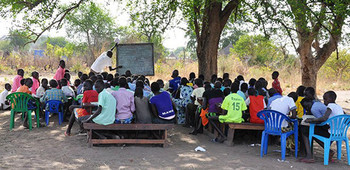
I was born in a cattle camp somewhere in the bushes of Rumbek during the height of the civil war. Around ages 4-5, I started taking care of goats and calves, and later attended to larger cattle in the forest. Like many of my peers, that is where my story of resilience begins. From around 2000 to 2003, when I was just starting primary school, we used to sit under trees for lessons at Amer Comboni, in a small village in Rumbek East. When it rained, you had to look for the side of the tree with the densest leaves to cover your head. At some point, our beloved headmaster, Gabriel Wade, made us go to the forest every day to cut thatch for temporary shelters so that we would not get rained on during lessons. Because we didn’t have many books, we practiced writing on the ground. I believe this was the experience of most South Sudanese pupils during those years. It was an act of resilience, continuing our education even under the worst conditions.
South Sudanese are among the most resilient people on earth, as demonstrated during the twenty-one-year war of liberation that led to independence in 2011, and in the displacement and economic hardship our people continue to face today. Decades of civil war forced communities to endure extreme suffering through strong social networks and deep cultural endurance.
Despite independence in 2011 and the enormous natural and human potential our country possesses, our people still suffer greatly. We face political instability, economic hardship, communal violence, and a poverty rate that some estimates place at 92% of the population living below the poverty line as of 2025. As Emmanuel Jal sings in his song “Stronger”, our people, “even in the hard times, still afford to give you a good smile that you can see from a mile.”
Resilience in the face of adversity is one of our greatest strengths-we always survive. However, I am concerned about the fact that we seem to be just surviving while other nations are progressing in other parts of the world. It has made me wonder if our resilience could be the reason we seem to be trapped in survival mode nearly 15 years after our freedom and Independence. Doing research, I found substantial academic studies and theories supporting the idea that resilience, our very strength, can become counterproductive or even harmful to societies when applied in the wrong context or to a dysfunctional degree. I believe the findings from these social and development studies, if taken seriously by our policymakers and intellectuals, can help chart a way forward for our nation.
The dark side of resilience
One important concept, “The Dark Side of Resilience”, was proposed by researchers Hamideh Mahdiani and her colleague Michael Ungar. They noted that too high a degree of resilience can be dysfunctional. It can encourage people to tolerate inequality, shift responsibility away from institutions, and celebrate overcoming hardship instead of finding ways to remove the hardship altogether. They argue that in some contexts, resilience may become so normalised after a long period of adversity that people begin to normalise poverty itself.
They noted that in the context of poverty, resilience is not the solution if it means being resilient means “adapting to the new idea of meritocracy”, defined as a society in which social position results from someone’s innate ability and efforts. In the Dinka language, resilience means “guam/gum/rialpuou”. Due to economic hardship in the country, youth humorously started forming “Resilience Associations” on social media, like the Gum Chok Youth Association. “Chok” is a Dinka word for hunger. This is a symptom of celebrating overcoming the odds. This is what Diprose termed “learned helplessness,” which she believes results from cultures that celebrate “overcoming-the-odds performance”.
A related concept is what Charles Ogunbode and his team describe as the “Resilience Paradox”. This is a phenomenon where experiencing extreme hardship, such as flooding, can increase a person’s psychological coping capacity but paradoxically reduce their motivation to take action against the underlying cause. In simple terms, if you have learned to survive hardship, you may no longer feel the urgency to remove it. Some researchers have also found that a society can become so skilled at coping with bad conditions that it remains stuck in them. Rather than transforming the underlying system, people adapt and survive without achieving any fundamental change. This is what researchers call the “Resilience Trap”.
How are these findings relevant to our society? As someone who was born in a cattle camp and grew up there before going to school, and who later studied alongside South Sudanese from many different regions to learn of their experience, I find them deeply relatable, or at the very least, I see a real danger of our resilience becoming dysfunctional. We are too comfortable in the face of adversity. For example, South Sudanese do not fear hunger in a way that drives urgent action. Someone would rather protect their pride by “gum-ing chok”-enduring hunger stoically-than seek work with their hands to earn a meal. What I am saying is that an average South Sudanese will not go to work with his hands to earn a meal. This is because it is not a big deal to go hungry for a day or two. Of course, this mindset is changing, but at a very slow rate that is insignificant.
As resilient as we are, we can survive a bad economy, a broken healthcare system, and countless other hardships. But survival alone cannot build South Sudan into a great nation.
What is the way forward?
The central questions become: how do we escape the dark side of resilience? How can a society move beyond surviving a crisis and begin to develop and prosper? How do we convert our resilience into a force for progress rather than merely a mechanism for endurance?
Some nations have done exactly this. After the Korean War in the early 1950s, South Koreans were among the poorest people in the world. Today, fewer than 14% of South Koreans live below the poverty line, compared to an estimated 90% or more of South Sudanese by world standards. Rwanda, after the genocide of 1994, is now one of the fastest-growing economies in Africa. The question worth asking is: how did they do it?
The answer is not that they suffered less, but what they chose to do with their suffering.
Shift from coping to transformation and investing in human capital.
Research on resilience led by Carl Folke and Brian Walker argues that the key to escaping stagnation is transformational change-transforming institutions and governance, redesigning economic systems, and building new social norms. After the Korean War, the South Korean government invested heavily in education, industrialisation, and export-driven growth, which drove its transformation into a high-income country.
Does South Sudan have the resources to invest in education? Yes. South Sudan has oil revenues that could serve as the engine of transformation. This is exactly what our leaders, the freedom fighters, promised. South Sudan has vast arable land. What it critically lacks is the investment in human capital to make use of these assets. The failure to invest in education is not simply a missed opportunity-it is a form of slow self-destruction in a world governed by the law of nature: the survival of the fittest. The harsh truth is that our society currently lacks the skills needed to compete in the modern global economy. More than 60% of our population cannot read or write. Only through sustained investment in education can the government accelerate the transformation of our society. The majority of our people depend on subsistence farming, but through education and technology, this can evolve into industrialised, exportable agriculture.
Are we capable of this transformation? Yes, without doubt, South Sudan has huge potential in human capital. Between 70% and 75% of South Sudan’s population is under the age of 30. South Sudanese students consistently perform well when given access to quality education, as seen in their results in Kenyan and Ugandan examinations.
Education can do extraordinary things. Take my own story. I was born in a cattle camp in the bushes of Rumbek during the height of the civil war. I grew up there until I was old enough to attend school in a nearby village. I was fortunate enough to receive a scholarship from Petronas to study Information Technology at a university in Malaysia, and became a Software Engineer. After 5 years in Germany, today, I work as a Software Development Team Lead in a big company, managing engineers and developers from Germany, Romania, India, and China. How does a boy born in a cattle camp in South Sudan end up leading a software development team in Europe? Through education. I share this not to boast, but to make a point. I was not the most gifted student in my class in South Sudan. In my village, some of the most intellectually capable pupils sat beside me in that classroom under the trees. Now imagine what we could achieve in South Sudan if the government invested seriously in education.
Building accountable institutions
Education alone is not enough. Institutional reform is equally essential, specifically, the adoption of meritocracy, so that capability and effort are what determine opportunity. At present, even graduates with strong qualifications struggle to find employment. Some of our top petroleum engineers spend years jobless. Who is transforming our oil industry if our best-trained engineers are not being hired?
Development research consistently shows that societies escape stagnation when they build strong institutions that hold leaders accountable. Botswana is one of the most stable and prosperous countries on the African continent. But this was not always the case. After gaining independence in 1966, the government of Botswana built transparent institutions, established a stable rule of law, and managed its diamond revenues responsibly. The results speak for themselves.
Rwanda, after the genocide, embarked on a comprehensive state-rebuilding project: long-term national planning, anti-corruption policies, and significant investment in technology and governance. Rwanda’s transformation is not simply an African success story but a direct blueprint that South Sudan can and should model.
Conclusion
Few nations on earth have demonstrated the depth of endurance that the South Sudanese people have shown through war, displacement, and economic hardship. Our strong social networks and cultural resilience are genuine and hard-won strengths that we should be proud of.
But the research is detailed: when resilience becomes a society’s primary response to systemic failure, when endurance replaces demand for change, it can quietly become the very force that keeps a people trapped. Resilience can substitute for the structural transformation that is needed to escape hardship, rather than enabling it.
I think of the boy in the cattle camp in Rumbek or Bentiu, or a young boy trying to make ends meet, walking in the sun in Juba, cleaning shoes on the streets. I think of the children who are still sitting under trees in the rain to attain education. That is resilience. But those children deserve more than the ability to survive. They deserve strong institutions and a strong government investment that matches their endurance with ambition. Resilience should be the foundation of progress, not a substitute for it. The way forward is to transform survival into ambition, build accountable institutions, and invest in the education of our people. We have endured enough. It is time to build South Sudan.
The writer is a concerned citizen and a Software Engineer based in Germany. He can be reached at jmagany@gmail.com or website: maboragany.com.
The views expressed in ‘opinion’ articles published by Radio Tamazuj are solely those of the writer. The veracity of any claims made is the responsibility of the author, not Radio Tamazuj.

 and then