



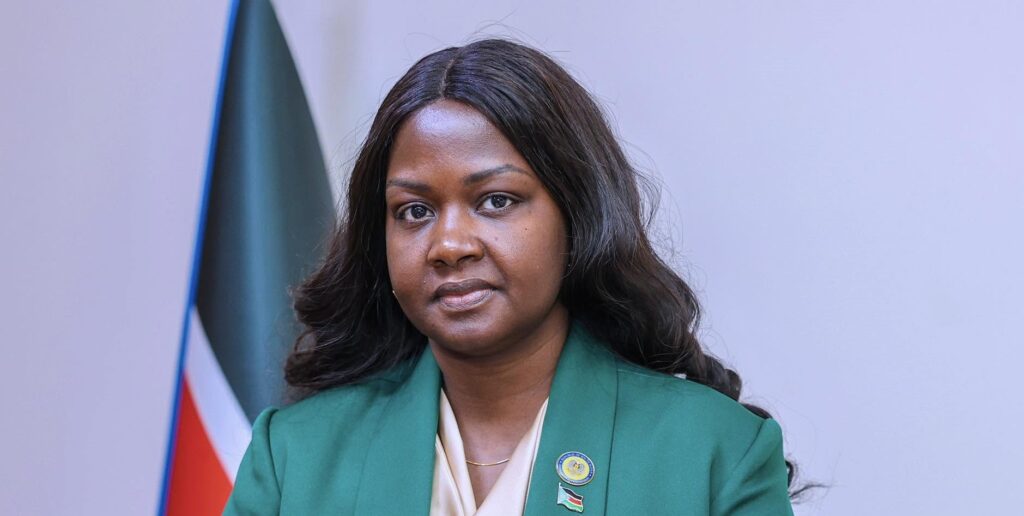
There have been many rumors and allegations surrounding First Daughter Adut Salva Kiir, who also serves as the Senior Presidential Envoy on Special Programs. Her appointment to the position generated considerable debate, with critics attempting to use it against the president, the government and Adut herself. However, those efforts have largely failed to gain traction.
Some critics have, over the years, raised concerns about nepotism. However, such claims have struggled to resonate because Adut’s record is well known, particularly her work as a philanthropist, self-made businesswoman and administrator.
To understand why some of Adut’s detractors continue to target her, it is worth revisiting her marriage in October 2011. She married Ethiopian businessman Nardes Gebeyehu Alemneh in a widely attended church ceremony at All Saints Rejaf Catholic Church in Juba. Shortly after the wedding, controversy emerged because she had married a foreigner.
Much of the criticism came from some Jieng (Dinka) youth who argued that, as the president’s eldest daughter, she should have married a South Sudanese, particularly a fellow Jieng. Many viewed the marriage through a political lens rather than as a personal decision.
When those opposed to the marriage failed to derail it, they shifted their criticism toward the president and his family. Some accused President Salva Kiir of failing the country simply because his daughter had married a foreigner. Yet one must ask: what does an individual’s choice of spouse have to do with the governance of a country?
First Lady Mama Mary Ayen later invited some of the most vocal opponents of the marriage for discussions and urged them to leave Adut’s private life out of politics. By then, however, the issue had already become highly politicized.
Adut has long led the Adut Salva Kiir Foundation (ASK), which has provided scholarships to disadvantaged pupils and students, distributed food and non-food items to displaced and vulnerable South Sudanese, supported public causes and financed medical treatment for the sick, among other charitable activities. These efforts have benefited many citizens across the country.
Why should such contributions be overlooked? Has the trauma of years of conflict hardened society to the point where people can no longer acknowledge positive actions when they occur?
Several former government officials who left office under clouds of controversy now regularly criticize Adut and her father on social media. Others who played roles in political conflicts after independence continue to criticize the government while the country struggles with the consequences of those conflicts.
Their criticisms, according to supporters of Adut, often reflect political grievances rather than objective assessments of her performance. They portray her as a target because of her family name rather than because of her actions.
Some have accused President Kiir of nepotism for appointing his daughter as a special envoy without considering the qualifications she brings to the position. Adut is widely regarded by those who have worked with her as measured, composed and thoughtful. She is educated, articulate, disciplined and professional in both public and official settings.
If competence is the standard by which public officials should be judged, then Adut deserves the same fair assessment afforded to others serving in government. Her supporters argue that she brings professionalism, decorum and poise to public service and should be encouraged rather than condemned.
President Kiir is not the first leader in the world to appoint a family member to public office. Former U.S. President Donald Trump appointed his daughter, Ivanka Trump, and his son-in-law, Jared Kushner, to senior advisory roles in the White House during his first administration.
Similarly, Ugandan President Yoweri Museveni’s son, Muhoozi Kainerugaba, serves as Chief of Defence Forces. Rwandan President Paul Kagame appointed his daughter, Ange Kagame, as Deputy Executive Director of the Strategy and Policy Council in the Office of the President, while his son, Ivan Kagame, was appointed to the board of the Rwanda Development Board. Former Gabonese President Ali Bongo Ondimba also appointed his son, Noureddin Bongo Valentin, to a senior role in government.
Whether one agrees with such appointments or not, the existence of these examples demonstrates that family appointments in government are not unique to South Sudan. More importantly, the key issue should be competence, integrity and performance rather than family relationships alone.
In a fragile country such as South Sudan, where political defections and shifting alliances are common, some argue that it is understandable for a president to place trust in individuals whose loyalty is beyond question.
Ultimately, public officials should be judged on their performance and contribution to national development. Adut should be assessed according to the same standard.
Others have argued that Adut’s involvement in private business should disqualify her from public office. Such an argument overlooks the fact that, like every South Sudanese citizen, she has the right to engage in lawful business activities.
Adut has never denied her business interests and has reportedly used some of the proceeds to support the humanitarian activities of her foundation. No law prohibits her or her siblings from engaging in legitimate business ventures.
At the same time, some critics contend that women should not occupy senior leadership positions. Others argue that a married woman should seek public office through her husband’s community rather than her own.
Such views belong to a different era. Modern societies increasingly recognize leadership based on merit rather than gender or marital status. To reject a qualified leader simply because she married outside her community would be both unfair and counterproductive.
President Kiir, his daughter and other members of the first family have also faced repeated allegations of corruption. Critics have sought to link Adut to Crawford Ltd. and the government’s E-Service System, despite a lack of publicly available evidence establishing such connections.
Those making the allegations have identified known shareholders and directors of the company, yet Adut’s name does not appear among them. After failing to establish a direct link, some critics circulated organizational charts purporting to show her involvement in the company despite the absence of any documented role or ownership stake.
Supporters of Adut view such claims as attempts to damage her reputation through speculation rather than evidence.
If credible evidence of wrongdoing exists, the appropriate course of action would be to present it before the relevant local, regional or international judicial institutions. To date, such legal action has not materialized.
Just on Saturday, Adut’s office convened the second High-Level Pan-African Engagement Forum, attended by H.E. Jakaya Kikwete, former President of Tanzania and the African Union High Representative for the Horn of Africa and the Red Sea.
During the forum, Adut announced plans to launch an inter-party dialogue next month aimed at bringing together political parties and other stakeholders ahead of the December 2026 elections.
For years, many South Sudanese have called for a broad-based political dialogue that includes both armed and unarmed opposition groups. Such a process is widely viewed as essential to placing the country firmly back on the path toward lasting peace.
Supporters argue that Adut’s initiative reflects a willingness to listen to those concerns and pursue dialogue at a time when political consensus remains elusive. Such efforts deserve recognition, regardless of political affiliation.
Those making accusations should be prepared to substantiate them. Rumors, speculation and propaganda have often contributed to division and mistrust in South Sudan and should not replace evidence-based public discourse.
Adut Salva Kiir deserves the opportunity to prove herself through her actions and performance. South Sudanese should give her the benefit of the doubt and allow her time to demonstrate her value in public service.
God bless South Sudan.
The writer, Peter M. Akol, is a concerned South Sudanese. He can be reached via email at: akolp376@gmail.com.
The views expressed in ‘opinion’ articles published by Radio Tamazuj are solely those of the writer. The veracity of any claims made is the responsibility of the author, not Radio Tamazuj.

 and then