



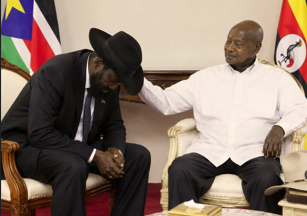
Salva Kiir’s regime is not a normal government. It functions like a mafia enterprise, sustained by violence, theft, and an insatiable pursuit of imagined greatness. Yet the political system on which it depends is far more fragile than it appears. Once the illusion of its absolute control begins to unravel, even Kiir himself may not recognize the collapse until it is too late to stop it.
President Kiir operates within a political bubble modeled after Uganda, where his leadership mindset cannot tolerate genuine opposition or dissenting views. This is one reason why he prefers powerless, briefcase opposition parties over influential ones. Accordingly, his claim that the people of South Sudan want elections held in December 2026 and that his unilateral amendments to the peace agreement and the constitution reflect the people’s will is, at best, misleading.
Salva Kiir has intentionally obstructed the implementation of the 2018 Revitalized Peace Agreement while insisting that both the peace process and preparations for the December 2026 elections are proceeding as planned. That claim is both deceptive and self-serving. One thing is clear: Kiir is the South Sudanese political leader most closely associated with preserving the dictatorial tendencies that contributed to the December 2013 civil war and the July 2016 collapse of the 2015 peace agreement.
The president has deliberately narrowed political space for genuine opposition and critical voices over time. His tribally and politically motivated move to arrest and prosecute prominent opposition leaders mirrors the methods employed by his Ugandan counterpart, Yoweri Museveni. In Uganda, only weak and pro-ruling opposition parties are allowed to freely participate in the political space, while the strong ones, or those with massive support, are kept in detention centers, under house arrest, or forced to flee the country.
The similarities between the two systems, however, extend far beyond political repression. In Uganda, critics have long argued that political power has become deeply intertwined with economic power, with President Museveni, members of his family, and close political allies alleged to wield significant direct and indirect influence over key sectors of the Ugandan economy. Kiir appears to have embraced a comparable model in South Sudan, where political authority and economic privilege have increasingly become inseparable. His family members and close allies are widely perceived to exercise direct or indirect control over major interests in the hotel, oil, mining, and other strategic sectors, reinforcing a system in which political loyalty is rewarded with economic privilege, while genuine competition is steadily marginalized.
Against this backdrop, in late April 2026, a high-level source within South Sudan’s National Security Service told this author that Kiir panicked and informed Museveni that he was canceling the December 2026 elections and that he was also willing to order the closure of the ongoing fabricated legal case against prominent leaders of the Sudan People’s Liberation Movement-In-Opposition (SPLM/A-IO).
However, just before May 1, 2026, Museveni informed Kiir that he should not implement any of the ideas he was considering. Instead, he lectured him on how successful he had been in fabricating legal cases against dissenting Ugandan opposition leaders and keeping them under house arrest or, in some cases, creating conditions so difficult that they were ultimately forced into exile.
Museveni also reminded Kiir that 2026 might be his last chance because, according to him, he might not run again for the Ugandan presidency. According to this account, that moment was when Salva Kiir became so emboldened that he began embracing the idea of imposing unilateral amendments to the peace agreement and the constitution, paving the way for the upcoming staged elections regardless of what the other peace partners had to say.
Ultimately, Kiir and his inner circle can deflect attention and manufacture narratives that serve only their interests. However, they must understand that even if the sham elections move forward and the predetermined winner is announced, the ongoing conflict and humanitarian crisis will persist. That is a political reality the regime cannot escape, regardless of how many narratives it manufactures or how many elections it stages.
Duop Chak Wuol is an analyst, critical writer, and former editor-in-chief of the South Sudan News Agency. He is a graduate of the University of Colorado and writes on geopolitics, security, and social affairs in South Sudan and the broader East Africa region. His work has appeared in leading regional and international outlets, including AllAfrica, Radio Tamazuj, The Independent (Uganda), The Arab Weekly, The Standard (Kenya), The Chronicle (Ghana), Addis Standard (Ethiopia), and Sudan Tribune. In 2017, the Ethiopian Broadcasting Corporation highlighted his article on Meles Zenawi’s role in Ethiopia’s economic transformation. He can be reached at duop282@gmail.com.
The views expressed in ‘opinion’ articles published by Radio Tamazuj are solely those of the writer. The veracity of any claims made is the responsibility of the author, not Radio Tamazuj.

 and then