



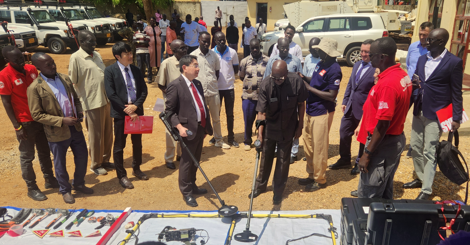
The Government of Japan on Tuesday handed over seven vehicles, 12 motorcycles and other communication and operational equipment to South Sudan’s National Mine Action Authority (NMAA) to strengthen the country’s capacity to clear landmines and unexploded ordnance and expand life-saving risk education.
The equipment, donated through the Japan International Cooperation Agency (JICA) under a project implemented in partnership with the United Nations Mine Action Service (UNMAS), was officially handed over during a ceremony in Juba attended by senior government officials, diplomats and development partners.
Speaking at the event, Japanese Ambassador to South Sudan Toshio Odagiri said the equipment would enhance the authority’s ability to reach more communities affected by explosive hazards.
“Today, on behalf of the Government of Japan, we are officially handing over vehicles, motorcycles, mine detectors and a range of other operational equipment to the National Mine Action Authority,” Odagiri said. “These assets will directly support NMAA’s survey and explosive ordnance risk education teams, enabling them to reach more communities more safely and more effectively across South Sudan.”
The ambassador said landmines and unexploded ordnance continue to claim lives, obstruct agriculture and infrastructure development, and delay the return of displaced families. He noted that ongoing conflict has resulted in the laying of new landmines, making mine action even more critical.
Odagiri said Japan has contributed more than US$16 million to mine action in South Sudan since the country’s independence in 2011, supporting institutional capacity, equipment and community protection. He added that the current project will later introduce Japan’s Advanced Landmine Imaging System (ALIS), which can detect buried landmines in three dimensions, alongside specialised training for South Sudanese personnel in Cambodia.
He also urged the government and all parties to pursue peace, saying international assistance alone cannot replace strong national commitment to mine action.
Jurkuch Barach, Chairperson of the National Mine Action Authority, welcomed the donation, describing it as another milestone in strengthening the country’s mine action programme.
“The vehicles and motorcycles you saw today will enhance the mobility of our survey and explosive ordnance risk education teams, enabling them to reach more counties, deliver life-saving risk education and coordinate mine action operations more effectively across South Sudan,” Barach said.
According to Barach, South Sudan has made significant progress since independence, reducing confirmed hazardous areas from more than 447.4 square kilometres in 2011 to approximately 20.5 square kilometres today.
While describing the achievement as encouraging, he said the country still faces serious challenges and appealed for continued international support until South Sudan is declared free of landmines.
“We are sincerely requesting continued support for mine clearance. Our work is not yet finished, and assistance should continue until South Sudan becomes a mine-cleared country,” he said.
Meanwhile, Borys Pokalyuk, UNMAS Chief Mine Action Programme Officer-in-Charge, said the Japanese-funded project has already delivered tangible results by strengthening South Sudan’s national mine action capacity.
He said the National Mine Action Authority now has its own survey and explosive ordnance risk education teams for the first time in many years, with six teams comprising 24 members becoming operational in March.
“As of 30 June, these teams had completed 313 surveys, marked 131 hazardous areas and conducted 333 risk education sessions, reaching 8,444 beneficiaries,” Pokalyuk said.
He added that the seven vehicles, 12 motorcycles and other communication and operational equipment provided through the project would continue strengthening South Sudan’s mine action capacity for years to come.
Pokalyuk said mine action goes beyond clearing explosive hazards, noting that it creates conditions for peace, humanitarian access, recovery and sustainable development while helping South Sudan meet its obligations under the Anti-Personnel Mine Ban Convention.
The latest support forms part of Japan’s long-standing partnership with South Sudan to reduce the threat posed by landmines and unexploded ordnance, improve community safety and strengthen national ownership of mine action operations.

 and then