



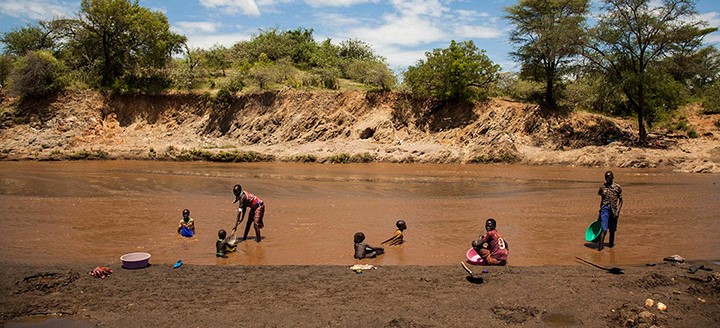
The commissioner of Magwi County in Eastern Equatoria State has strongly urged parents to keep their children away from gold mining activities.
Following the first term holidays, which saw hundreds of school-going children engaging in gold mining, the commissioner warned that involvement in mining would disrupt their education and create an unhealthy obsession with money, particularly with the current economic challenges in the country.
“This is holiday time, and parents must recognize the risks involved. Teenagers are increasingly drawn to activities that can distract them from their studies, and many view mining as a quick way to earn money,” Commissioner Lam Francis Gabriel stressed. “Numerous learners have been trying to reach local gold mining centers, even venturing outside Magwi County and into neighboring regions like Torit. It is unacceptable to see so many young teenagers getting involved in such activities. Education should be their primary focus during the holidays, especially for those who have completed primary school and are waiting for their exam results.”
In these environments, parents often lose control over their children, exposing them to negative influences that detract from their educational priorities,” he added.
Lam said his leadership is dedicated to securing the future of youngsters and transforming the community for a better tomorrow.
“Local government exists to govern our community and prioritize future development and service delivery. If resources are scarce, we will leverage our local manpower to enhance living standards,” he stated. “Similar challenges undoubtedly exist in Kapoeta, as you have noted. Our future depends on the collective accountability of all stakeholders. This principle must guide our actions in Magwi County, rooted in the governance framework provided by the constitution and regulations for civil servants and leaders.”
“We must actively guide this generation; failure to do so endangers our nation’s future. That’s why we are unwavering in our commitment to raising awareness. This is not merely a matter of discussing problems; it is about proactive solutions,” the commissioner added.
He said Magwi County is a peaceful community that excels in education, with school enrollment statistics consistently demonstrating that locals lead in performance.
“We cannot afford to remain silent. The more we speak out, the better citizens we develop. While some may choose to ignore our messages today, they will have to confront them tomorrow,” Lam said. “We will continue to call for action because, as the saying goes, ‘prevention is better than cure.’ We cannot wait until problems arise to seek solutions. We must act now and prevent them before they occur.”
For her part, Caroline Anena, a parent in Magwi Town, said children must stay away from mining because they will get distracted and neglect their education.
“The future of our country hinges on our children focusing on their studies, and it is absolutely unacceptable for them to gravitate toward mining sites. The dangers there are considerable. Health issues are rampant due to the lack of medical facilities,” she said. “Additionally, children are at risk of negative influences from those around them. Many individuals in these areas engage in drinking alcohol and smoking, which creates an environment that is toxic for young minds.”
“I unequivocally reject the idea of allowing any underage child to go to the mining area; it is simply unacceptable, and it adversely affects their mental well-being and poses serious health risks,” Anena added.
Meanwhile, Vicky Kulang, the deputy chairperson of the Civil Society Network for Eastern Equatoria State, lauded what she described as a commendable decision by the Commissioner to prohibit school children from participating in gold mining.
“This significant action plays a crucial role in safeguarding the education of our youth and ensuring a brighter future for our communities,” She stated. “Our children’s rightful place is not in the gold mines but within the classrooms, where they can receive education that fosters development, imparts knowledge, and equips them with vital skills for their future.”
“Education is the most powerful foundation for development and lasting peace in our society,” Kulang emphasized.
She urged community leaders, youth organizations, and both national and international agencies to work together to protect children’s rights and promote safe, conducive learning environments.
“Together, we can pave the way for a future where every child can thrive,” she concluded.

 and then