



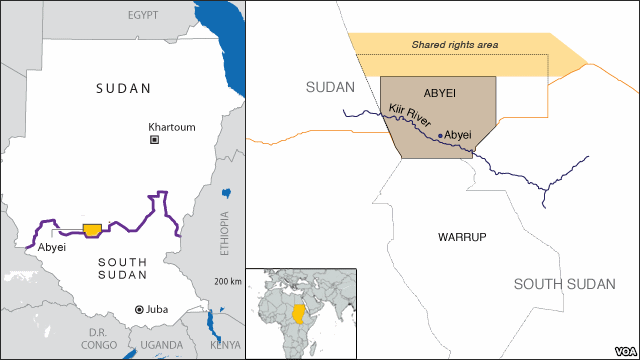
The recent presidential decree awarding Constituency No. 1 to the Abyei Special Administrative Area has created a shockwave across Twic County in Warrap State. It is a decision that contradicts administrative reality, electoral history, and the fragile peace between two communities whose identities and political statuses are fundamentally different. It quietly rewrites boundaries and risks reopening a conflict that has not yet healed.
To understand the gravity of this decree, we must begin with clarity. Twic County is a fully recognized county of Warrap State, part of the sovereign territory of South Sudan. Its people voted in the 2011 referendum. Its borders are defined. Its constituencies existed when Southern Sudan was a region within Sudan before separation, and they continued to exist for more than a decade after independence.
Abyei, by contrast, is a Special Administrative Area whose final status remains unresolved between Sudan and South Sudan. Abyei did not vote in the 2011 referendum. Abyei is governed under a joint arrangement because it is politically suspended between two nations. Abyei is not part of Warrap State. Abyei is not a county of South Sudan. Abyei does not share Twic County’s administrative certainty or citizenship history.
These two communities do not share the same political identity, the same administrative status, or the same electoral destiny. Yet the decree forces them into one constituency. This is the contradiction at the heart of the problem.
The decree places Twic County’s polling areas—the whole of Ajak Kuac Payam, Anyiel, Majak Kool, Aweng, Aneet, Athoony, Akok, Nyin Deng Ayuel, Madau, Mading-Jonthian, etc. (just to mention a few)—inside Abyei’s constituency.
These areas are not Abyei. They have never been Abyei. They are Twic County territories. But Abyei Administration claims them, and that claim triggered the 2022 Twic–Abyei conflict, a conflict that killed people, displaced families, and left deep scars that have not healed. The conflict is still unresolved. The borders are still contested. The communities remain tense.
Now, by awarding Constituency No. 1 to Abyei, the decree quietly suggests that these Twic areas belong to Abyei. It gives political weight to a territorial claim that has already caused bloodshed. It tells Abyei: “These areas are yours.” It tells Twic: “Your land can be reassigned without your consent.” This is not an administrative adjustment. It is a political provocation.
Twic County residents have already made their position clear: they will not accept Abyei residents voting inside Twic territory. This is not defiance; it is self-defence. Allowing Abyei voters into Twic polling stations would be interpreted as surrendering land. It would create confrontation at the ballot box. It would turn election day into a flashpoint. It would undermine the sovereignty of Twic County and the integrity of Warrap State. The decree does not calm tensions; it inflames them.
Every other administrative area in South Sudan—Greater Pibor, Ruweng, Panriang—is assigned its own constituency, separate from any state. Abyei must be treated the same way. Abyei is not a payam of Twic County. Abyei is not a county of Warrap State. Abyei is not under South Sudan’s full administrative jurisdiction. It is a special territory awaiting a referendum. Awarding it Twic’s Constituency No. 1 is not only illogical—it is unlawful.
Before the decree, the eastern part of Twic County had two constituencies—No. 1 and No. 2—giving Twic County four constituencies in Warrap State. Removing Constituency No. 1 without replacement reduces Warrap’s representation, disrupts the state’s constituency sequence, and breaks the national pattern where every state begins its numbering at 1. Warrap State now begins at 2, because 1 has been taken away and handed to a territory that is not even part of the state. This is a contradiction that cannot stand.
South Sudan is preparing for its first general elections. These elections must be peaceful, credible, and grounded in administrative truth. They cannot be built on contradictions, territorial confusion, or decisions that reignite conflict. Constituency No. 1 must be restored to Twic County. Abyei must be assigned its own constituency, reflecting its special status.
The boundaries of Warrap State must be respected. The identities of both communities must be acknowledged. Anything less is an invitation to instability. South Sudan deserves better. Twic County deserves clarity. Abyei deserves consistency. And the nation deserves an electoral map that does not turn polling stations into battlegrounds. The decree must be corrected—not for politics, but for peace.
The writer, Morris Yoll, is an advocate for truth, reconciliation, and territorial integrity and can be reached via myoll2002@yahoo.com.
The views expressed in ‘opinion’ articles published by Radio Tamazuj are solely those of the writer. The veracity of any claims made is the responsibility of the author, not Radio Tamazuj.

 and then