



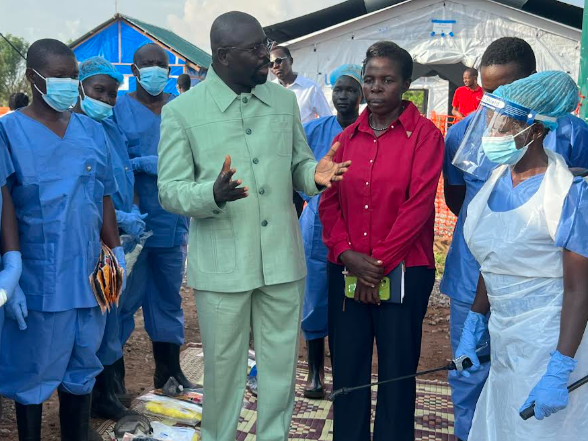
Western Equatoria State Caretaker Governor Badagbu Daniel Rimbasa on Thursday led a high-level delegation to inspect an Ebola isolation unit in Yambio to assess the facility’s readiness to receive and manage suspected cases.
The inspection took place at the Infectious Disease Unit (IDU), also known as the Ebola Treatment Unit (ETU), where health workers conducted a simulation exercise to assess emergency response procedures and identify areas requiring improvement.
The delegation included State Health Minister Nama Bukulu, security officials, government representatives, health partners and a team from the National Public Health Institute in Juba.
The exercise focused on the facility’s capacity to screen patients, isolate suspected cases, prevent infection and ensure that health workers are prepared to respond safely if an Ebola case is reported.
Speaking during the visit, Governor Rimbasa said the government was working with health authorities, security agencies and humanitarian partners to strengthen preparedness and protect communities from the risk of Ebola.
“We have taken drastic measures as the Government of Western Equatoria State to control the entry of the dangerous Ebola through our state. There is political will to increase our surveillance and also to visit the readiness in case we have a case,” Governor Rimbasa said during the inspection. “I called all officials, including security organs, so that we can have concerted efforts in place to prevent Ebola from entering South Sudan through Western Equatoria because we are just a few kilometers from the Democratic Republic of Congo (DRC).”
He commended the Ministry of Health and its partners for their efforts to strengthen disease prevention and emergency response capacity in Western Equatoria.
For her part, Nama Bukulu, the state’s health minister, said authorities were assessing the isolation unit’s readiness, including its facilities, documentation and response procedures.
“We have come to this center to check how prepared the facility is to receive a confirmed case,” she said. “We are also carrying out a simulation exercise that is supposed to check on our surveillance.”
Bukulu said the facility has separate male and female sections and a designated red zone for patient isolation and green zones to support health workers, to support infection prevention and patient management.
Meanwhile, Dr. Nomi Poni, the facility manager of the Infectious Disease Unit and acting team leader for the International Medical Corps (IMC) in Western Equatoria State, said the facility has a capacity of 28 beds across four wards.
“This Infectious Disease Unit is where we will treat Ebola patients if we receive any. You have seen government officials and partners here because we are doing a simulation exercise to test our readiness,” she said. “Since the outbreak of Ebola in DRC, we have not received any cases in South Sudan, so this delegation from Juba came to test our readiness.”
Other facilities include a pharmacy, an ambulance parking area, staff accommodation and space for psychosocial support.
The International Medical Corps manages the facility in collaboration with health authorities and supporting partners, including the World Health Organization (WHO) and UNICEF.
The exercise is part of ongoing efforts to strengthen Western Equatoria’s capacity to detect, investigate and respond to suspected Ebola cases and protect the wider population.

 and then