



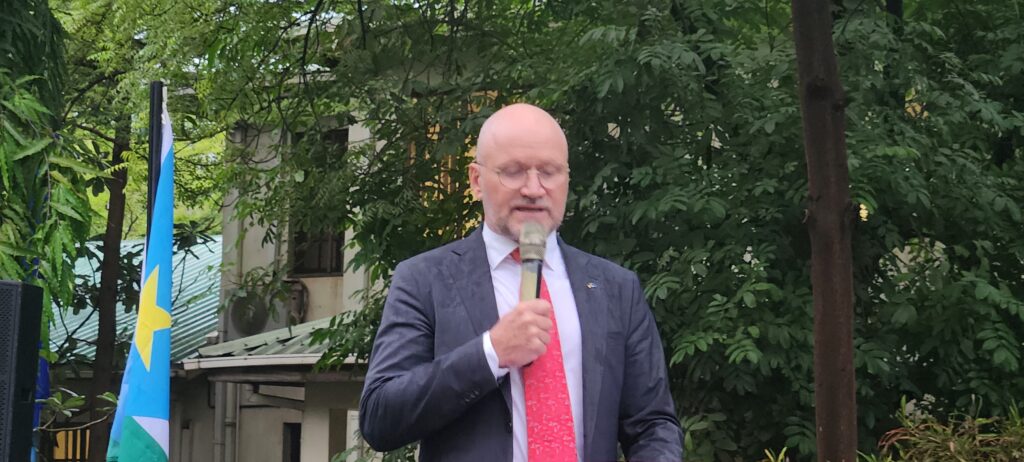
European Union Ambassador to South Sudan Pelle Enarsson on Friday warned that the country was at a “precarious moment” and called for visionary leadership to unite the population and steer the nation toward peace and prosperity.
Speaking during a Europe Day reception at the EU compound in Juba attended by senior government officials, diplomats, civil society representatives and international partners, Ambassador Enarsson said South Sudan needed leaders capable of fostering unity and advancing the peace process.
“South Sudan, in our view, is at a precarious moment. There is a strong need for visionary leadership to bring the people of South Sudan together,” Enarsson said.
Drawing parallels with Europe’s post-war reconciliation process, he urged South Sudanese leaders to identify shared national interests that could promote stability and economic growth.
“You need to find your coal and steel. When you do, we will be here to support your peace, to support South Sudan’s people to become prosperous,” he said, referring to the industries that formed the basis of European cooperation after World War Two.
Enarsson said lasting peace and development would depend on political dialogue and a democratic transition through credible elections.
“That is why the EU is emphasizing the need for political dialogue and peace. South Sudan needs peace and a transition to democracy by credible elections,” he said.
He said the European Union continued to support implementation of the 2018 peace agreement, election preparations, constitution-making efforts, civic education programmes, human rights defenders and youth peace ambassadors.
The envoy added that the bloc was working closely with the African Union, the Intergovernmental Authority on Development (IGAD) and neighbouring countries in support of the peace process.
Enarsson also criticised South Sudan’s spending priorities, saying less than 1% of the national budget was allocated to health and education.
“The financial allocation to health and education is under 1% of the state budget. The bulk of it goes elsewhere, and not necessarily for building peace,” he said.
He said international donors, including the EU, continued to finance many basic services in the country.
“Nine out of 13 million South Sudanese depend on external aid to survive day by day,” Enarsson said.
“This dependency on external aid is a disgrace to the years of fighting and human suffering to achieve independence.”
He quoted President Salva Kiir as saying that “there is no meaning of revolution unless it makes our people happy, unless the masses of our people become prosperous.”
Despite the humanitarian challenges, Enarsson highlighted EU investments in infrastructure, livelihoods, energy and conservation projects across South Sudan.
He cited recently completed road projects in Northern Bahr el Ghazal State, saying they had improved market access for remote farming communities and benefited around 150,000 people.
“What impressed me most was how these roads had changed the mindset of the farmers. Instead of farming just enough to survive, they had started to produce more, to sell on the market and to make their own money,” he said.
The envoy also pointed to EU support for a regional electricity interconnection project linking Uganda to Juba, which he said could provide cleaner and more reliable power to the capital in the coming years.
Europe Day is celebrated annually on May 9 to mark the 1950 Schuman Declaration, which laid the foundation for the European Union. Enarsson described the EU as a peace project built on reconciliation, cooperation, rule of law and economic integration after the devastation of World War Two.
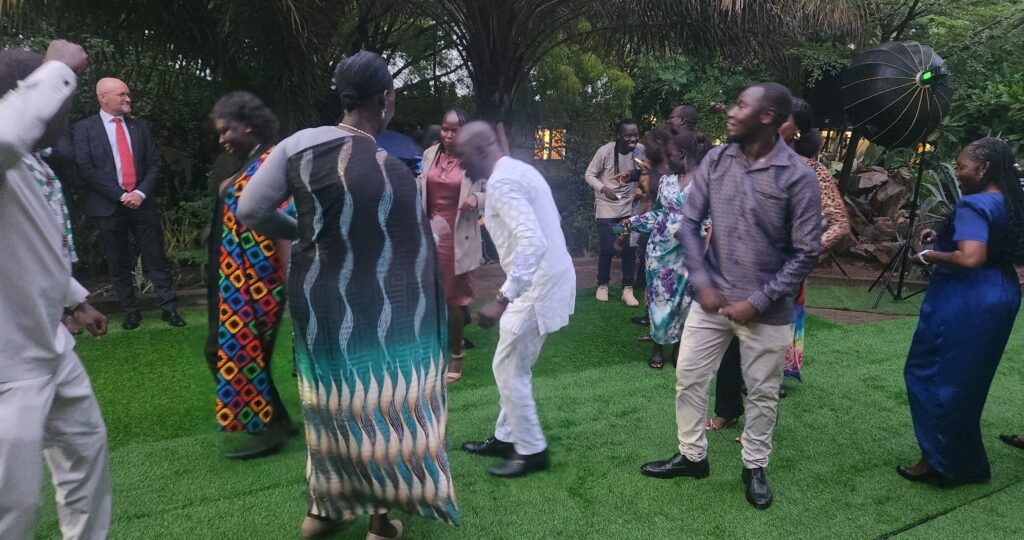
The reception was attended by representatives of EU member states, South Sudanese officials, diplomats, U.N. agencies, civil society groups, business leaders and journalists.

 and then