



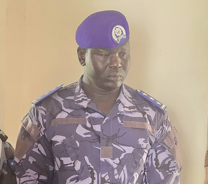
A police captain whose assault on a teenager in Juba sparked widespread public outrage after it was captured on video has been sentenced to six months in prison and fined SSP5 million by the Joint Special Emergency Court for Organised Forces.
The court on Thursday convicted Captain Richard Ruai Kuol, an officer attached to the Police Directorate of Customs Services, after finding that his conduct fell below the professional and ethical standards expected of a police officer.
Delivering the judgment, Major General Raymond Legge, President of the Joint Special Emergency Court for Organised Forces, said the panel had carefully considered the evidence, assessed the credibility of witnesses, and weighed mitigating factors presented by the defence before reaching its decision.
“The act perpetrated by the accused doesn’t reflect the professional and ethical conduct of a police personnel as a member of a well-disciplined institution,” Legge said.
The court sentenced Kuol to six months’ imprisonment, effective from 6 May 2026, the date he was placed in lawful detention at the Police Professional Standards Unit. It also imposed a fine of SSP 5 million, with an additional six-month prison term in default of payment. The court said the prison terms would run concurrently and informed the convict of his right to appeal within the legal timeframe.
The case attracted national attention after a video circulated on social media in May showing Kuol repeatedly beating a teenager on a street in Juba, prompting public condemnation and his subsequent arrest and prosecution.
Following the verdict, lead prosecutor Major Amil Khamis Mayen said the judgment demonstrated that no police officer is above the law.
“We are here to send a message to the people of South Sudan that we have a court and we have accountability for any police officer who violates the law or attacks any citizen of South Sudan,” Mayen said. “The citizens have their rights. We have to keep the law of South Sudan. We have the authority to protect the lives of the citizens and their property, and we will keep the law of South Sudan. This is our duty as the police of South Sudan.”
He added that the police leadership had issued strict instructions against unlawful assaults on civilians.
Defence lawyer Dut Paulino said his team respectfully disagreed with the length of the prison sentence but would not challenge the judgment.
“We dissented respectfully from the excessive time of imprisonment, which reached six months,” Paulino said.
However, he welcomed the court’s decision to dismiss the charge under Section 233 of the Penal Code, which relates to assault using a dangerous weapon, arguing that the prosecution had failed to produce sufficient evidence to sustain that count.
“Justice comes in many forms,” he said. “We do not have anything to appeal on, and we agree with the sentences that the court has given. Our client will serve his sentence and then continue his work as a police officer.”
Paulino noted that the sentence would be calculated from the date of Kuol’s arrest on 6 May, meaning the period already spent in detention would count toward the six-month prison term.
Also commenting after the ruling, Brigadier General Thomas Tut Nyon Kueth, Vice President of the Special Court for Organised Forces, urged members of the organised forces to uphold professionalism and remember that their primary responsibility is to protect the country and its citizens.
He stressed that soldiers, police officers, national security personnel and other members of the organised forces have a duty to serve the public and warned that misconduct undermines the values for which South Sudan’s liberation generation fought.
The judgment brings to a close one of the country’s most closely watched police misconduct cases, which ignited debate over the use of excessive force by law enforcement officers and the need for accountability within the organised forces.

 and then