



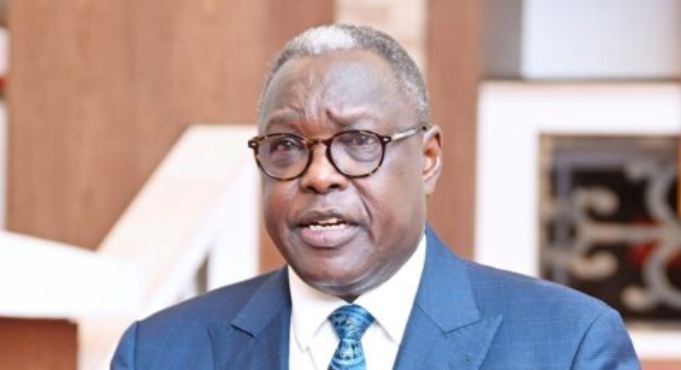
South Sudan’s Council of Ministers has backtracked on proposed changes to provisions on the supremacy of the 2018 peace agreement, following pressure from Western governments.
Speaking to reporters after a cabinet meeting chaired by President Salva Kiir in Juba on Friday, Cabinet Affairs Minister Dr. Martin Elia Lomuro said the cabinet had reviewed amendments submitted to parliament and decided to retain Articles 8.1, 8.2 and 8.3 of the Revitalised Agreement on the Resolution of the Conflict in South Sudan (R-ARCSS), which set out the agreement’s legal supremacy.
He said the cabinet agreed that amendments would instead be limited to Articles 1.2.5, 1.14 and 6.14 of the agreement to pave the way for general elections in December 2026.
Article 8.1 states that the agreement is legally binding on all parties, replaced the 2015 peace agreement and required ratification by the Transitional National Legislature.
Article 8.2 provides that the agreement shall be incorporated into the Transitional Constitution of South Sudan and that, in the event of a conflict, the provisions of the R-ARCSS prevail.
Article 8.3 stipulates that the agreement takes precedence over national laws and any earlier agreements that are inconsistent with its provisions.
Together, Articles 8.1, 8.2 and 8.3 establish the agreement as the supreme transitional legal framework during the transitional period.
“We confirmed the amendments submitted,” Lomuro said. “We decided to maintain Articles 8.1 on the supremacy of the agreement, 8.2 and 8.3, so that the amendments are restricted only to Articles 1.2.5, 1.14 and 6.14.”
Articles 1.14 and 6.14 relate to transitional governance and security arrangements, including power-sharing and implementation of ceasefire provisions.
The decision followed U.S. sanctions and pressure from 17 Western embassies and the European Union, which warned that unilateral changes to the 2018 peace agreement would undermine its legitimacy and jeopardise peace efforts in South Sudan.
In a joint statement on Tuesday, diplomatic missions from Australia, Canada, Cyprus, Denmark, Finland, France, Germany, Ireland, Japan, the Netherlands, New Zealand, Norway, Portugal, Slovenia, Sweden, Switzerland, the United Kingdom and the United States, together with the EU delegation, called for an immediate return to dialogue.
“The Peace Agreement remains the basis of legitimacy for the transitional government in South Sudan,” the statement said. “Unilateral changes to the Agreement are not in accordance with the letter and spirit of the Agreement and will not bring peace to South Sudan.”
The missions said full implementation of the 2018 agreement remained essential for stability.
President Salva Kiir Mayardit’s camp submitted the proposed amendments on 11 May to parliament to pave the way for elections in December 2026, prompting opposition lawmakers to boycott proceedings, saying the process violated provisions of the accord.
Among the controversial amendments tabled by Justice Minister Michael Makuei Lueth was the repeal of clauses establishing the supremacy of the peace agreement over the constitution and national laws.
The Sudan People’s Liberation Movement-in-Opposition (SPLM-IO), led by Dr. Riek Machar, a key signatory to the deal, has opposed the amendments, saying it was not consulted.
The Reconstituted Joint Monitoring and Evaluation Commission (RJMEC), which oversees implementation of the agreement, has also expressed concern, warning that any amendments require consultation and consensus among all signatories, including the SPLM-IO faction aligned with First Vice President Riek Machar.
Machar was detained in March 2025 and later suspended from office over allegations linking him to violence in Nasir County. He is facing treason charges before a special court.
International actors have repeatedly called for his release, renewed political dialogue and full implementation of the peace agreement ahead of planned elections.

 and then