



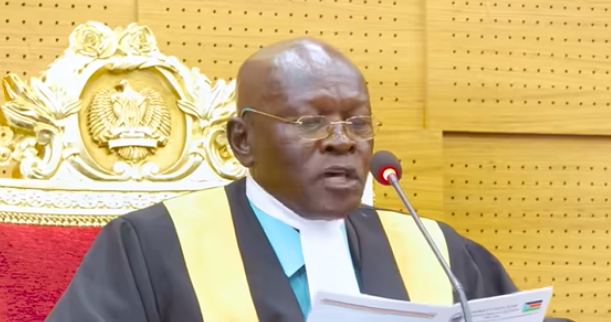
South Sudan’s government on Monday tabled controversial amendments to the country’s 2018 peace agreement before parliament, triggering a boycott by opposition lawmakers who said the process violated procedures set out in the accord.
Justice Minister Michael Makuei Lueth presented the proposals to the Transitional National Legislature, saying the changes were necessary to address challenges delaying implementation of the peace agreement and to pave the way for elections due in December 2026.
Lawmakers aligned with the opposition Sudan People’s Liberation Movement-in-Opposition (SPLM-IO), loyal to detained First Vice President Riek Machar, walked out of the chamber in protest shortly after the proposals were introduced.
The SPLM-IO lawmakers chanted slogans in Arabic translating to “Freedom, Peace and Justice” and “No amendments to the peace agreement” after leaving the session hall.
Makuei defends changes
Makuei, who is a close ally of President Salva Kiir, said the amendments had been endorsed by signatory parties under Article 8.4 of the peace agreement before being approved by the cabinet.
“To my surprise, there are some South Sudanese whom I believe to be opposition, who decided to march out from this hall, sending a clear message that they are not for elections,” Makuei told parliament.
He accused the opposition lawmakers of working against the wishes of South Sudanese seeking democratic elections after years of delays under the transitional government.
“The people of South Sudan have been pressing the parties signatory to the agreement and the government all these years so that we give them the opportunity to choose the leadership and the government they want,” he said.
Meanwhile, Minister of Cabinet Affairs Martin Elia Lomuro defended the process, accusing SPLM-IO members and the Reconstituted Joint Monitoring and Evaluation Commission (RJMEC) of attempting to obstruct preparations for elections.
He said the amendments were part of government efforts to advance the implementation of the peace agreement and ensure elections proceed as planned.
Speaker of parliament Joseph Ngere Paciko referred the proposals to the Legislative and Legal Affairs Committee for scrutiny and directed it to report back within two weeks before debate begins.
According to the speaker, the committee will conduct public consultations before tabling its findings in parliament as lawmakers move to finalise the legal framework ahead of the planned elections.
SPLM-IO protests
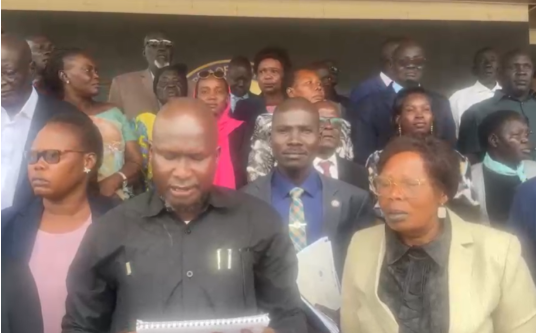
Separately, the group of the SPLM-IO lawmakers who boycotted the sitting accused the government of violating the 2018 peace agreement.
Chaguor Ater Bol, chairperson of the parliamentary committee on livestock and fisheries and an SPLM-IO lawmaker, said the process failed to comply with provisions governing amendments under the agreement.
“Presenting the bill before the assembly for ratification without first securing the consent of all parties was unprocedural under Article 8.4,” Bol told reporters outside parliament.
“What we need is an inclusive dialogue that will lead us back to full implementation of the agreement,” he added.
The boycott follows warnings from international partners and peace monitors over the amendment process.
In a joint statement issued in April, the embassies of Canada, France, Germany, Japan, the Netherlands, Norway, Britain and the United States, together with the European Union delegation, said any amendments to the 2018 peace agreement must strictly follow procedures outlined in the accord.
The Reconstituted Joint Monitoring and Evaluation Commission (RJMEC), which oversees implementation of the agreement, has also warned that amendments require consultation and approval from all signatory parties, including the SPLM-IO faction aligned with Machar.
Civil society groups have also raised concerns.
Edmund Yakani, executive director of the Community Empowerment for Progress Organization (CEPO), said any amendment process conducted outside RJMEC procedures would violate the peace agreement.
Proposed changes
Under Article 8.4 of the accord, amendments must be approved by at least two-thirds of the Council of Ministers and two-thirds of RJMEC voting members before ratification by parliament.
The proposed amendments have not been processed through RJMEC, according to opposition lawmakers and peace monitors.
The government’s proposals seek to amend three chapters and one annex of the agreement, including provisions related to elections, constitutional reforms and the legal supremacy of the peace accord.
Among the changes, the proposals would require amendments to the transitional constitution to be completed before the end of the transition period, separating elections from the permanent constitution-making process.
Other proposed changes include reducing the deadline for publishing the voter register from six months to three months before elections and repealing provisions establishing the supremacy of the peace agreement over national laws and the transitional constitution in cases of conflict.
South Sudan’s bicameral legislature consists of the Transitional National Legislative Assembly as the lower house and the Council of States as the upper chamber. Under the 2018 Revitalized Peace Agreement, the TNLA has 550 members, with the SPLM holding 332 seats.
Several SPLM-IO MPs perceived to be loyal to Machar have recently been replaced by members aligned with a faction of the SPLM-IO led by peacebuilding minister Stephen Par Kuol.

 and then