



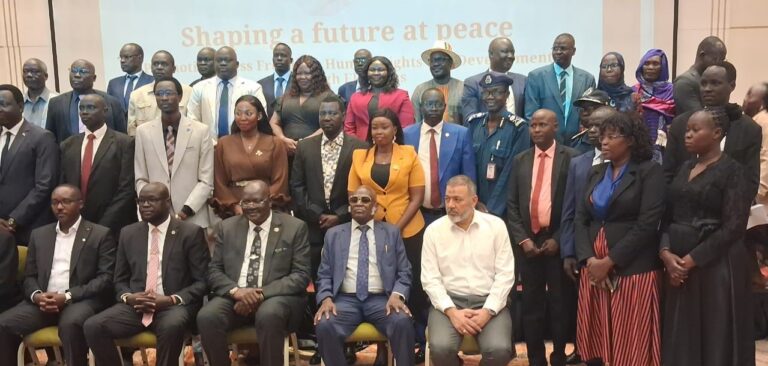
The three-day Media and Security Conference concluded in Juba on Thursday with participants reaffirming their commitment to strengthening relations between journalists, security personnel, and government officials, while urging media practitioners to report responsibly and avoid damaging the country’s image.
The conference, which began on Tuesday, brought together journalists, security officials, civil society representatives, and international partners to discuss media safety, election reporting, misinformation, artificial intelligence, and digital governance.
During the symposium, discussions focused on the need to balance access to information and freedom of expression with professionalism, ethical, and responsible reporting.
Speaking during the closing session, Eastern Equatoria State Information Minister Elia John stressed that journalists must report responsibly to protect the country’s image internationally. He said negative portrayals in the media contribute to the country’s poor press freedom rankings.
“It is South Sudan’s ranking; it is not security,” he said. “Whatever you are doing contributes to the image of this country, whether good or bad.”
John defended closer coordination between journalists and authorities, saying Eastern Equatoria State has maintained relative peace through regular engagement between media practitioners, security institutions, and government officials.
“That is why you hear Eastern Equatoria was relatively peaceful, despite when the other part of the country was almost boiling,” he said. “Eastern Equatoria remained peaceful because our journalists are responsible, they love their state, and they love their communities. In weekly meetings, I represent the journalists in the government. I have to advise the government about the rights of journalists.”
The minister also defended government guidance to journalists, rejecting accusations of censorship.
“We guide, we do not call it censorship,” he stated.
For her part, Unity State Information Minister Nyakenya Johannes said her ministry has repeatedly intervened to secure the release of detained journalists and improve relations between the media and security agencies. She described journalists as “partners in peace building” and said confrontation between reporters and security institutions should be avoided.
“We continuously emphasize that journalists are partners in peace building, and we emphasize that reporting should not be treated as hostility,” she said.
The minister said she had earned the nickname “mother of journalists” after repeatedly intervening in cases involving detained reporters.
“One time I had to make sure that I leave my office and go to that station where they (journalists) were detained to make sure they are released,” she said. “So, anything to do with journalists, I do not compromise. We are not fighting; journalists and the government are the same because we are all trying to serve the community.”
“Dialogue between media and security institutions is more effective than confrontation,” Nyakenya added.
However, she raised concerns about misinformation, hate speech, and the lack of professional training among journalists at the grassroots level.
“We still have untrained and also uneducated journalists, people who do not have the right skills of journalism at the grassroots level,” she said. “As leaders, we must work together to create an environment where journalists can operate safely, professionally, and independently.”
Meanwhile, Lul Ruai Koang, Spokesperson of the South Sudan People’s Defense Forces (SSPDF), cautioned journalists against rushing to publish casualty figures and unverified reports during conflicts, saying such numbers can fuel revenge attacks and panic among communities. He cited a recent case in which revenge attacks allegedly left 15 people dead after one community believed it had been specifically targeted.
“You do not know the psychological impact of numbers,” he said. “We lost 15 people as a result of revenge attacks because a certain community felt that a certain community targeted them.”
He acknowledged the pressure journalists face in trying to break news, but appealed for balanced and patriotic reporting.
“You also balance the need to be patriotic and the need to get your job done,” he said. “The pressure that you put on us, all of us here, is too much. So, let us have this common understanding that all of us are working differently, but we are working for the same country, for the same people.”
Gen. Ruai complained about journalists recording officials without consent and publishing information prematurely.
“Sometimes I have been recorded without my permission,” he said.

 and then