



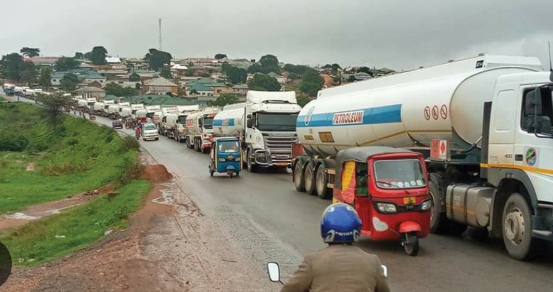
Uganda faces imminent fuel shortages if the just-ended transport strike in Kenya, temporarily suspended for a one-week grace period to allow dialogue, fails to resolve the underlying crisis [1]. The shutdown had effectively choked the Northern Corridor from Mombasa port, the main supply route for landlocked East Africa [1]. With neither government releasing a comprehensive contingency plan, South Sudan will also feel the pressure, showing how quickly the ripple effects are traveling toward Juba [4].
The Kenyan trigger stems from an unprecedented 23.5 percent fuel hike announced by the Energy and Petroleum Regulatory Authority (EPRA) in May 2026, pushing diesel to an excruciating $1.87 per liter [3]. Under the umbrella of the Transport Sector Alliance, matatu (minibus) and boda-boda (motorcycle) operators completely paralyzed major towns like Nairobi and Mombasa [3]. They are demanding an immediate reversal of the price hike and a return to a competitive free-market procurement system.
The Kenyan government managed to negotiate a fragile seven-day pause in the strike [3]. However, the state is caught in a vice: current prices are already heavily subsidized. With the Kenyan Treasury facing massive import bills, the government can scarcely afford to hold back the tide of global market forces for more than a few days without risking fiscal collapse [3].
This regional shockwave is directly linked to a broader Middle East squeeze [1]. The military escalation involving the US, Israel, and Iran has severely choked the Strait of Hormuz, the critical maritime artery handling 20 percent of global oil trade [2]. Compounded by aggressive global supply disruptions, crude prices have comfortably breached the $80-a-barrel threshold [2].
For a landlocked capital like Juba, this global bottleneck dictates domestic survival [4]. Every drop of refined fuel consumed in South Sudan must navigate a perilous, multi-country overland transit. When global supply contracts, the highest economic premiums are extracted at the very end of the logistical tail, turning an international shipping crisis into an immediate localized emergency [5].
Uganda’s position is rapidly teetering toward exhaustion [1]. The Ministry of Energy and Mineral Development, alongside the Uganda National Oil Company (UNOC), previously reassured the public that the country held roughly 22 days of petrol and 23 days of diesel reserves. However, those buffers were calculated under normal operating conditions.
With the Mombasa pipeline and highway networks choked by the transit standstill, these modest reserves will draw down fast [4]. The Energy Ministry has issued quiet statements urging the public not to engage in panic buying, but without a functional bypass to the Kenyan supply artery, Kampala’s fuel security will remain entirely hostage to the political temperature in Nairobi [1].
Meanwhile, South Sudan finds itself trapped in a structural double bind [5]. The irony is that the country stands as an oil producer but lacks the domestic refinery capacity to process its own crude. The country cannot even move its own oil exports to international markets without importing the expensive, refined diesel required to run its heavy extraction infrastructure and transport trucks.
Worse still, South Sudan’s domestic oil flow through neighboring Sudan remains severely broken by ongoing conflict [5]. Forced to rely heavily on refined imports coming up through the East African corridor, Juba must absorb extreme border taxes and transport premiums [4]. The result is a hyper-inflated economy where local food prices are spiraling; in regions like Jonglei, Warrap, and Western Equatoria, the cost of a basic food basket has surged by 8% in a matter of weeks [5].
Across the region, the defining feature of this crisis is the absolute vacuum of official preparation, a collective failure to plan [1]. Governments have offered defensive press releases rather than actionable contingency frameworks. Energy experts argue that the EAC must establish joint regional strategic fuel reserves and standardized tax protections for cross-border haulage. Instead, each nation continues to manage these systemic infrastructure shocks as isolated, short-term market hitches.
The lack of strategy translates into human suffering on the street [3]. Informal business owners are losing all their profits directly to the pump [3]. A boda-boda rider in Kampala or a vegetable trader in Juba cannot simply absorb a massive spike in transport costs [3]. Urban populations are forced to walk to work, food prices at local markets are tripling, and critical facilities like hospitals, which are reliant on diesel generators to survive erratic grid power, are left counting down the hours before their lights go out.
The writer is a PhD student at the University of Nairobi, Kenya, and an associate researcher at The Sudd Institute, South Sudan.
The views expressed in ‘opinion’ articles published by Radio Tamazuj are solely those of the writer. The veracity of any claims made is the author’s responsibility, not Radio Tamazuj’s.
Bibliography
- Omer, M.K. (2026). Iran War Exposes Africa’s Vulnerability to Global Energy Shocks. [online] Pan African Review. Available at: https://panafricanreview.com/iran-war-exposes-africas-vulnerability-to-global-energy-shocks/.
- Abdellatif El-Menawy (2020). The world after the Strait of Hormuz crisis. [online] Arab News. Available at: https://www.arabnews.com/node/2643938/amp [Accessed 20 May 2026].
- Njuguna, H. (2026). The Kenyan Wall Street. [online] The Kenyan Wall Street. Available at: https://kenyanwallstreet.com/fuel-price-may-cycle-epra-2026 [Accessed 20 May 2026].
- Reuters (2026a). Protests erupt over Kenya fuel price hikes, strike strands commuters. [online] @CNBCAfrica. Available at: https://www.cnbcafrica.com/2026/protests-erupt-over-kenya-fuel-price-hikes-strike-strands-commuters [Accessed 20 May 2026].
- Matamis, J. (2026). Global Markets and the Strait of Hormuz: The Economic Shockwaves of the Iran War • Stimson Center. [online] Stimson Center. Available at: https://www.stimson.org/2026/global-markets-and-the-strait-of-hormuz-the-economic-shockwaves-of-the-iran-war/.

 and then