



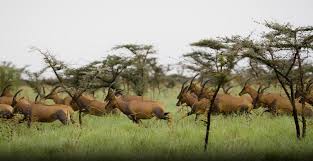
South Sudan warned on Thursday that expanding roads, illegal hunting and environmental destruction are threatening one of the world’s largest land mammal migrations, as officials concluded a two-day workshop on balancing infrastructure development with conservation efforts.
The workshop in Juba brought together government officials, conservation groups and infrastructure planners to discuss how South Sudan can expand roads and other public works without disrupting critical wildlife corridors across the country’s wetlands and savannahs.
Lt. Gen. Khamis Adiang Ding, Director-General of the National Wildlife Service, said South Sudan still had a rare opportunity to preserve its migration systems before they suffer the decline seen elsewhere in the region.
“When you cross into our side here, you see a lot of destruction,” Adiang said after visiting Ethiopia’s Gambela National Park, which forms part of the wider Great Nile migration landscape shared with South Sudan.
“You see falling of trees, burning of charcoal and these types of things,” he added, warning that poaching and environmental degradation were increasing in wildlife areas.
South Sudan is home to the Great Nile Migration, a seasonal movement of white-eared kob, tiang antelope and Mongalla gazelle across Boma and Badingilo national parks and surrounding community lands. Conservationists describe it as the world’s largest remaining land mammal migration.
Adiang said poaching networks operating along the Ethiopian border were driven partly by economic hardship and cross-border demand for bushmeat.
“We are poaching animals, but you are buying this meat,” he said, referring to discussions with Ethiopian officials. “If there is no demand, there will be no supply.”
He said conservation efforts in South Sudan were increasingly shifting beyond armed enforcement toward community engagement, awareness campaigns and land-use planning.
The workshop, supported by African Parks, focused heavily on the risks posed by poorly planned roads and other infrastructure projects cutting through migration routes and protected ecosystems.
Dudu Docaus Hamilton of African Parks said South Sudan still had a chance to avoid the environmental losses experienced in neighbouring Ethiopia.
“In South Sudan, you have this incredible migration that remains intact,” Hamilton said. “On the other side of the border in Gambela, they have lost a great deal of their migration. There’s very little left.”
“That work is much harder than protecting something that already exists,” she added.
Hamilton said around 70% of the migration landscape lies on community-managed land rather than inside protected parks, making local communities central to both conservation and infrastructure planning.
“We can’t protect the Great Nile migration without communities,” she said. “We also can’t build dynamic, sustainable infrastructure without communities.”
African Parks said it has spent the last three years mapping wildlife movement, grazing areas, seasonal migration patterns and community land use to help guide future planning.
Hamilton warned that roads, while critical for development, could also accelerate wildlife exploitation by opening remote areas to hunters and traders.
“We know roads are a foundational component of development,” she said. “But roads can also lead to exploitation of resources.”
She cited growing bushmeat trafficking along the Juba-Bor highway corridor, where motorcycles, automatic weapons and improved transport access had increased commercial hunting pressure on migrating antelope.
Officials from the South Sudan Roads Authority acknowledged that several planned transport corridors pass near sensitive ecosystems and wildlife routes.
Kose Luke Igga said the workshop had demonstrated that infrastructure development and conservation could coexist if projects were properly planned.
“Let us measure our success not through how many kilometres of roads we are able to construct, but through how many wildlife species we are able to protect after constructing these roads,” he said.
The government also said it planned to expand conservation areas and establish community conservancies under South Sudan’s new Wildlife Act, partly funded through World Bank-supported programmes.
Robert Ladu Benjamin said the workshop had highlighted the need for future land policies to be “wildlife-friendly” and environmentally sustainable.
Officials said recommendations from the workshop would feed into broader national land-use and infrastructure planning as South Sudan seeks to expand roads, trade routes and public services while preserving its globally significant wildlife migration systems.

 and then