



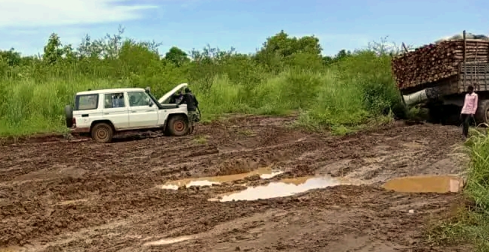
Motorists operating along the Yei–Juba and Yei–Kaya roads have raised concerns over the increasing number of checkpoints, multiple payments, and poor roads, saying the situation is negatively affecting their businesses and livelihoods.
According to the drivers, the numerous checkpoints along the roads are driving up operational costs, leaving many of them counting losses and struggling to sustain their businesses.
Speaking to Radio Tamazuj on Monday, Amule Stephen, a driver operating on the Yei–Juba route, described the situation as challenging. He said drivers encounter more than 30 checkpoints where they are required to make payments, and urged the government to intervene and address the situation.
“What is making our work difficult is the issue of numerous checkpoints as we drive from Juba to Yei. There are about 30 checkpoints, and at some of them, they demand SSP 100,000 while others take 5,000. If you multiply that by 30, it is a lot of money,” he lamented. “We charge passengers SSP 200,000 from Juba to Yei, yet some people pay 180, 000 which is not enough. When we protest, they (soldiers) get angry with us.”
“We drivers are facing a lot of challenges because they (soldiers) are the ones protecting us and we cannot do anything; only the government can,” Amule added.
Another commuter driver, Vita Emmanuel, who operates on the Yei–Kaya road, described the road as being in a state of disrepair, making movement very difficult because vehicles get stuck in potholes.
“We usually charge travelers SSP 120,000, but we have increased it to 150,000 per passenger due to the cost of fuel. Sometimes they don’t pay the full amount. Sometimes, the checkpoints demand something from us, which is not bad because they also help us,” he explained. “Our road is in a bad condition; vehicles get stuck during the rainy season like now. Let the government at least work on the road connecting to Uganda, even if it means just grading and putting murram.”
Another Yei–Juba driver who identified himself as Kennedy cited multiple challenges affecting road transport, including payments at checkpoints and the limited number of passengers.
“These days there are no passengers, and sometimes you come from Juba and spend three or four days before going back, unlike traveling from Juba to Yei,” he bemoaned. “I was coming from Juba to Yei, and my vehicle got stuck due to the road’s poor condition and had to spend a night before a colleague rescued me in the morning. Up to now, my vehicle is spoilt at Lainya Centre.”
Meanwhile, Naumi Nadia, a trader who frequently travels between Yei and Juba, said transport fares have increased and transporting goods has also become expensive.
“We used to pay SSP 100,000 for transport, but it is now 200,000. This is a challenge to us as business people,” she said. “If you have goods like groundnuts or other produce, the driver may charge between SSP 400,000 and 500, 000 and we no longer make any profits.”
On his part, Justin Luate, the Chairperson of Yei River County Chamber of Commerce, acknowledged fluctuations in prices and partly attributed them to increased taxes and the high cost of road transportation. He urged business people to regularly review and adjust their prices in line with prevailing market conditions.
“I acknowledge the fluctuations in prices and many other factors, including bad roads and an increase in taxation; all these are factors that affected prices,” he said. “You have to charge according to the market; otherwise, you may incur losses.”
Efforts to reach Yei River County government officials for comment were futile.

 and then