



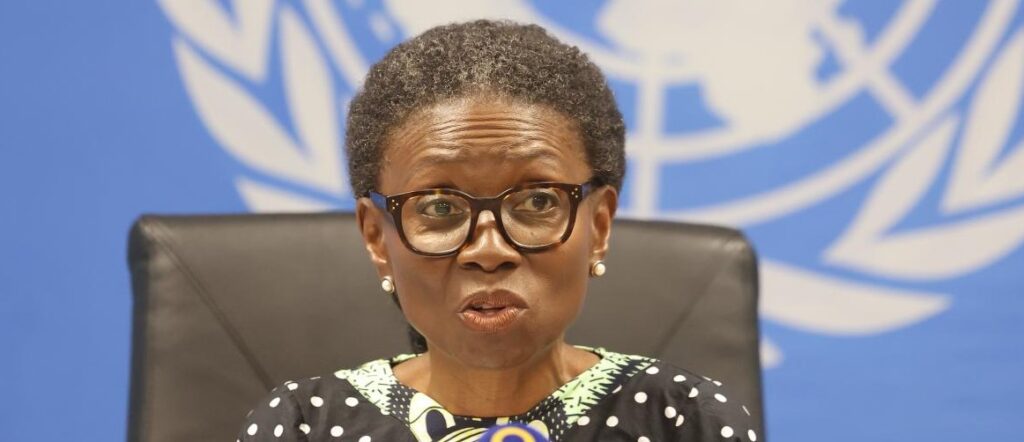
South Sudan is at a critical juncture ahead of planned elections on December 22, with weakening political consensus, rising insecurity and a deepening humanitarian crisis threatening the country’s fragile transition, the head of the United Nations Mission in South Sudan (UNMISS) told the Security Council on Tuesday.
Anita Kiki Gbeho, the UN secretary-general’s special representative and head of UNMISS, said political consensus had weakened, raising concerns about the sustainability of progress made under the 2018 peace agreement and the country’s prospects for a peaceful transition beyond the polls.
“With just 42 days until South Sudan’s planned first elections as a sovereign state, the country is at a critical juncture,” Gbeho said.
She said the central question is whether the transition would remain anchored in the 2018 revitalised peace agreement and whether outstanding commitments would be implemented.
Amendments to the National Elections Act were adopted on September 21, a day before the Transitional Government of National Unity was dissolved and replaced by a caretaker administration.
The government has said the amendments are intended to facilitate elections and advance the transition.
Gbeho said her engagements with government officials indicated a clear determination to proceed with the December 22 vote. However, she expressed concern about security arrangements, logistical preparations, the capacity of the National Electoral Commission to organise elections within a compressed timeframe and delays in implementing outstanding provisions of the 2018 peace agreement.
She also said recent political changes had fallen short of the agreement’s requirement for 35% women’s representation.
The Inter-Party Dialogue has been held, but its outcome remains pending, with some opposition groups staying outside the process. The Sudan People’s Liberation Movement/Army-in-Opposition (SPLM/A-IO) has maintained that the release of its detained leader, Riek Machar, is a prerequisite for its participation in dialogue.
Meanwhile, the ruling Sudan People’s Liberation Movement (SPLM) has begun nationwide party primaries, while electoral activities among other registered political parties remain limited.
Gbeho cautioned that elections should mark a milestone in the transition rather than its conclusion, saying they could not substitute for political dialogue, confidence-building or implementation of the peace agreement.
Rising insecurity
On security, Gbeho said armed confrontations between the main signatories to the peace agreement had generally declined, but the overall security situation had become increasingly complex.
The number of people killed, injured and displaced had risen since the beginning of the year, driven by local grievances, factional divisions and competition over resources, she said.
In Jonglei State, clashes involving government and opposition-aligned local forces, coupled with the mobilisation of armed youth, continued to threaten civilians and stability.
In Unity State, divisions within the SPLM/A-IO had contributed to fighting around Leer and Rubkona counties.
Violence in Rumbek and Greater Tonj counties last month, which reportedly killed more than 140 people, underscored the deadly consequences of persistent local conflicts.
Communal violence accounted for more than 60% of reported civilian casualties this year, making it the leading cause of civilian harm, Gbeho said.
She called for stronger accountability, efforts to address local grievances and effective governance mechanisms to prevent violence and resolve disputes.
Peacekeeping challenges
Gbeho said UNMISS was strengthening its prevention and response efforts under its Security Council mandate.
In Rumbek, the mission rapidly deployed personnel to help protect civilians, secure the local hospital and support humanitarian partners. In Mundri East County, local conflict prevention efforts had helped secure the release of 72 abductees, she said.
The mission had also streamlined its structure following an internal review and adjusted its deployment to concentrate resources in priority areas and locations facing heightened risks.
UNMISS had doubled its force protection tasks in support of humanitarian operations, helping deliver life-saving assistance to more than 321,000 vulnerable people since her previous briefing, Gbeho said.
But the mission continued to face security threats. Three peacekeepers were killed during an operation in a conflict-affected area of Jonglei in August, while UN and national personnel were injured.
Gbeho said UNMISS needed to move freely, safely and predictably across the country to fulfil its mandate, describing freedom of movement as a protection issue.
Humanitarian access constraints had increased by 38% over the past year, she said. Delays in government acknowledgements, including for force protection, had affected Ebola preparedness activities and humanitarian drought assessments in parts of the Equatorias.
Despite assurances, UNMISS continued to face movement restrictions in conflict-affected areas, including along the Sobat River corridor, limiting its ability to respond to protection concerns and support humanitarian operations, she added.
Humanitarian crisis
The humanitarian situation was also deteriorating, with about 10 million people in need of assistance, Gbeho said.
Some 1.4 million people had crossed into South Sudan since fighting erupted in neighbouring Sudan in April 2023, while an estimated 7.5 million people faced food insecurity.
The number of people at risk of famine had increased, while prolonged dry spells and anticipated El Niño-induced flooding threatened to compound the effects of climate change.
An Ebola outbreak in the region posed an additional threat, underscoring the need for preparedness, cooperation and an effective response.
Gbeho warned that the political, security and humanitarian crises risked reinforcing one another, deepening tensions and vulnerabilities across the country.
Regional engagement
Gbeho said instability in South Sudan remained a regional and international concern as parts of the Greater Horn of Africa continued to grapple with conflict, displacement and public health challenges.
She said she had stepped up engagement with President Salva Kiir and other national stakeholders, neighbouring countries, the African Union, the Intergovernmental Authority on Development (IGAD) and diplomats in Juba to prevent further escalation and preserve political space.
She welcomed regional initiatives led by the AU High Representative for South Sudan, former Tanzanian president Jakaya Kikwete, including efforts to implement the C5+ recommendations and establish a joint AU-UN-IGAD mechanism to support political engagement.
While regional actors could help build consensus on the next phase of the transition, Gbeho said responsibility for determining the country’s political future rested with South Sudanese leaders.
She called for renewed dialogue to establish a clear and credible roadmap for implementing outstanding provisions of the revitalised peace agreement, saying this would help rebuild confidence, reduce uncertainty and address the root causes of conflict beyond the elections.
“The challenge facing South Sudan is not simply whether elections can be held on December 22 or not. It is whether the remainder of the transition can preserve peace, strengthen public confidence and deliver on the commitments made to the people of South Sudan,” Gbeho said.
“The true measure of success is simple: whether South Sudanese citizens are safer tomorrow than they are today.”

 and then