



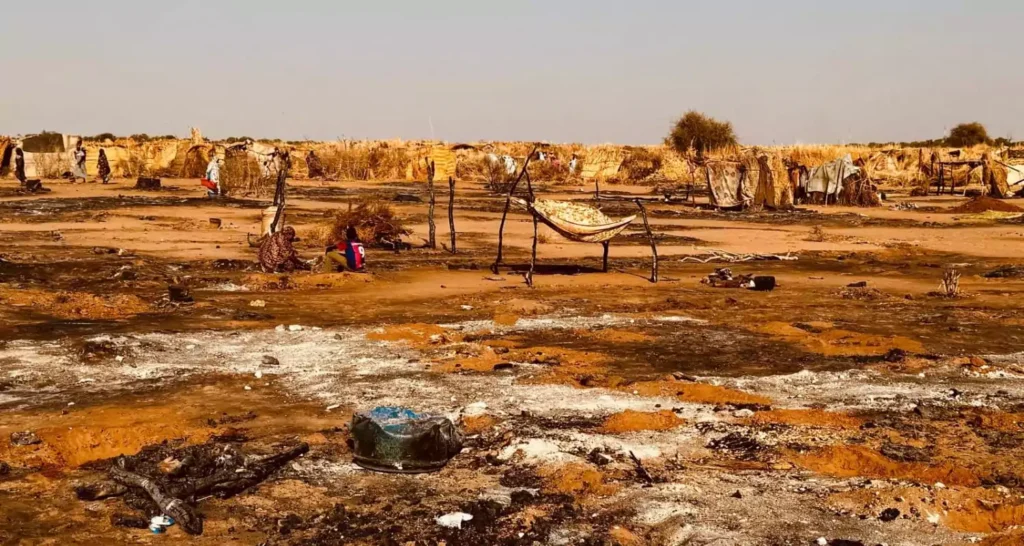
At least 650 displaced families who fled the horrors of war in Sudan’s West Kordofan State and arrived in East Darfur State have recounted the harrowing conditions they endured along their displacement routes, including repeated incidents of armed robbery and the deaths of several of their children during the arduous journey to safety.
Speaking to Radio Tamazuj in tears on Sunday, Saadia Mohamedain Mohamed, a displaced woman, said she had fled the Hegleija area of West Kordofan following fierce clashes between the Sudanese Armed Forces (SAF) and the Rapid Support Forces (RSF) several days earlier, seeking safety in the Khazan administrative unit of East Darfur State.
“My children and I set off on foot because there was no means of transport available, and we were subjected to robberies along the way,” she said.
Her ordeal was compounded by the death of one of her children from illness during the journey. She said she had arrived at Al-Nakheel displacement camp in Khazan Jadeed five days earlier but had yet to receive any humanitarian assistance.
Salwa Mohamed Suleiman Abdelhamid, another woman displaced from West Kordofan to Al-Nakheel camp, praised the warm reception and kindness extended to the new arrivals by longer-established displaced residents. However, she said they had received no humanitarian assistance since arriving in the area.
“The acute shortage of shelter materials is one of the most pressing challenges facing displaced families, many of whom are sleeping in the open in the cold winter weather,” she lamented. “There is also a severe shortage of food and medicines. We appeal to humanitarian organizations to urgently provide displaced families with sheltering materials and blankets.”
Meanwhile, Abubakar Khamis, the traditional leader of Al-Nakheel Camp, told this publication that the camp previously accommodated 3,800 people, but the arrival of 659 additional families had brought the displaced population to 45,555.
“400 families remain without accommodation because the camp is situated on land held under the traditional Hakura land tenure system, whose customary owners are yet to consent to allocating plots on which the displaced families can erect shelters,” he explained.
Khamis also lamented the acute shortage of drinking water at Al-Nakheel Camp following the breakdown of the only water station on which residents depend.
Displaced families are also grappling with inadequate healthcare services and malnutrition, with the camp’s clinic operating only twice a week, on Sundays and Wednesdays.

 and then