



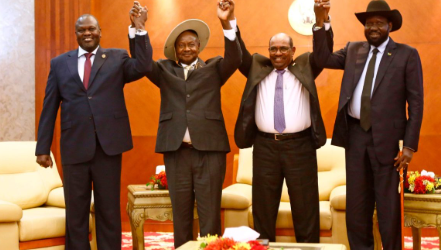
The primary purpose of this article is to convey my opinion to South Sudan’s 2018 peace guarantors, including the Intergovernmental Authority on Development (IGAD), the African Union (AU), the United Nations (UN), and the Troika (the United States, the United Kingdom, and Norway), to stop South Sudan’s government from proceeding with general elections and revert to the implementation of the 2018 peace agreement.
Elections were designed to be the culmination of a structured political transition, not a shortcut around it. Key prerequisites stipulated in the R-ARCSS remain dangerously unfulfilled. In this article, I highlight some critical challenges that disqualify the SPLM-IG from conducting unilateral general elections without the participation of the SPLM/A-IO, SSOA, FDs, and OPP. The non-signatory parties President Salva Kiir has mobilized to ‘challenge’ him in the sham elections are just rubber stamps and insignificant. They provide a facade of multiparty democracy while lacking independent constituencies and just want to validate the elections and give Kiir legitimacy as an elected president.
South Sudan’s one-party-handpicked so-called “National Election Commission” announced the postponement of the single-party elections from December 2026 to February 2027. The delay comes as a result of the electoral commission’s desire for more time to distribute registration materials and conduct civic education. Those activities will be carried out amid growing violence and political tensions across the country. They want to conduct a unilateral election to legitimize Kiir.
If South Sudan continues to be led by Kiir, the country’s political stability and desirable economic development will only deteriorate. Furthermore, ethnic divisions, corruption, and underfunded public services will destabilize social stability. South Sudan stands at a dangerous crossroads at the moment. Moving forward with general elections before fulfilling the foundational pillars of the 2018 revitalized peace agreement threatens to plunge the country back into full-scale civil war. As international guarantors, you must intervene decisively to halt these premature polls and compel the government in Juba to return to genuine implementation of the agreement.
In short, the political atmosphere in the Republic of South Sudan is characterized by deep polarization, widespread public frustration, and a sharp rejection of incumbent President Kiir’s leadership following the outbreak of the civil war in 2013, 2016, and 2025. Kiir’s recent political and electoral moves undermine the implementation of the core 2018 Revitalized Peace Agreement. His refusal to implement peace prerequisites made the conduct of the election flawed and undesirable. The elections are meant to bring South Sudan’s post-conflict transition to an end.
South Sudan’s general elections, now rescheduled for February 2027, need to be postponed given that they are not inclusive. The country should be focused on repairing the broken 2018 peace agreement that Kiir abrogated and doesn’t want to implement entirely. The government has opted to pursue a path of selective implementation of the 2018 peace agreement and systematically sidelining other political parties from participating. Without the participation of the other political parties, urgent political consensus and adherence to the Revitalized Peace Agreement on the Resolution of the Conflict in the Republic of South Sudan (R-ARCSS), the elections will face a credibility crisis. At the moment, the only immediate need is to find a necessary political framework that can move the country towards a legitimate democratic process rather than conducting an election that will result in ethnic domination and endless civil war.
The signatories to the Revitalized Peace Agreement must be reminded that South Sudan is facing severe political tensions, shrinking civic space, and heightened conflict as it approaches national elections. They need to stop the government from proceeding with elections. Other actors like Reconstituted Joint Monitoring and Evaluation Commission (RJMEC) that were established to oversee unresolved political disputes and incomplete security reforms, should also be involved in stopping the government from continuing with the election. The growing uncertainty surrounding the general election stems from the weak implementation of the R-ARCSS, which set clear guidelines to be followed before any general elections can take place. Failure to do so will increase the danger as fighting continues in many parts of the country, and the rule of law and justice mechanisms envisioned by R-ARCSS remain incomplete. Moreover, the arrest and the trial of former Vice President Dr. Riek Machar, who is also the leader of the Sudan People’s Liberation Movement-in-Opposition (SPLM-IO), is a serious concern as the government intentionally keeps him away from participating in the election.
The 2018 Revitalized Peace Agreement did not envision general elections as a stand-alone event, as Salva Kiir and his party project. The peace agreement projects an election for every party. Elections were meant to be the last phase of the transitional process, setting the foundation for post-conflict reconstruction in South Sudan. The R-ARCSS sought, among many things, to establish a unified security force, a permanent constitution, a functioning electoral system, and a transitional justice system. As such, the general elections cannot be separated from the R-ARCSS. The implementation of the R-ARCSS has been very slow, and the parties adopted a roadmap that extended the transitional period and moved the general elections to December 2026 because many critical tasks had remained unresolved. The parties justified each extension as additional time needed to complete reforms that will enable a credible transition.
The debate changed in September 2026 when the electoral framework was amended to remove the completion of the permanent constitution and national census as prerequisites for conducting national elections. This may remove legal and practical obstacles to conducting the election, but it also changes the sequencing envisioned by the peace agreement. The reconfiguration of the institutions through which the R-ARCSS power-sharing agreement had been operated has significantly changed the political context. Just a week before the dissolution, the regional body IGAD reaffirmed R-ARCSS as the “sole viable framework for peace,” and the December election remained anchored to the peace agreement. The question now is how the institutions established to monitor and implement the agreement will operate under the caretaker administration.
The Kiir government bypassed some unfinished reforms, such as security-sector unification, electoral rules, the political rights of parties, civic space, and dispute resolution. Transitional justice remains incomplete because the Hybrid Court and the Compensation and Reparation Authority, which were supposed to be established, are still pending, even as the Commission for Truth, Reconciliation and Healing is still pending. Many of the clauses of the Revitalized Peace Agreement have not been implemented. This was supposed to be the basis for any general elections.
Political actors in South Sudan, particularly Kiir and his cronies, are not concerned that every aspect of the R-ARCSS has not been implemented before the general elections can take place. That stance made other actors wonder, asking for clarity and full implementation of the peace agreement before a free, fair, and peaceful election could be conducted. When R-ARCSS was designed, the general elections were supposed to be the outcome of the transition. However, under current circumstances, the risk is that holding general elections becomes a substitute for completing the transition without implementing all provisions. This concern has become immediate because of the dissolution of the transitional government. The critical question now is whether the new caretaker administration can oversee the elections in a way that all political parties and actors regard as sufficiently inclusive and legitimate.
Well-wishers and many South Sudanese citizens who are watching from distant shores are concerned that the government wants to conduct elections without first conducting a census. They can only imagine that the move of bypassing a census count will make it harder to know the number of voters. Voter registration will determine who is eligible to vote, but the absence of a new census complicates demographic and constituency questions.
The September amendments have now settled the legal question of whether the election can proceed without a new census, but they do not resolve the practical challenge lying ahead. The immediate challenge for the National Election Commission is whether it can complete a credible voter registration across all states, conduct civic education that clearly explains the rules, and finance the operation transparently and predictably. Salva Kiir has intentionally delinked requirements linking general elections with a permanent constitution and a national census.
In October, the SPLM Party commenced the process leading up to primary elections. Other political parties have not done the same. If implemented correctly, the agreement would recognize SPLM-IG, led by President Kiir, SPLM/A-IO, led by Dr. Riek Machar, SSOA, Former Detainees (FD), and Other Political Parties (OPP) to contest equally and launch their primary elections simultaneously. A unilateral election process without consensus and participation of all parties to the 2018 peace agreement is a recipe for returning the country to full-scale violence. The best thing Salva Kiir can do now is the immediate and unconditional release of Dr. Riek Machar and other political detainees.
Kiir does not want to compete with anybody. He is using political hooliganism, which is perhaps the most abysmal manifestation of democratic schizophrenia. If your political party cannot tolerate another political party campaigning within the same geographical territory, then what precisely are you campaigning for?
Democracy is fundamentally about the freedom to mobilize, canvass, persuade, debate, and intellectually engage the electorate. Yet, with bewildering suddenness, political antagonism degenerates into intimidation, disruption, and confrontation. Has democratic campaigning now metamorphosed into some barbaric gladiatorial coliseum where political disagreement must inevitably culminate in confrontation? Do you find political propositions intellectually disagreeable? Magnificent! Present your candidate. Brandish your manifesto. Unleash your statistics. Deploy your intellectual artillery. Defeat the argument with a superior argument.
To deliberately disrupt another party’s peaceful political mobilization merely because its presence threatens your political calculations is nothing short of democratic atavism, a primitive regression into political domination through intimidation and coercion. Democracy does not operate by the jurisprudence of frustration, where the inability to intellectually vanquish an opponent becomes justification for obstructing his microphone. If another political organization is exercising its democratic right to campaign, it could be permitted to campaign.
What are some indications, illustrated, that Salva Kiir is working on abdicating power and relinquishing it to one of his children or fellow tribesmen? There have been indications that South Sudanese political observers and analysts deem tactical appointments to consolidate power within his family or a potential successor among his tribesmen. For example, in early 2025, President Kiir appointed Benjamin Bol Mel as Vice President and first deputy chairman of the ruling SPLM Party. The move brought widespread speculation that he was being groomed as Kiir’s successor. However, President Kiir abruptly dismissed Bol Mel on November 12, 2025, stripping him of his vice presidency, removing him from the ruling SPLM party leadership, and demoting him within the National Security Service. No official successor has been named to replace him in that capacity, and James Wani Igga was subsequently reappointed to the vice president position.
At the same time, President Salva Kiir appointed his daughter, Adut Salva Kiir, as Senior Presidential Envoy for Special Programs. A position previously held by Benjamin Bol Mel, before he was elevated to the vice president position. The move was criticized as a clear nepotism political dynasty within the country’s leadership. In September 2026, Salva Kiir appointed his son, Major General Atem Salva Kiir, as commander of the presidential guard. The appointment has again attracted the attention of South Sudanese political observers and analysts that Salva Kiir is preparing his children to succeed him in the foreseeable future. Kiir, who is 74, has been in power since South Sudan gained independence in 2011 and has not said when he is going to retire from politics.
Kiir remains in power and continues to issue major political decrees. He seems to be incapacitated. Whenever he is travelling abroad for diplomatic engagements, South Sudanese people are worried, wondering whether he will represent the country with dignity and clarity. Unfortunately, many of these appearances have raised serious concerns about his ability to think and speak coherently. His physical and cognitive decline has fueled intense speculation about who is actually drafting and executing President Kiir’s sweeping decrees. Political analysts note that decrees are formulated behind closed doors with minimal transparency, relying heavily on a tight circle of loyalists, military intelligence figures, and traditional advisors like the Jieng Council of Elders. Additionally, internal discussions within the presidency have reportedly focused on succession and elevating family members, including his daughter or his son, which will make South Sudan a nepotistic dynasty.
In conclusion, South Sudan’s general elections, previously scheduled to be conducted in December, now pushed to 11 February 2027, need to be stopped by the 2018 peace guarantors. The 2018 peace agreement established safe, free, fair, peaceful, inclusive, and transparent elections, not unilateral abrogation of the agreement. If peace guarantors allow President Kiir to proceed with the elections, the result will be an implementation of nepotism or single tribe ethnocracy.
International actors should push for a consensual extension with a clear, time-bound roadmap to elections. This could salvage the deal and save the country from returning to entrenched large-scale violence. It would also save the country from being a family nepotocracy or a single tribe ethnocracy. We in the SPLM-IO are yearning for a faithful implementation of all provisions enshrined in the peace agreement. Achieving faithful implementation would start by reverting to talks that would be conducted under regional and international mediation, which must include IGAD, the African Union, the Troika, and the United Nations, among other peace-loving international organizations.
Respectively.
The writer is a political commentator and the author of the book “South Sudan’s Endless Sorrows.” He can be reached via lulgatluak09@gmail.com.
The views expressed in ‘opinion’ articles published by Radio Tamazuj are solely those of the writer. The veracity of any claims made is the responsibility of the author, not Radio Tamazuj.
 and then