



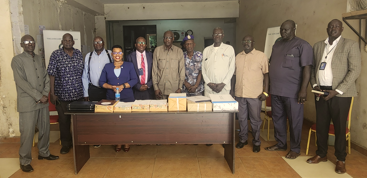
South Sudan’s judiciary says years of budget constraints have left courts without essential record-keeping materials, forcing it to rely on support from international partners, as the United Nations Mission in South Sudan (UNMISS) on Thursday donated laptops, registry books, and court forms to help improve judicial administration.
The donation, which included 10 laptops and various registry books and forms, was handed over by UNMISS’s Rule of Law Advisory Section to the Judiciary of South Sudan to support record management, case registration, and ongoing efforts to modernize court operations.
Speaking during the handover ceremony in Juba, Justice Dr. James Alala, a Justice of the Supreme Court and Chief Registrar of the Judiciary, said the judiciary had struggled for years without critical materials needed for its daily operations.
“We have been facing difficult times with the absence of these things. We didn’t have these things for a long time,” he said. “So it is now with this intervention of the UNMISS that things are being put in place.”
Alala explained that registry books are essential for recording judgments and preserving court records, allowing citizens, lawyers, and judicial officers to access information when needed.
“The judiciary is supposed to be the one producing and printing all these things, but for some time, we have not been able to print. That’s why these people came in to help and put their hand on our hand,” he said. “The problem is that the judiciary has gone for years now without these things simply because the budget is not being implemented. That’s why we resort to our partners to ask them to come in so that our work does not stop.”
The judiciary’s Chief Administrator, Alex Tombe Gregory, said the shortage dates back to South Sudan’s independence in 2011, when the country exhausted judicial registry books inherited from Sudan but lacked the capacity and resources to produce new ones.
“When the registry books and forms of Sudan were finished, we were unable to get registry books because we have no printing press to print a new registry for South Sudan,” he said.
He noted that the donated materials would be distributed to the three Court of Appeal circuits covering Greater Equatoria, Greater Bahr el Ghazal, and Greater Upper Nile.
“These things will help in the registration of judgments of cases, civil and criminal. Registry books are custodians of cases. If a file gets lost, we can use it and produce a new file for a case,” he explained.
The donation also forms part of efforts to introduce digital systems within the judiciary. The 10 laptops are expected to be distributed among different departments as the institution gradually transitions from paper-based administration.
Alala described the donation as an important step toward the digitalization of the judiciary.
“We have been talking about digitalization of the judiciary itself, in other words, trying to get rid of using papers at this age of time,” he said. “These are samples, only 10 laptops, but we will start distributing them to various departments so that we start this issue of communicating through laptops.”
Samuel Wambugu, Judicial Affairs Officer with UNMISS’s Rule of Law Advisory Section, said the support was provided following a request from the Chief Justice and aligns with efforts to strengthen access to justice and improve court administration.
“This was a request received from the Chief Justice of South Sudan to help the judiciary be able to move from paperwork,” Wambugu said. “We have donated 10 laptops today, but also registers and forms that will help with record-keeping, case management, and all that to enhance better services for the judiciary.”
Wambugu said UNMISS remains committed to supporting the justice sector, including through mobile courts and other initiatives aimed at bringing justice closer to communities across the country.
He noted that the recent deployment of judges to nearly all states and administrative areas has improved access to justice, although resource shortages continue to hamper the judiciary’s work.
“We continue to do this as long as we have resources to ensure that the backlog of cases is reduced and to bring justice closer to the people of South Sudan,” he said.

 and then