



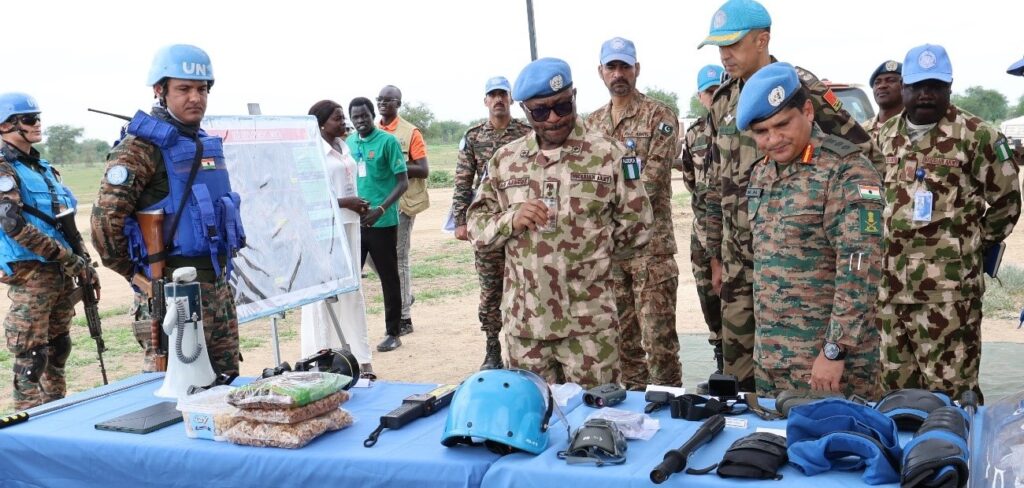
The United Nations Interim Security Force for Abyei (UNISFA) said on Thursday it had concluded a five-day security operation aimed at reducing the public display of weapons and restricting the movement of unauthorized armed groups in the disputed Abyei region.
The operation, conducted from July 24 to 28 across UNISFA’s three sectors, sought to improve civilian protection, facilitate humanitarian access and reinforce the area’s demilitarized status, the U.N. mission said.
According to UNISFA, about 2,509 peacekeepers took part in the campaign, carrying out 270 patrols, establishing 32 safe corridor deployments, 23 checkpoints and 18 command posts, alongside temporary operating bases and mobile patrols.
The mission said the operation focused on key population centres, markets and major supply routes to deter the movement of unauthorized armed elements and improve freedom of movement.
UNISFA’s acting head of mission and force commander, Brig. Gen. Adebowale Ajagbe, said the operation relied on cooperation with local communities and authorities to support the demilitarization of Abyei.
“The success of this campaign depends not only on the security posture but also on the trust and cooperation of the people of Abyei,” Ajagbe said in a statement.
The mission said community outreach activities were conducted in several locations, including the Amiet Common Market, to encourage public support for the campaign.
UNISFA said the operation resulted in a reduced visible presence of weapons and unauthorized armed actors in public areas, including markets and main transport routes. Peacekeepers also provided clean drinking water and medical and veterinary services during the campaign.
The mission said it would continue weapons confiscation efforts, day-and-night patrols, public awareness campaigns and civil-military cooperation activities to consolidate the gains made during the operation.
UNISFA said the campaign supports U.N. Security Council benchmarks requiring the withdrawal of unauthorized armed forces and the demilitarization of Abyei, with the aim of reducing intercommunal tensions and improving long-term security in the disputed territory.
UNISFA was established by the U.N. Security Council in June 2011 after Sudan and South Sudan failed to agree on the status of the oil-producing Abyei region following South Sudan’s independence.
The mission is mandated to monitor the demilitarized area, protect civilians under imminent threat, facilitate humanitarian access and support the Joint Border Verification and Monitoring Mechanism.

 and then