



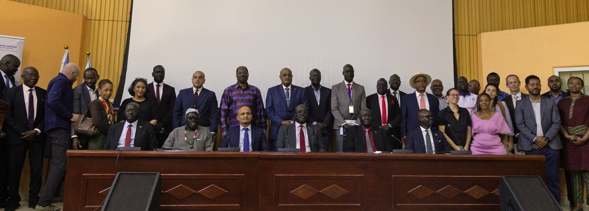
The Government of South Sudan and the United Nations (UN) reaffirmed their commitment to ending protracted displacement for at least 60,000 South Sudanese by the end of this year at the second Steering Committee Meeting on Durable Solutions in Juba.
Ministers and state-level authorities, alongside representatives of the UN, took stock of progress and challenges since the inaugural Steering Committee meeting in January, which resulted in a joint communiqué on durable solutions signed by 13 ministries, a UN press release extended to Radio Tamazuj on Tuesday said.
The meeting highlighted that while progress is being made in specific locations, the pace and scale of solutions continue to depend heavily on local conditions, including access to services, land, and stability.
“For every South Sudanese family still living in protracted displacement, every year of delay is another year of lives put on hold,” said Hon. Albino Akol Atak, Minister of Humanitarian Affairs and Disaster Management. “We reaffirm our commitment to continuing to drive the durable solutions agenda forward, creating the enabling conditions for voluntary and safe return and reintegration, and monitoring progress at every step.”
The statement said that in 2026, more than 2.5 million people are internally displaced across South Sudan, including some 964,000 in camps and displacement sites. Many have lived in displacement for years since the conflict erupted in 2013, with additional pressures linked to recurring flooding and climate shocks in parts of the country. The situation is further compounded by the ongoing conflict in Sudan, which has driven over 1.3 million people into South Sudan since 2023.
“Since the launch of South Sudan’s National Durable Solutions Strategy and Plan of Action in 2024, two state-level roadmaps have been operationalized in Upper Nile and Western Bahr el Ghazal, while a third is planned for Unity State. These frameworks are helping to coordinate responses across humanitarian, development, and peace actors in support of government-led priorities,” the statement said. “Across these three states, over 28,000 formerly displaced people have so far returned, reintegrated or resettled in areas where conditions have allowed, with the joint support of the Government, the UN – led by its three Solutions Champions: International Organization for Migration (IOM), United Nations Development Programme (UNDP), and UNHCR, the United Nations Refugee Agency, and partners.”
Among them are 13,000 people in Unity who are rebuilding their lives on land reclaimed from flooding, 12,000 former camp residents in Western Bahr el Ghazal, and 3,400 people in Upper Nile, including residents of the former Protection of Civilians site. This is in addition to hundreds of thousands of people supported with livelihood opportunities and Housing, Land and Property (HLP) rights.
“The continued commitment and engagement of the Government of South Sudan at all levels is indispensable for achieving durable solutions for its people,” said Ramanathan Balakrishnan, UN Resident and Humanitarian Coordinator ad interim (RC/HC a.i.). “The United Nations, in collaboration with other partners, and most importantly with the communities, will continue to support these efforts and build on the progress made. Ultimately, peace and stability will be the foundations for building resilience, leading to pathways of development for the South Sudanese people.”
According to the statement, achieving durable solutions requires sequenced and longer-term interventions, including landmine clearance, land restitution support, legal aid, shelter construction, rehabilitation of essential services, and income-generating opportunities. Under the directive of the National Technical Committee on Durable Solutions (NTC), these activities are conducted through the State Task Force on Solutions, using an area-based coordination approach led by the UN and NGOs, tailored to the specific needs in each state.
Progress will be reviewed at the next Steering Committee Meeting, due in the third quarter of 2026, to maintain momentum toward the year-end target, the statement concluded.

 and then