



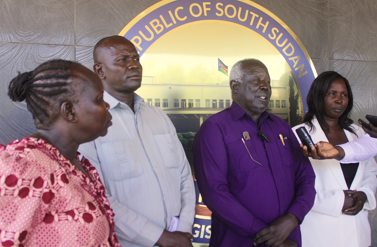
The Greater Pibor Administrative Area (GPAA) caucus at the national parliament on Tuesday urged the Council of States, the Upper House of the National Legislature, to establish a fact-finding committee to investigate the killing of the Kapoeta East commissioner in the disputed Kassengor area.
Stephen Lowosio Lomongin was killed on 12 June 2026 while on an official visit to Kassengor, a disputed area claimed by both Eastern Equatoria State and the Greater Pibor Administrative Area (GPAA).
Addressing a press conference in Juba on Tuesday, Lawryen Ibon, Chairperson of GPAA Caucus at the National Legislative Assembly, urged the upper house to take immediate steps to ensure that the matter is independently investigated.
“We are calling for the formation of a committee for a fact-finding mission to Kassengor. The committee should investigate the killing of the Kapoeta East County commissioner because he is a government official and he shouldn’t have been killed,” he said. “The committee should be formed by the Council of State to investigate the incident. We also urge the Council of State to summon the leadership of Greater Pibor Administrative Area and Eastern Equatoria State to explain how the incident happened.”
He argued that the death of the county official has raised serious security concerns and requires a comprehensive inquiry to establish the facts and identify those responsible.
“First of all, Kassengor is a payam in Boma County of Greater Pibor Administrative Area, and the whole world knows this, even the Upper Nile region knows Kassengor belongs to Pibor,” Ibon stressed. “If anybody is claiming that it is theirs, then this is wrong; it is ours.”
He stated that GPAA Chief Administrator Gola Boyoi Gola and David Yau Yau, the Deputy Minister of Information, do not require anyone’s approval to visit their own people.
“Those residing in Kassengor Payam are the Jie Community and not the Murle, as reported by the authorities of Eastern Equatoria State, and the Jie are part of the Toposa tribe. They came during the war, and our government is aware that these people had conflict, and they were brought to Boma in the 1990s, and they stayed with us in our area until today,” he said. “They are South Sudanese; we can’t refuse to stay with them, and we welcomed them. Those staying in Kassengor Payam are Jie, and when the fighting started, others are saying it is between Murle and Toposa. This is not true. The people residing there are Jie, including the payam administrator.”
Bangut Amum, a member of the GPAA Caucus, refuted claims that the Kapoeta East County commissioner was killed in an ambush by Murle youth, arguing that the residents of Kassengor are predominantly from the Jie Community and not Murle.
“I will correct the statement, which was given first, that the commissioner of Kapoeta East was ambushed by the Murle. That area is actually totally Jie, and there is no resident of Murle there,” she said. “So, correction, it was a visit of the commissioner to Kassengor, and the statement of that Payam administrator indicates that people were moving with him, and they went down, and they were shooting.”
Meanwhile, Edmund Yakani, Executive Director of the Community Empowerment for Progress Organization (CEPO), described the Kassengor violence as politically motivated and urged the Council of States to summon the governor of Eastern Equatoria State and the GPAA chief administrator to account for the cause of the conflict and the deteriorating security situation in the area.
“The communities at the border of Eastern Equatoria and Pibor have been living peacefully. We have never seen any story of assassination among the communities,” he stated. “My take as a civil society activist is that this incident is politically motivated. My appeal to everybody is not to politicize this issue to the level that you want to cause tension among our communities.”

 and then