



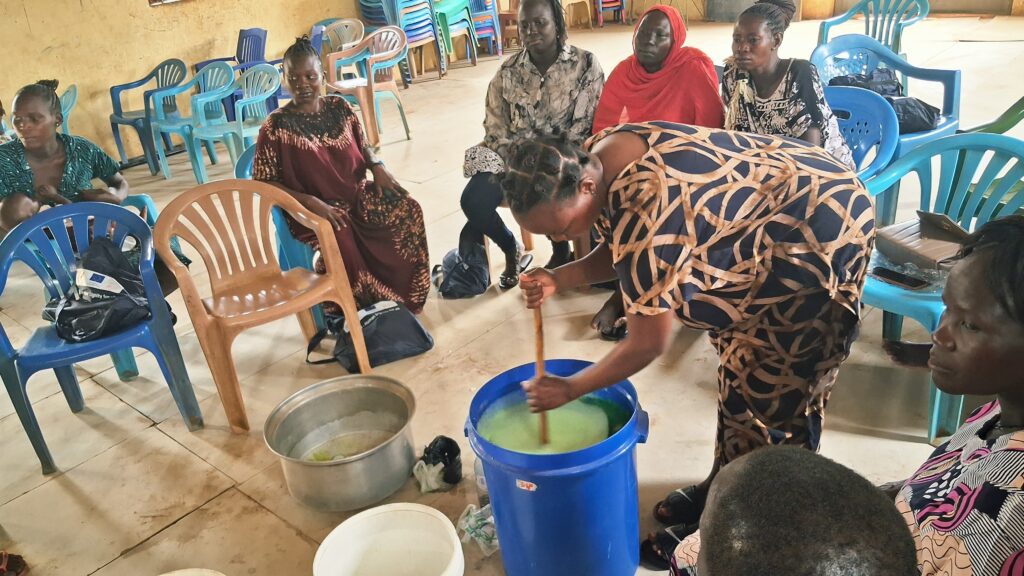
More than 20 women in a Juba suburb have been trained to produce liquid soap under a livelihoods initiative aimed at helping households generate income as South Sudan grapples with economic hardship.
The training, organized by the Women Foundation for Humanity in Jebel Yesua, equipped participants with practical skills to manufacture liquid soap for sale while strengthening women’s savings groups.
Lamon Beatrice, a member of the Jebel Yesua Women’s Group and a mother of one, told Radio Tamazuj that the training would enable women, particularly housewives, to earn an income from home.
“The training is good. It is especially beneficial for us housewives because it keeps us productive at home,” she said.
Beatrice said women could start small-scale businesses by producing and selling liquid soap, generating income to meet household needs.
“Making liquid soap is a business. When you buy the raw materials, produce it and sell it, the profit can help empower women in the group,” she said.
She added that profits could also strengthen women’s savings groups by providing loans to members facing financial difficulties.
“Sometimes when a woman has challenges at home and has nowhere to get financial support, she can borrow from the women’s group. That will help her,” Beatrice said.
She said the income could help women pay school fees and support single mothers struggling to provide for their families.
During the training, participants learned how to measure ingredients, mix chemicals, add fragrances and colours, and package the finished product.
Beatrice said her immediate challenge was securing start-up capital to begin production.
“I’ve learned how to make liquid soap. The next step is to find a little capital so I can start, empower myself and teach others,” she said.
She said producing high-quality soap would be essential to attracting customers.
Josephine Achan Nelson, another participant, said the skills would help women cope with the country’s difficult economic conditions.
“This training will help us pay our children’s school fees. I learned that producing quality liquid soap is important because quality attracts customers,” she said.
Christine Dudu, the women’s leader for Gumbo Shirikat, said many households in Juba rely on women engaged in small businesses to support their families.
“Women are very tired, and without such training we will not be able to help ourselves, even as a group,” she said.
Dudu said limited access to capital remained the biggest challenge facing women’s groups but expressed hope that soap production would provide a sustainable source of income.
“The biggest challenge we have is how to make money. This training can strengthen our group,” she said.
The Women Foundation for Humanity said the training is part of broader efforts to equip women with practical vocational skills that promote entrepreneurship, self-reliance and financial resilience amid South Sudan’s economic challenges.

 and then