



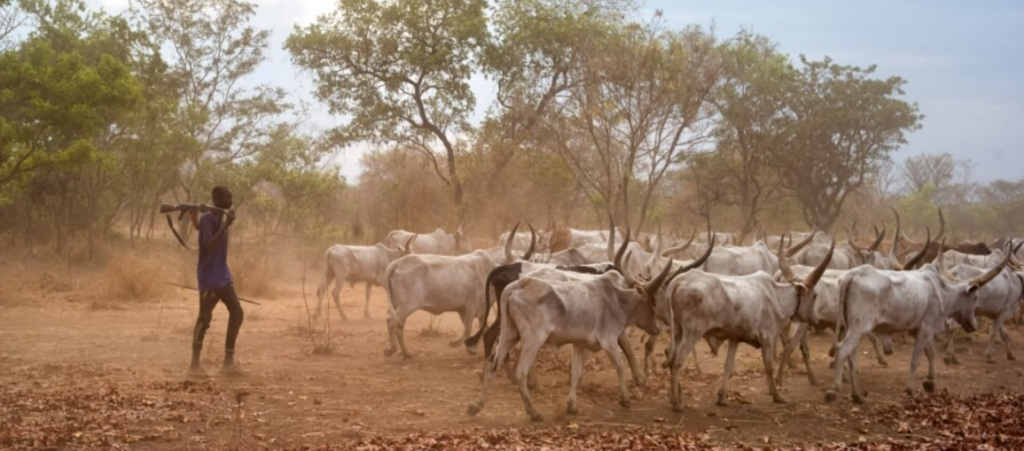
A South Sudanese policy think tank on Friday called for a national dialogue over the failure to implement a presidential order directing the withdrawal of cattle from parts of the Equatoria region, saying the delay has fuelled land disputes, food insecurity and localised violence.
The Institute of Social and Policy Research (ISPR) and the South Sudan National Land Coalition said consultations held across Greater Upper Nile, Greater Equatoria and Greater Bahr el Ghazal found that a presidential order issued in 2015/2016 had not been fully enforced, allowing tensions between pastoralists and farming communities to persist.
Boboya James Edimond, chief executive officer of ISPR, said the findings pointed to weak enforcement and governance failures that required a broader political process.
“We conducted consultations in Greater Upper Nile, Greater Equatoria and Greater Bahr el Ghazal to assess the implementation of the presidential order. The findings show it has not been properly implemented, and there is a need for a national dialogue on how to implement it,” he told Radio Tamazuj.
Boboya said the consultations involved parliamentary committees on security, peace, agriculture, livestock, water resources and land, as well as officials from Central Equatoria State institutions, civil society organisations, academia and development partners.
He said international agencies, including the U.N. Mission in South Sudan (UNMISS), the Food and Agriculture Organization (FAO) and the International Organization for Migration (IOM), had also been consulted on issues related to pastoral migration, displacement and food security.
Boboya alleged that a lack of political will and vested interests within the government had contributed to the failure to enforce the order.
“There are individuals in government who do not want to implement the order because they have cattle in the Equatoria region,” he said. “Implementing it would mean moving their cattle, including cattle taken from Jonglei.”
Former Yei River County Commissioner and security coordinator Juma David Agustin said the order had remained largely unenforced because authorities had not established a mechanism to implement it.
“This presidential order has never fallen into action because no mechanism has been put in place for its implementation,” he said.
Agustin called for a clear institutional framework defining the responsibilities of the Ministry of Livestock and state authorities.
Member of parliament Festo Lemi, who serves on the parliamentary Reconciliation and Peace Committee, said insecurity had worsened in affected areas, accusing armed cattle herders of attacking civilians and looting property.
“The cattle herders are killing people, raping and taking away goats and food items. This has been going on for a long time,” he said. “We have reported to the government but nothing has been done.”
He urged authorities to restore security in the affected communities.
Karlo Arigo Wani, a concerned citizen, said weak security institutions and limited public awareness had also undermined enforcement of presidential directives.
“Our security institutions are weak. Enforcement needs personnel and training,” he said. “The media also has a role in sensitising the public about presidential orders.”
He added that the issue had become politicised and called for tighter control of arms within the country’s security institutions.
The think tank said it would submit its recommendations to parliament and state authorities, including proposals for a national dialogue, legal reforms and stronger enforcement mechanisms to address the long-running dispute over cattle migration.

 and then