



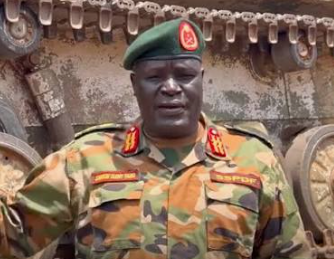
To observers, both domestic and international, who are familiar with political patterns of South Sudan, the recent absorption of the Agwelek-Kitgwang Faction into SPLM on Saturday, 8, 2026, could not be a surprising development. Rather, it is a commonplace occurrence where dissidents believed to have a certain degree of power to contest the state’s legitimate monopoly of power over its territory are integrated into the mainstream ruling party with no accountability whatsoever.
As part of its general organization and the operationalization of its “Big Tent” strategy, the leadership of the Sudan People’s Liberation Movement (SPLM) Party has succeeded in formalizing the integration of Agwelek leadership into its political camp. The political landscape of South Sudan has long been defined by such a fluid calculus of alliances, where today’s bitter adversary routinely becomes tomorrow’s key coalition partner.
At the heart of this political dynamic is General Johnson Olony Thabo, the commander of the Agwelek forces, whose career serves as a striking case study of the Sudan People’s Liberation Movement (SPLM)’s broader political stratagem. In South Sudan, ideological cohesion is secondary to armed leverage. Thus, shifting alliances can change from a tactical difference into the primary mechanism for political survival and state management. For so long, the nation’s political architecture has been operating not on constitutional regularities, but on a perpetual market of allegiances where military power dictates political capital.
Gen. Olony’s trajectory—moving from independent militia leadership to alignment with Riek Machar’s SPLM-In-Opposition (SPLM-IO), and later fracturing to cut direct deals with the SPLM—is not an isolated narrative of personal opportunism. Instead, it reflects a deeply institutionalized pattern within South Sudanese politics. For decades, the SPLM has maintained its political strength not through robust democratic institutions, but through a cyclical process of co-optation, rebellion, and reintegration.
Power is negotiated through the barrel of a gun, and peace agreements often resemble transactional corporate mergers rather than genuine social contracts. This cycle rewards violent destabilization, signalling to ambitious commanders that launching a rebellion is the most reliable way to secure a seat at the table.
For readers to have a deeper understanding of this transactional politics, and to underpin my central arguments, I will use well-grounded theories developed by distinguished political scientists such as Alex de Waal, Jean-François Médard, Michael Bratton, Nicolas van de Walle, Mancur Olson, among others. It is my conviction that their theoretical frameworks illuminate core points throughout this article.
From a theoretical perspective, this development is a textbook illustration of Alex de Waal’s concept of the political marketplace. In this framework, governance is not conducted through formalized state institutions, but rather through a dynamic, monetized arena where political loyalty and military enforcement are bought and sold as commodities. The currency of this marketplace consists of oil revenues, administrative appointments, and territorial autonomy. Within this market, sovereign authority is fragmented, and peace agreements function less as binding social contracts and more as short-term budget re-adjustments between the central elite and peripheral military entrepreneurs.
The SPLM’s masterclass in co-optation
The Sudan People’s Liberation Movement (SPLM) has transformed the co-optation of rivals into an art form, utilizing its resources and state administrative appointments to systematically dismantle opposition factions. Instead of attempting to decisively defeat opponents on the battlefield or outvoting them at the ballot box, the party relies on a deliberate strategy of “checkbook diplomacy” to engineer military and political integration. The ruling party acts less like an ideological political platform and more like a massive patronage machine. By offering lucrative military ranks, government portfolios, and blanket amnesties to rebel commanders, the SPLM spoils opposition momentum, gradually taking the wind out of potential revolutions by absorbing them into the state apparatus.
This institutionalized co-optation can be understood through the lens of neo-patrimonialism, a theory pioneered by political scientist Jean-François Médard and expanded by Michael Bratton and Nicolas van de Walle. In a neo-patrimonial system, the formal structures of a modern bureaucratic state exist on paper, but the actual exercise of power is entirely personalized and driven by clientelism. The formal absorption of over 5,000 members of Olony’s Agwelek-Kitgwang faction directly into the ruling SPLM serves as a perfect empirical example. The SPLM utilizes public offices and military commissions as private property to distribute to ‘clients’ like Olony. This structural architecture strips opposition movements of their momentum, but it drains the state treasury and locks the nation into a system where public resources are consistently diverted away from development to feed elite survival networks.
Revolution versus governance
The strategy of fluid alliances, shifting loyalty, and decentralized commands was highly effective when the SPLM/A was waging a protracted guerrilla revolution against Khartoum. During an active insurgency, loose networks and tactical flexibility allowed the liberation movement to absorb localized ethnic militias, survive overwhelming military pressure, and maintain operational resilience across vast, disconnected terrains. In a revolutionary context, building broad, anti-regime coalitions mattered far more than strict ideological alignment or administrative cohesion. The primary goal was the disruption of the central state, a task for which decentralized warfare was uniquely suited.
However, the organizational methods required to win a liberation war are fundamentally incompatible with the requirements of governing an independent state. This structural friction is brilliantly illuminated by Mancur Olson’s theory of collective action and interest groups, particularly his distinction between roving bandits and stationary bandits. During the liberation struggle, competing armed factions acted much like roving bandits—their primary economic incentive was the disruption and destruction of Khartoum’s control, with little concern for the long-term institutional health of the territory. When the SPLM transitioned to governance, it failed to convert these factions into a stationary bandit mindset—an authority that recognizes its own long-term wealth depends on protecting the population, upholding the rule of law, and building an accountable bureaucracy. Instead, the revolutionary blueprint persists, leaving South Sudan trapped in a state of institutional paralysis where budgets are continuously drained to sustain redundant officer corps.
The myth of permanent loyalty
Can Gen. Johnson Olony remain genuinely loyal to the SPLM? History suggests that in South Sudan’s highly commercialized political climate, political loyalty is entirely conditional and transactional. Olony’s extensive trajectory—moving from an independent militia leader to the SPLM/A-IO, SPLM/A-IO-Kitgwang faction and now directly into the core SPLM Party ruling structure—demonstrates that allegiances last only as long as the underlying transactional conditions remain favourable. In this environment, political commitments are treated as short-term leases rather than permanent ideological shifts. Alliances are forged to counter specific and immediate threats or to capitalize on fluid resource distributions, meaning that today’s signatures on peace accords are rarely binding guarantees of tomorrow’s stability.
This systemic instability is effectively captured by Principal-Agent Theory, which examines the friction that arises when a principal (the SPLM leadership) delegates authority to an agent (Gen. Johnson Olony) whose goals may not perfectly align with their own. In South Sudan’s political marketplace, the principal suffers from severe information asymmetry and a lack of enforcement mechanisms. The integration of the Agwelek forces into the state apparatus does not mean their command structure has been dissolved. Olony has consistently resisted comprehensive disarmament, demobilization, and reintegration (DDR). His forces remain a distinct entity operating under the umbrella of the national army, maintaining their own internal hierarchies. This dual-loyalty framework ensures that the agent retains the operational capability to defect the moment the principal fails to deliver financial subsidies or political influence, making his alignment a strategic partnership rather than an institutional merger.
All in all, the historical record of South Sudan’s civil conflicts reveals that today’s co-opted general is often tomorrow’s renewed insurgent. When the central government fails to deliver on the implicit promises of security, autonomy, and financial backing, the structural incentive for compliance vanishes. Co-opted commanders routinely return to the bush, using their newly acquired state resources and validation to launch an even more formidable rebellion. For this reason, Olony’s integration into the SPLM should be viewed not as a permanent political reconciliation, but as a temporary tactical truce born of mutual, time-bound convenience.
What drives Gen. Johnson Olony?
To accurately predict the future of this partnership, one must understand that Johnson Olony’s core interests are primarily local and protective rather than national or ideological. His overriding objective has always been the security, demographic preservation, and political dominance of the Shilluk ancestral lands in the Upper Nile region against rival communities. For Olony, the civil war was never truly about who occupied the presidential palace in Juba, but about how national power dynamics could be leveraged to defend his community’s territorial integrity. His military career is defined by this fierce, localized focus, rendering national political platforms mere instruments for regional survival.
This behavioural reality aligns closely with the core tenets of political realism (realism), which posits that actors in an anarchic environment are driven fundamentally by survival, security, and the accumulation of relative power. In Olony’s calculation, national political institutions possess no intrinsic moral authority. Instead, they are merely arenas of raw competition.
Beyond territorial defence, Olony is driven by the necessity of maintaining an autonomous military command over his Agwelek forces, as their collective firepower represents his primary source of political leverage. He understands that in South Sudan’s political marketplace, a politician without an army is quickly marginalized.
His localized focus was clearly demonstrated during intense regional clashes, where his forces operated alongside government troops to launch aggressive counteroffensives against local rivals. While this campaign successfully asserted his faction’s regional dominance, it also drew heavy criticism from international monitors due to his hard-line rhetoric and its devastating impact on local populations. For Olony, high-level national appointments, such as his integration into the military command structures in Juba, are valuable only to the extent that they enhance his ability to protect his home region and sustain his armed constituency. Should his national alignment conflict with his local obligations, the regional imperatives will inevitably take precedence, steering his forces back toward independent action.
Conclusion
The fragile partnership between Gen. Olony and the SPLM underscores the urgent need for a fundamental paradigm shift in the governance of South Sudan. As long as political relevance is measured solely by military leverage and the capacity to destabilize strategic regions, the nation will remain trapped in a self-perpetuating cycle of rebellion and co-optation. The current system provides no incentives for peaceful political mobilization. Instead, it reinforces the dangerous premise that violence is the quickest route to resource allocation and state recognition. This dynamic drains the country’s wealth, hollows out its public institutions, and leaves the state permanently vulnerable to fragmentation.
To break this equilibrium, the SPLM Party must undergo a transition that political scientists Douglass North, John Wallis, and Barry Weingast describe as moving from a limited access order (a natural state where elites manage violence through personal privileges and patronage) to an open access order (where power is regulated by impersonal, sustainable institutions). True stability will only arrive when South Sudan’s political actors move away from armed alliances and begin investing in institutional accountability, the rule of law, and a genuine, non-violent democratic process. Security sector reform must transition from a process of accumulating independent militias into a transparent mechanism for creating a truly unified, loyal, and professional national army. Until the SPLM shifts from a vehicle for elite transactional politics to an instrument for public service and legal order, real peace will remain elusive in South Sudan.
The writer is a South Sudanese teacher and political commentator. He can be reached via amajuayani@gmail.com.
The views expressed in ‘opinion’ articles published by Radio Tamazuj are solely those of the writer. The veracity of any claims made is the responsibility of the author, not Radio Tamazuj.

 and then