



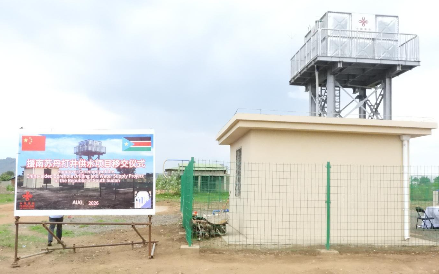
The South Sudan Ministry of Water Resources and Irrigation last week officially commissioned 50 water facilities funded by the Government of China to combat rural water scarcity, lower disease rates, and ease economic burdens across Central Equatoria and Lakes states under the China Aid Borehole Drilling and Water Supply Project.
The package, which includes 35 solar-powered mechanized water yards and 15 high-yield boreholes, was officially handed over to South Sudan during a ceremony in Juba last Wednesday.
Speaking at the event, Water Resources and Irrigation Minister James Mawich Makuach highlighted the vital role of clean water in public health, sanitation, agriculture, and economic development.
“We are executing a national objective to ensure our people get clean water,” he said. “I praise the strong bilateral relations between South Sudan and China, thanking the Chinese Embassy and ministry engineers for their hard work in completing the project.”
He urged local communities to protect and maintain the new infrastructure. He also noted that until centralized water treatment plants are established, localized solar water yards remain the most effective solution for vulnerable neighbourhoods.
For his part, Ma Qiang, Chinese Ambassador to South Sudan, lauded the successful completion and official handover of the China-aided Borehole Drilling and Water Supply Project, describing it as a vital initiative for improving local livelihoods.
He highlighted that the project has delivered key water infrastructure across Central Equatoria and Lakes states, providing communities with direct access to safe drinking water.
“Water is the source of life and the foundation of health. This project will not only effectively reduce waterborne diseases and improve sanitation but also support livestock production and community development—truly quenching thirst for today and removing worries for tomorrow,” Amb. Qiang said. “The facilities will reduce waterborne illnesses, support livestock, and strengthen local economic development. The project has delivered key water infrastructure across Central Equatoria and Lakes states, providing communities with direct access to safe drinking water.”
The ambassador urged local communities to take ownership of the infrastructure by ensuring proper daily maintenance and management to guarantee its long-term operation for future generations.
The envoy noted that the project represents a practical step under the Forum on China-Africa Cooperation (FOCAC) framework and China’s Global Development Initiative (GDI), reflecting Beijing’s policy principles of sincerity, real results, amity, and good faith.
Looking forward, Amb. Qiang reaffirmed China’s commitment to deepening bilateral cooperation with South Sudan across key sectors including energy, infrastructure, agriculture, education, and public health.
Meanwhile, Sidonia Adut Yel, who represented the beneficiaries of the project, expressed gratitude to both governments for bringing essential services to communities.
“The project addresses the critical water shortages we faced,” she stated. “We urge officials to expand coverage to surrounding blocks still lacking water.’
Another beneficiary, Luaak Gabriel, 55, said before the project was commissioned, residents had to buy water from tankers, with a single water drum costing around SSP 17,000, which he said placed a heavy financial burden on many households.

 and then