



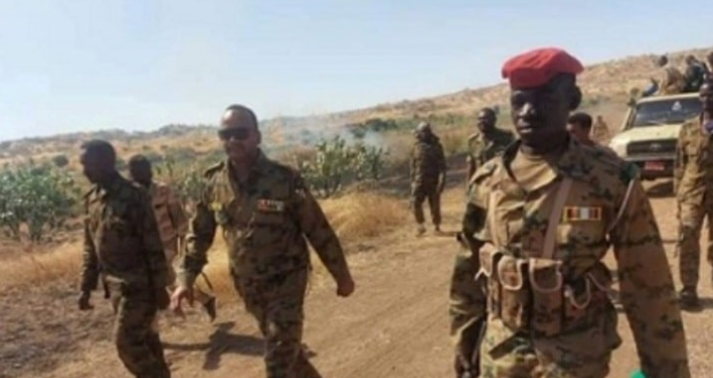
Sudanese military officials have announced plans to mobilise 6,000 fighters along the country’s border with Ethiopia in Gedaref State, amid rising tensions and accusations that Addis Ababa is supporting armed groups fighting the Sudanese army.
Major General Ammar Sayed Ahmed, head of the mobilisation and support committee of the Sudanese army’s Special Forces, announced the plan at a press conference on Monday, accusing Ethiopia of assembling troops and military formations near the Sudanese border.
He described the alleged military build-up as a growing security threat but said it would not deter Sudan from defending its territory.
Ahmed said the Sudanese people had twice driven what he described as occupying forces from the capital and remained capable of protecting the country’s borders.
Major General Amer Hassan Abbas, a Sudanese army security expert, said instability in Ethiopian regions bordering Sudan, coupled with developments inside both countries, is undermining border security.
Abbas accused Ethiopia of supporting armed groups fighting the Sudanese army, alleging that the Rapid Support Forces (RSF) and the Sudan People’s Liberation Movement-North (SPLM-N), led by Abdelaziz Adam al-Hilu, were seeking to open a new military front from Ethiopian territory under the Sudan Founding Alliance (Tasis).
He said the Sudanese government had previously raised allegations about military training camps in Ethiopia’s Assosa area, near the border with Sudan’s Blue Nile State, as well as facilities in Bahir Dar allegedly used to launch drones.
Abbas also alleged that recent attacks in Kurmuk and Geissan localities in Blue Nile State could not have been carried out without the involvement of forces operating from Ethiopian territory.
On the disputed Al-Fashaga border area in Gedaref State, Abbas said the Sudanese Armed Forces (SAF) had re-established their presence there in 2020 after the territory had remained under what he described as Ethiopian occupation for more than two decades.
He warned that further escalation along the border could have serious consequences for both countries and their populations.

 and then