



An election is meant to express national sovereignty, giving citizens a moment to decide who governs them and what political mandate their leaders should carry. But what happens when the outcome of an election is shaped not by citizens, constitutional institutions, or transparent political negotiations, but by private conversations involving foreign security operatives and a president struggling to hold on to political power? South Sudan’s December 2026 elections raise precisely this troubling question.
At the heart of South Sudan’s electoral crisis is a deeper question of national sovereignty and democratic legitimacy. The crisis goes beyond the government’s failure to organize elections; it reveals how external political interference, domestic political dependency, and the lack of meaningful public participation threaten the country’s ability to determine its own political future.
On November 14, 2026, the National Elections Commission announced that the elections scheduled for December 22 would be postponed to February 11, 2027. Publicly, the Commission cited the need for additional time to complete electoral preparations. Yet information obtained from two highly confidential sources within South Sudan’s National Security establishment suggests that the decision was preceded by a much more complicated political drama involving Ugandan security operatives, presidential anxiety, and pressure on political allies.
The two confidential sources, both familiar with internal security assessments and political developments at the presidential level, provided consistent accounts of what had happened. Their knowledge of the security establishment and developments within the presidency offered important insight into the circumstances surrounding the election postponement.
To further verify the information, I also spoke with a senior Sudan People’s Liberation Movement-In-Government (SPLM-IG) official who cautiously confirmed its accuracy but declined to say more, citing concerns about possible reprisals. The official’s position within the governing political establishment makes the confirmation significant. However, it is important to distinguish what the official independently confirmed from the broader account provided by the two confidential sources. The official’s reluctance to speak openly underscores the sensitivity of the issue and the risks that individuals may face when discussing politically sensitive developments within South Sudan’s political and security institutions. For this reason, the official’s identity has been withheld.
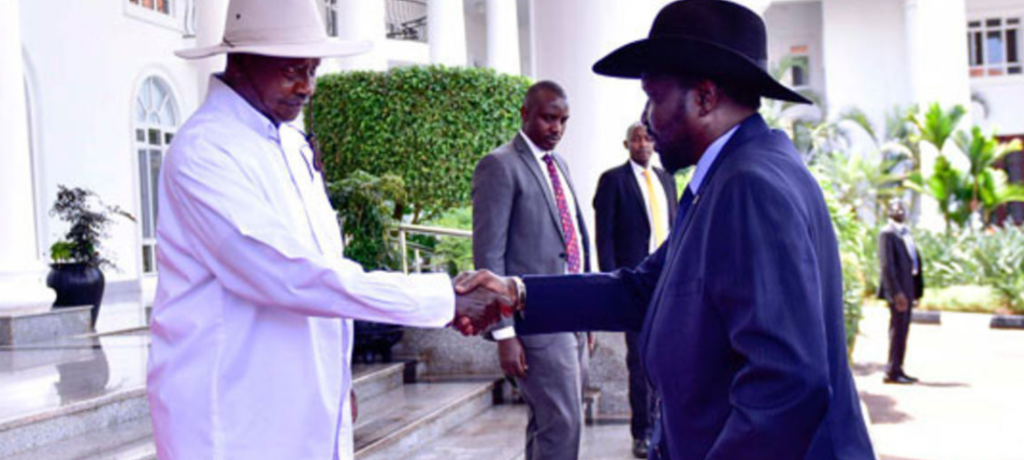
According to the two sources, on November 11, at approximately 3:15 p.m., two Ugandan nationals who allegedly presented themselves as members of the Uganda People’s Defence Forces (UPDF) met President Salva Kiir at his residence. The sources claim that the individuals were actually employees of Uganda’s External Security Organisation (ESO). Their reported message was that international pressure had become overwhelming and that Kiir should suspend the December elections.
The sources describe the encounter as a moment of considerable political discomfort for Kiir. Although he reportedly disliked the suggestion, he was reluctant to disregard the position of Uganda’s President, Yoweri Museveni, whose influence over Juba’s political calculations has long attracted regional attention. The same sources further allege that Museveni had previously encouraged Kiir to proceed with elections in April 2026, despite external pressure, following Museveni’s return from Ethiopia.
The significance of this account extends beyond the postponement itself. If foreign security officials can privately influence the electoral timetable of a sovereign country, what remains of that country’s political independence? Sovereignty cannot simply mean possessing a national flag, a presidential palace, and a seat at the United Nations. It must also mean having the capacity to make fundamental national decisions without external political direction.
This question becomes even more consequential when considered alongside the alleged discussions about the actual date of the elections. The sources further claim that the Ugandan operatives presented Kiir with two possible dates: February 11 or March 15, 2027. The February date eventually appeared in the National Elections Commission’s revised timetable. This alleged sequence raises questions about who actually shaped the decision and whether the Commission exercised independent institutional judgment. However, the available public record does not establish that Uganda dictated the new date, leaving unresolved questions about the extent to which South Sudanese citizens were excluded from decisions concerning their country’s electoral future.
Beyond the external pressure, the sources describe political maneuvering within Kiir’s own domestic political circle. According to a source within the National Security Service (NSS), on November 19, at approximately 7:23 p.m., Stephen Par Kuol, leader of the so-called In-Opposition (IO) party faction (formerly part of the Sudan People’s Liberation Movement-In-Opposition (SPLM-IO), from which it split in April 2025), was contacted by an aide to the National Elections Commission and encouraged to reject any further postponement and demand immediate elections. The source alleges that Par subsequently approached Kornelio Kon Ngu, leader of the National Alliance of Political Parties, to seek his views.
The confidential sources characterize Par as politically dependent on Kiir, alleging that his political position was shaped by a secret arrangement reached during his detention alongside his former SPLM-IO colleagues. They further allege that the arrangement involved weakening the Sudan People’s Liberation Army-in-Opposition. These are serious allegations, and independent evidence, as well as responses from the individuals concerned, would be necessary to establish their accuracy.
On November 21, at approximately 12:43 p.m., Kiir decided to pursue dialogue with opposition leaders, according to the two sources. If accurate, this development suggests that the administration was recalibrating its political strategy following the electoral postponement rather than simply implementing a predetermined democratic transition.
But the deeper question is not whether February 11 is more convenient than December 22. It is whether changing an election date can resolve the political conditions that made the original timetable so difficult to implement.
This brings the debate back to the fundamental issue of democratic legitimacy. South Sudan’s democratic crisis cannot be reduced to a disagreement over electoral calendars. Elections require functioning institutions, political freedoms, credible security arrangements, public confidence, and meaningful participation by competing political forces. Without these conditions, moving the election from December to February merely changes the date on which the same unresolved questions will resurface.
South Sudan’s political crisis is no longer just a domestic failure; it is an East African regional crisis with far-reaching humanitarian, security, and economic consequences. Millions of South Sudanese refugees remain displaced across neighboring countries, including Uganda, Kenya, Ethiopia, and Sudan, where their prolonged displacement places mounting pressure on host communities, public services, and already stretched humanitarian resources. Every political failure in Juba carries consequences beyond South Sudan’s borders, fueling regional instability, prolonging refugee displacement, and undermining development across East Africa. The future of South Sudan is therefore inseparable from the stability of the region. East African leaders, particularly those who wield political and security influence over Juba, cannot continue treating South Sudan’s crisis as someone else’s problem. They must recognize that peace in South Sudan is not simply a national obligation; it is a regional necessity.
The regional consequences, however, should not obscure the underlying philosophical contradiction at the center of South Sudan’s crisis. There is something profoundly contradictory about a country claiming democratic sovereignty while its most consequential political decisions are allegedly influenced through private conversations with foreign security officials. Democracy cannot be imported, negotiated in presidential residences, or manufactured through pressure on political party leaders. Nor can it be established by asking political actors to endorse electoral arrangements whose legitimacy remains contested.
If the allegations surrounding the November 11 meeting are substantiated, South Sudan will face a question larger than the postponement of its elections: whether its political independence has become subordinate to the calculations of external patrons. Without a genuine commitment to lasting peace from Kiir and other political leaders, the underlying causes of South Sudan’s civil conflict will remain unresolved.
History does not judge elections merely by whether ballot boxes are eventually opened. It judges whether citizens have the freedom and institutional protection necessary to make their votes meaningful. Many South Sudanese citizens have expressed dissatisfaction with the continued detention of key opposition leaders in connection with what they consider to be a fabricated legal case. Lasting peace requires allowing opposition leaders to exercise their political freedoms and operate without undue restrictions.
The legitimacy of an election rests not merely on the act of voting but on the political conditions that make the exercise of that vote meaningful. A sovereign nation must determine its political future through its own constitutional institutions and the freely expressed will of its people. Otherwise, elections risk becoming ceremonies of political convenience rather than instruments of democratic legitimacy.
South Sudan does not merely need an election date. It needs an election whose destiny belongs to South Sudanese citizens, not to the private calculations of those who govern them or those who seek to influence them from beyond its borders.
The writer, Duop Chak Wuol, is an analyst, critical writer, and former editor-in-chief of the South Sudan News Agency. He is a graduate of the University of Colorado and writes on geopolitics, security, and social affairs in South Sudan and the broader East African region. His work has appeared in leading regional and international outlets, including AllAfrica, Radio Tamazuj, The Independent (Uganda), The Arab Weekly, The Standard (Kenya), The Chronicle (Ghana), Addis Standard (Ethiopia), and Sudan Tribune. In 2017, the Ethiopian Broadcasting Corporation highlighted his article on Meles Zenawi’s role in Ethiopia’s economic transformation. He can be reached at duop282@gmail.com.
The views expressed in ‘opinion’ articles published by Radio Tamazuj are solely those of the writer. The veracity of any claims made is the responsibility of the author, not Radio Tamazuj.

 and then