



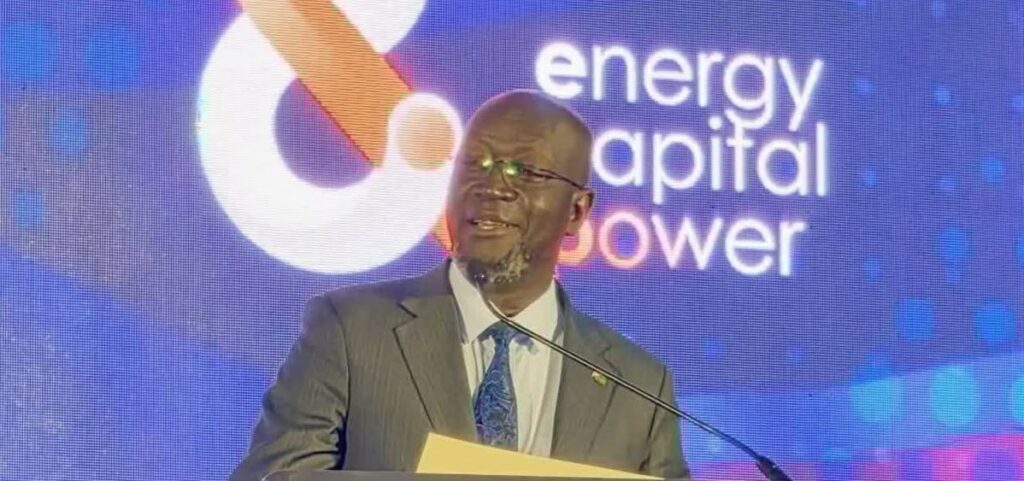
South Sudanese President Salva Kiir has called for increased oil production, domestic refining capacity and expanded electricity access, acknowledging that the country’s petroleum wealth has yet to translate into improved living standards for all citizens.
In a speech delivered on his behalf by Presidential Affairs Minister Africano Mande Gedima at the opening of the seventh South Sudan Oil and Power Conference in Juba on Tuesday, Kiir said the government wants to turn the country’s natural resources into jobs, infrastructure and broader economic development.
“Oil alone has not yet transformed the life of every South Sudanese,” Kiir said, describing petroleum as the backbone of the economy and a major source of government revenue.
“How do we turn our oil into electricity, into jobs, into schools, into hospitals, into prosperity for all?” he asked, urging conference participants to make those questions central to their discussions.
His remarks come as South Sudan continues to grapple with widespread poverty, food insecurity, displacement and inadequate infrastructure, despite its substantial oil resources. Millions of people face acute food shortages, while access to electricity, healthcare, education and other essential services remains severely limited.
Kiir said South Sudan is open to investment and urged international companies to explore opportunities in oil and gas, pipelines, refinery development, solar and hydropower projects, and regional electricity interconnection.
He said the government was committed to reforms and had legal frameworks to protect investors, urging potential partners not to be discouraged by what he described as negative perceptions of the country.
The president also said South Sudan is destined to hold its first democratic and fair elections, which he said would pave the way for a stable government.
He stressed that the government wants investors who would establish long-term partnerships, create jobs for young people, protect the environment and ensure that local communities benefited from resource development.
Production and power
Kiir said he had directed the Ministry of Petroleum and Nile Petroleum Corporation to increase production, open new exploration blocks and ensure the establishment of a refinery to enable the country to process its crude oil domestically and add value to petroleum products.
He also called on the Ministry of Finance and Planning to enforce the Public Finance Management and Accountability Act, which provides a framework for the management and oversight of public funds.
On electricity, Kiir urged the Ministry of Electricity to expand access to schools, hospitals and counties across the country.
“Having access to power is no longer a luxury. It is a right,” he said.
Electricity access remains extremely low in South Sudan, limiting economic activity and the delivery of essential services. The country’s heavy dependence on oil revenues has also left its economy vulnerable to fluctuations in production and disruptions to exports through Sudan.
Kiir called for greater coordination among government ministries, saying energy development requires cooperation beyond the petroleum sector, including with institutions responsible for finance, trade, the environment, education and foreign affairs.
Call for partnerships
Kiir urged conference participants to exchange experiences, share best practices and discuss past mistakes to help shape the development of South Sudan’s energy sector.
“Do not leave Juba with only speeches, but with partnerships that will change lives,” he said.
He thanked the Ministry of Petroleum, Nile Petroleum Corporation, sponsors and the organising committee before declaring the conference officially open.

 and then