



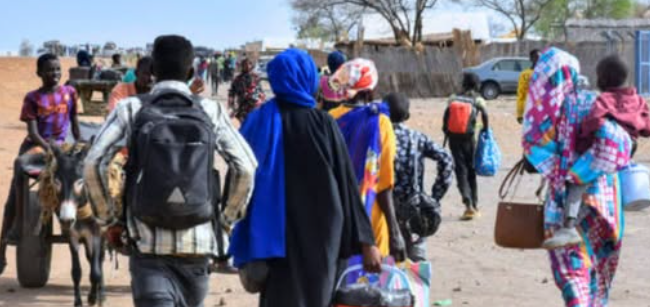
The displacement crisis is worsening and spreading across relatively stable areas of Sudan’s Blue Nile Region as families continue to flee military confrontations in Bau and Geissan, amid mounting humanitarian needs and shortages of essential services in host communities.
According to figures from the Humanitarian Aid Commission (HAC), approximately 93,000 people from Bau and Geissan have arrived in Damazin over the past few days, following fighting between the Sudan Armed Forces (SAF) and the Rapid Support Forces (RSF) and allied rebel forces in areas close to the regional capital.
Most displaced people are sheltering in schools and other centers under dire humanitarian conditions, with mounting pressure on essential services and supplies, including food, drinking water, healthcare and shelter materials.
Badr Al-Tom, head of one of the displacement camps in the Ganeis East area of Rosseires Locality, appealed for urgent humanitarian assistance, saying displaced families were sleeping in the open and enduring prolonged exposure to the sun.
“There are shortages of shelter, food, medicines and drinking water. Displaced residents are forced to fetch water from residential neighbourhoods near the camp,” he said. “I appeal to the relevant authorities and humanitarian organizations to intervene and address basic needs.”
Meanwhile, displacement continues towards Rosseires and Agadi, as well as other areas in Al-Tadamun Locality. Local sources report that groups of civilians remain trapped in areas affected by fighting, raising concerns over the inability of humanitarian organizations to reach them.
Ahmed Issa, an activist who spoke to this publication from a displacement shelter in Agadi in the Al-Tadamun Locality, appealed to humanitarian organizations, social welfare agencies, young people and community-led initiatives to visit the school accommodating displaced families and provide much-needed assistance.
“There are numerous children among the displaced, and their living conditions are very harsh,” he said. “With the onset of winter, there is urgent need for blankets, mattresses, food and drinking water.”
Testimonies from displaced residents reveal the scale of suffering endured by families during their flight, compounded by the loss of property and limited access to humanitarian assistance.
Al-Tom Ibrahim, a displaced resident from Geissan Locality, said his family had moved from one area to another before eventually reaching Rosseires Locality.
“We lost our possessions and farms during the displacement journey. Displaced families are experiencing acute shortages of food and medicines, with several children and sick people requiring medical attention,’ he said. “Some patients stay in houses near the camp, while others are receiving treatment in hospitals.”
“The displaced have received no meals since their arrival, apart from a single sack of flour provided for approximately 1,000 people, which was used to prepare a thin, salted porridge,” Ibrahim added.
He said no humanitarian organization had reached the camp as of the time of his interview and appealed to local and international humanitarian organizations and well-wishers to intervene urgently to alleviate the suffering of displaced families.
The deteriorating conditions come against the backdrop of a decision by the Humanitarian Aid Commissioner to suspend the operations of Emergency Response Rooms (ERRs) across all localities in the region.
Civil society activist Azhari Hassan described the humanitarian conditions of displaced people in Damazin, Rosseires and Agadi as extremely dire. He said large numbers of families had arrived over the past three days amid a humanitarian response that remained grossly inadequate relative to the scale of needs.
“The assistance delivered to some camps covered only a fraction of the displaced population’s needs,” he said. “Many displaced people are sheltering in streets and schools without adequate accommodation or sanitation facilities and with limited access to safe drinking water. Humanitarian organizations and well-wishers should act swiftly to provide food, water, shelter and medicines.”
As fighting rages across Kurmuk, Geissan, Wad Al-Mahi and Bau localities, concerns are mounting over the safety of civilians trapped in conflict-affected areas, amid growing calls for intensified humanitarian interventions and the establishment of safe corridors to evacuate civilians and deliver assistance to affected communities.

 and then