



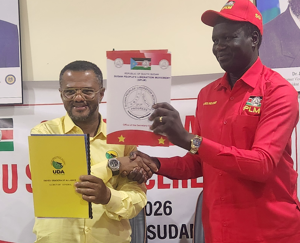
South Sudan’s ruling Sudan People’s Liberation Movement (SPLM) said on Monday that it hopes to draw lessons from Kenya’s electoral experience through a newly signed cooperation agreement with Kenya’s governing United Democratic Alliance (UDA), as the country prepares for long-delayed elections.
The five-year memorandum of understanding (MoU), signed in Juba by the secretary generals of the two parties, seeks to strengthen cooperation in cadre training, policy development, youth and women empowerment, research and exchange programmes, with both sides saying the partnership would also support democratic governance and regional integration.
Speaking after the signing, SPLM Secretary-General Dr. Akol Paul Kordit said the agreement would enable the ruling party to benefit from Kenya’s experience in electoral management and political party development as South Sudan works towards holding its first post-independence elections.
“Kenya has been helping South Sudan for many years, from the liberation struggle to the peace process after the 2013 crisis,” Kordit said. “We are going for elections now, and I believe there is a lot we as SPLM can learn from Kenya’s experience. They have gone through election-related challenges before, and we can learn what they did.”
He said the cooperation would not transform either party into the other but would allow both to share experiences and grow through mutual learning.
“The MoU has issues of cadre training and development, empowerment of youth and women in both organisations, experience sharing, exchange programmes and joint policy development, especially in research and developing evidence-based policies that will help the two parties function in their respective countries,” he explained.
Kordit said the agreement would also contribute to regional integration under the East African Community (EAC) and the African Union, noting that both parties would work together to promote political and social cooperation across the region.
He described the agreement as a flexible instrument that can be reviewed and amended whenever necessary to respond to changing political realities.
“The world is changing very fast, and political parties must also adjust. We included provisions allowing either party to review and amend the agreement because we do not want to become outdated,” he said.
On the Kenyan side, UDA Secretary-General Hassan Omar Hassan said the partnership would move beyond symbolic relations and create structured cooperation between the two ruling parties, particularly as both countries prepare for elections.
“We want our relationship to be extremely deliberate between ourselves and yourselves so that in the future we can have programmes that are deliberate and joint,” Hassan said.
“More urgently, we want to see how we can be of mutual support in terms of your election preparedness. As you prepare for your elections, we are also preparing for ours next year. There are different areas of mutual interest, so that we offer ourselves stability and continuity for our respective people and governments.”
He said political parties can play a significant role in strengthening bilateral relations and influencing public policy more quickly than traditional diplomatic channels.
Hassan also described the agreement as part of a broader vision of Pan-African cooperation and deeper East African integration, calling for stronger collaboration among political parties in the region.
Also addressing the event, UDA National Organising Secretary Vincent Kawaya said the agreement should help advance regional integration and strengthen ties between the peoples of South Sudan and Kenya.
“We are one people with a deep-rooted history, and we need to walk the talk,” Kawaya said. “We need to encourage people and goods to move freely across our nations, and political parties can help advance our common goals and deepen regional integration.”
He said sports, politics, and other exchanges could be used to foster closer cooperation among East African countries.
The MoU will remain in force for five years, with provisions allowing either party to review or amend it by mutual consent. Both parties said the agreement is intended to deepen institutional cooperation while promoting democratic governance, capacity building and regional cooperation.

 and then