



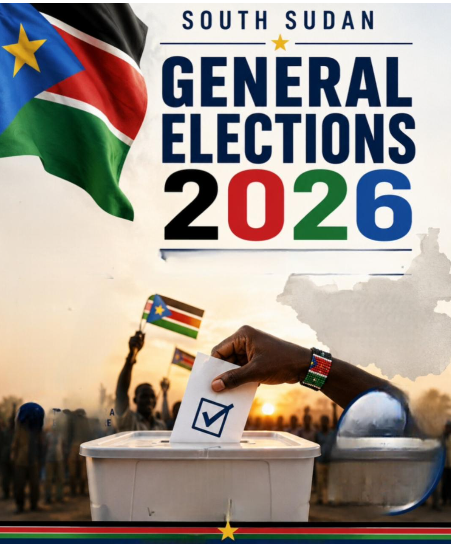
As the repressive regime in Juba prepares to hold general elections later this year, concerns are growing about the future of South Sudan due to the absence of national consensus—a fundamental prerequisite for free, fair, and credible elections.
In fact, given the current arrangements taking place in an undemocratic and insecure environment, where state institutions function as the regime’s old guard, how can the upcoming elections be anything other than a tool to renew the legitimacy of a state terror regime, which was practiced in the past in the name of the Movement?
The regime’s portrayal of this electoral process as a constitutional right is presented as a statement of truth to justify political falsehood. Because going to polling stations is merely the final step in a much longer democratic process. Before asking the people to exercise this right, the regime should first have fulfilled its national obligations, including adopting a new constitution. The current wartime constitution is wholly unsuitable for conducting the first democratic elections in post-independence South Sudan.
The upcoming general elections cannot be separated from the political history of the Sudan People’s Liberation Movement (SPLM), particularly its deep-seated fear of democracy in both principle and practice. This history reveals the movement’s determination to proceed with the 2026 elections despite the absence of a democratic environment, using them as a means of renewing the legitimacy of a state terror regime that relies on repression to organize and control the electoral process.
The Sudan People’s Liberation Movement’s apprehension toward democracy has been deeply rooted since its founding in 1983 as a revolutionary movement built around political slogans. This is clearly reflected in the fact that its central ideals—freedom, justice, equality, democracy, and comprehensive development—are virtually absent from the daily political life of a country suffering from a profound political crisis. The regime continues to uphold the “law of the jungle” as the basis of governance, effectively putting the cart before the horse by attempting to organize elections under a constitutional order founded on arbitrary power rather than democratic principles.
The history of the Sudan People’s Liberation Movement/Army (SPLM/A) reminds us of many painful moments during which the law of the jungle prevailed over political solutions that could have prevented bloodshed. From the confrontation with the forces of Samuel Gai Tut, founder of the Anyanya II Movement, at Bilpam during the SPLM/A’s early years, to the devastating split of August 28, 1991, when Dr. Riek Machar and Lam Akol broke away from the movement, and later to the massacres associated with the 2013 conflict, the pattern has remained the same. These tragic episodes share a common legacy of killing, displacement, and immeasurable human and material suffering.
These tragic historical events raise a crucial question: Why does the Sudan People’s Liberation Movement (SPLM) continue to cling to the “law of the jungle” instead of embracing internal democratic practices before preaching its own version of democracy to the people? In the past, this approach was justified as necessary to protect the revolution from both real and perceived enemies. Over time, however, that justification appears to have evolved into an ideology of its own—one under which horrific atrocities have been committed. Indeed, several SPLM leaders have openly acknowledged on numerous occasions that more South Sudanese were killed in the movement’s internal conflicts than by its external enemies.
These admissions reveal the dangers of attempting to renew the legitimacy of a state terror regime through the upcoming elections. The regime’s continued reliance on the law of the jungle serves primarily to protect President Salva Kiir’s dictatorship and the political and economic interests of the leadership of the ruling movement. The inevitable result has been the repeated loss of innocent lives.
Throughout the history of the Sudan People’s Liberation Movement/Army (SPLM/A), attempts to impose the law of the jungle have come at an enormous cost. In every instance, those with no stake in the movement’s internal power struggles have borne the greatest burden. Had it not been for international intervention—including the efforts of the United States through its Special Envoy, Ambassador Richard Williamson, during the crisis surrounding the SPLM’s Second National Convention in 2008—the confrontation between supporters of President Salva Kiir, who were relatively new to the centers of political power, and the movement’s old guard, commonly known as the “Garang Boys,” could have had disastrous consequences for the Comprehensive Peace Agreement and for the people of South Sudan, who were anxiously awaiting the 2011 independence referendum.
Viewed in this historical context, the present moment appears to represent yet another chapter in the same recurring pattern. Following the events at Bilpam, the 1991 split, the tensions surrounding the SPLM’s Second National Convention, and the tragic conflict of 2013, the law of the jungle once again prevails over reason and over genuine efforts to democratize the Sudan People’s Liberation Movement itself. Before speaking of democratic transformation in South Sudan, the SPLM must first embrace democracy within its own ranks. Yet the movement appears to fear democracy more than any other political organization in the country. For its leadership, organizing elections to renew the legitimacy of a state terror regime has become a higher priority than implementing the Revitalized Peace Agreement in both letter and spirit.
The country’s grim situation today recalls the intense diplomatic efforts undertaken by the United States and other international partners to prevent South Sudan from descending further into conflict. Those efforts sought to avert a repeat of the disastrous decisions that plunged the country into civil war in 2013. Yet the regime has continued to defend the same doctrine of the law of the jungle—a political legacy that President Salva Kiir has upheld for more than two decades.
Against this backdrop, it is difficult to imagine how the elections scheduled for the end of this year could represent a genuine step toward democratic transition. South Sudan remains under a totalitarian system that bears little resemblance to democracy beyond its outward appearance. The institutions responsible for administering the electoral process—including the National Elections Commission—have long functioned as instruments of the police state rather than as independent public institutions. Instead of safeguarding democracy, they appear designed to renew the legitimacy of President Salva Kiir’s authoritarian rule through elections that amount to little more than a grand deception carried out in the name of democracy—a system that the Sudan People’s Liberation Movement has feared since its inception.
Yesterday, the legitimacy of the law of the jungle was justified in the name of protecting the revolution. Today, it is justified under the pretext of protecting the gains of that revolution—specifically, preserving the ruling party’s grip on power and its ability to manipulate the state and direct political life through state terror and authoritarian rule. Under such circumstances, how can free, fair, and credible elections possibly be held?
More than two decades of suffering caused by insecurity, corruption, political repression, and the continued humiliation of our people compel us to declare, loudly and unequivocally: Enough of this charade carried out in the name of democracy! We reject any attempt to renew the legitimacy of a state terror regime through the votes of an oppressed and forgotten people who continue to bear the consequences of the regime’s failure to govern.
We therefore say yes to boycotting the sham 2026 elections, which are nothing more than an attempt to legitimize a criminal regime. We also say yes to continuing the struggle to save our country from collapse as the first step toward establishing genuine and lasting peace, achieving sustainable development, providing basic services, and, above all, reclaiming our freedom, dignity, and history from the hands of yesterday’s revolutionaries, who have become today’s oppressors. Boycotting these elections is not a rejection of democracy itself; rather, it is a call to uphold genuine democracy founded on accountability, justice, respect for the rule of law, and the sovereignty of the people.
It is both infuriating and appalling that the regime, together with its exploitative ruling movement, insists on holding general elections at the end of the year while thousands of citizens continue to endure extreme poverty, displacement, insecurity, and inadequate access to basic services. Renewing the regime’s legitimacy under these conditions cannot bring peace, security, development, or democracy to our people. Over the past two decades, the SPLM has consistently abandoned its founding ideals of freedom, justice, equality, democracy, and inclusive development in favor of building a tribal republic where the promises of the liberation struggle have been replaced by oppression, exclusion, and fear.
In the interest of honesty and historical accuracy, and in remembrance of the years of armed struggle, I must acknowledge that the fighters of the Sudan People’s Liberation Movement/Army (SPLM/A) made immense sacrifices on behalf of the people of South Sudan. They fought in the hope that future generations would live in freedom, peace, and prosperity in an independent nation. Tragically, those sacrifices are now being exploited by a regime that seeks to preserve its rule by every available means, including the manipulation of elections. Those sacrifices belong to the people of South Sudan—not to any political party or ruling elite. It is therefore our national duty to ensure that they are never used to justify continued oppression or state terror.
Boycotting the general elections scheduled for the end of this year is neither a partisan agenda nor a regional one. On the contrary, it is a national cause that deserves the support of all South Sudanese through their intellectual, political, and organizational efforts. Most importantly, we must take this stand today rather than tomorrow, because elections designed solely to renew the legitimacy of a state terror regime can never place South Sudan on the path to national recovery.
In conclusion, our national responsibility extends beyond boycotting these sham elections and rejecting the injustices of today. It also requires us to continue the second liberation struggle aimed at building the nation for which our martyrs sacrificed their lives—a homeland founded on freedom, dignity, justice, equality, peace, and prosperity.
The writer, Sokiri Lo Poni, is a concerned South Sudanese. He can be reached via Sokiril8@gmail.com.
The views expressed in ‘opinion’ articles published by Radio Tamazuj are solely those of the writer. The veracity of any claims made is the responsibility of the author, not Radio Tamazuj.

 and then