



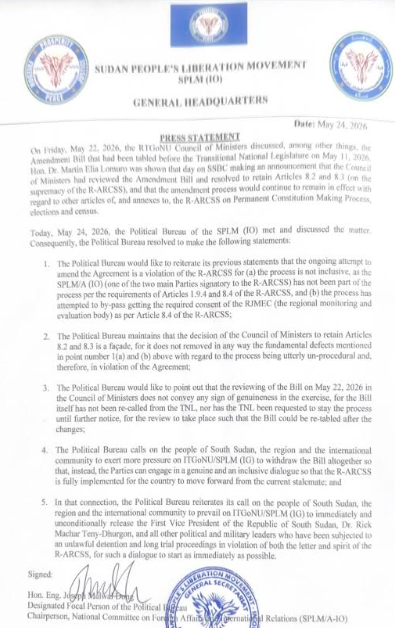
The Political Bureau of the Sudan People’s Liberation Movement-in Opposition (SPLM-IO), led by suspended First Vice President Dr. Riek Machar, on Sunday restated that the machinations to alter the 2018 Peace Agreement are a violation of the accord, not inclusive, and a façade.
A Sunday press release signed by Eng. Joseph Malwal-Dong, Designated Focal Person of the Political Bureau and Chairperson, National Committee on Foreign Affairs and Relations (SPLM/A-IO), extended to this publication said that on Friday, May 22, 2026, the RTGoNU Council of Ministers discussed, among other things, the Amendment Bill that had been tabled before the Transitional National Legislature on May 11, 2026.
Hon. Dr. Martin Elia Lomuro was shown that day on SSBC making an announcement that the Council of Ministers had reviewed the Amendment Bill and resolved to retain Articles 8.2 and 8.3 (on the supremacy of the R-ARCSS), and that the amendment process would continue to remain in effect concerning other articles of, and annexes to, the R-ARCSS on Permanent Constitution Making Process, elections, and census, the statement said.
“Today, May 24, 2026, the Political Bureau of the SPLM (IO) met and discussed the matter. Consequently, the Political Bureau would like to reiterate its previous statements that the ongoing attempt to amend the Agreement is a violation of the R-ARCSS for (a) the process is not inclusive, as the SPLM/A (IO) (one of the two main Parties signatory to the R-ARCSS) has not been part of the process per the requirements of Articles 1.9.4 and 8.4 of the R-ARCSS, and (b) the process has attempted to by-pass getting the required consent of the RJMEC (the regional monitoring and evaluation body) as per Article 8.4 of the R-ARCSS,” the statement reads in part. “The Political Bureau maintains that the decision of the Council of Ministers to retain Articles 8.2 and 8.3 is a façade, for it does not remove in any way the fundamental defects mentioned in point number 1(a) and (b) above with regard to the process being utterly un-procedural and, therefore, in violation of the Agreement.”
“The Political Bureau would like to point out that the reviewing of the Bill on May 22, 2026 in the Council of Ministers does not convey any sign of genuineness in the exercise, for the Bill itself has not been re-called from the TNL, nor has the TNL been requested to stay the process until further notice, for the review to take place such that the Bill could be re-tabled after the changes,” the statement added.
The Political Bureau called on the people of South Sudan, the region, and the international community to exert more pressure on ITGoNU/SPLM (IG) to withdraw the Bill altogether so that, instead, the Parties can engage in a genuine and inclusive dialogue so that the R-ARCSS is fully implemented for the country to move forward from the current stalemate.
“In that connection, the Political Bureau reiterates its call on the people of South Sudan, the region and the international community to prevail on ITGoNU/SPLM (IG) to immediately and unconditionally release the First Vice President of the Republic of South Sudan, Dr. Riek Machar Teny-Dhurgon, and all other political and military leaders who have been subjected to an unlawful detention and long trial proceedings in violation of both the letter and spirit of the R-ARCSS, for such a dialogue to start as immediately as possible,” the statement concluded.
Last Friday, the Council of Ministers backpedaled on proposed changes to provisions on the supremacy of the 2018 peace agreement, following pressure from Western governments.
The decision followed U.S. sanctions and pressure from 17 Western embassies and the European Union, which warned that unilateral changes to the 2018 peace agreement would undermine its legitimacy and jeopardise peace efforts in South Sudan.
In a joint statement on Tuesday, diplomatic missions from Australia, Canada, Cyprus, Denmark, Finland, France, Germany, Ireland, Japan, the Netherlands, New Zealand, Norway, Portugal, Slovenia, Sweden, Switzerland, the United Kingdom, and the United States, together with the EU delegation, called for an immediate return to dialogue.
“The Peace Agreement remains the basis of legitimacy for the transitional government in South Sudan,” the statement said. “Unilateral changes to the Agreement are not in accordance with the letter and spirit of the Agreement and will not bring peace to South Sudan.”
The missions said full implementation of the 2018 agreement remained essential for stability.
President Salva Kiir Mayardit’s camp submitted the proposed amendments on 11 May to parliament to pave the way for elections in December 2026, prompting opposition lawmakers to boycott proceedings, saying the process violated provisions of the accord.
Among the controversial amendments tabled by Justice Minister Michael Makuei Lueth was the repeal of clauses establishing the supremacy of the peace agreement over the constitution and national laws.
The Sudan People’s Liberation Movement-in-Opposition (SPLM-IO), led by Dr. Riek Machar, a key signatory to the deal, has opposed the amendments, saying it was not consulted.
The Reconstituted Joint Monitoring and Evaluation Commission (RJMEC), which oversees implementation of the agreement, has also expressed concern, warning that any amendments require consultation and consensus among all signatories, including the SPLM-IO faction aligned with First Vice President Riek Machar.
Machar was detained in March 2025 and later suspended from office over allegations linking him to violence in Nasir County. He is facing treason charges before a special court.
International actors have repeatedly called for his release, renewed political dialogue, and full implementation of the peace agreement ahead of planned elections.

 and then