



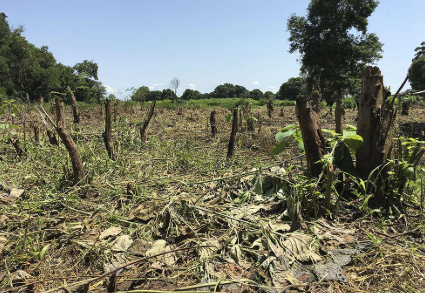
South Sudan is blessed with vast forests and woodlands that sustain millions of people and support some of the country’s most valuable ecosystems. According to the Food and Agriculture Organization (FAO), South Sudan’s forests and woodlands cover approximately 191,667 square kilometers, representing about 30 percent of the country’s land area (Food and Agriculture Organization of the United Nations [FAO], 2025). These forests provide timber, fuelwood, medicinal plants, and critical habitats for biodiversity (FAO, 2025; United Nations Environment Programme [UNEP], 2024).
Yet despite their immense value, South Sudan’s forests are disappearing at an alarming rate. Annual forest loss has been estimated at between 1.5 and 2 percent, driven largely by fuelwood collection, charcoal production, agricultural expansion, livestock activities, and construction demands (UNEP, 2018, 2024). If this trend continues, the environmental and economic consequences could be severe for both present and future generations.
The warning signs are increasingly visible across the country. Growing demand for charcoal, timber, and agricultural land is placing enormous pressure on forest resources. Urban centers, particularly Juba, consume vast quantities of charcoal and fuelwood. A UNEP-supported survey found that 88 percent of households in Juba rely on charcoal as their primary source of energy (UNEP, 2018). As forests shrink, communities become more vulnerable to environmental degradation, climate-related shocks, and declining natural resources (FAO, 2023; World Bank Group, 2026).
The loss of forests is not merely an environmental issue. It is an economic challenge, a food security challenge, and ultimately a national development challenge. A significant share of South Sudan’s population depends on forests and other natural resources for energy, livelihoods, and day-to-day survival (FAO, 2025; UNEP, 2018). However, continued forest degradation threatens the very resources upon which communities depend.
The FAO emphasizes that effective management of forest ecosystems is essential for protecting rural livelihoods and promoting sustainable development (FAO, 2023). Short-term gains from uncontrolled logging, charcoal production, and land clearing may provide immediate income, but they can also undermine long-term economic opportunities and environmental resilience. If forests continue to disappear, communities will face increasing challenges in sustaining agricultural production, securing energy sources, and adapting to a changing climate.
South Sudan’s forests also hold a special place in the nation’s history. During the long years of the liberation struggle, forests and woodlands provided refuge for civilians and freedom fighters alike. They sheltered families fleeing violence, offered protection during uncertain times, and stood as silent witnesses to the sacrifices that paved the way for independence. For many communities, forests are more than natural resources. They symbolize protection, resilience, and hope.
Today, however, the nation faces a different struggle. The threat no longer comes primarily from armed conflict but from environmental degradation and the unsustainable exploitation of the very landscapes that once sustained its people. The World Bank warns that climate change is acting as a threat multiplier in South Sudan, contributing to increasingly severe floods, rising temperatures, and mounting pressure on livelihoods and food systems (World Bank Group, 2026). The country’s vulnerability to climate shocks makes forest conservation more important than ever.
Fortunately, South Sudan is not alone in confronting this challenge. Across Africa, several countries have demonstrated that environmental decline can be reversed when communities are empowered to take the lead. Niger’s Farmer-Managed Natural Regeneration initiative restored millions of hectares of degraded land. Rwanda increased forest cover through sustained conservation efforts. Ethiopia mobilized citizens under its Green Legacy Initiative to plant billions of trees. Senegal’s participation in the Great Green Wall Initiative has helped restore degraded landscapes while creating opportunities for local communities.
While these initiatives differ in scale and approach, they share an important lesson: lasting environmental recovery begins at the community level.
This is the lesson South Sudan must embrace. The future of the country’s forests depends on a strong partnership between government leadership and community action. UNEP notes that much of South Sudan’s forestland is held under communal ownership, making community participation essential for sustainable forest management (UNEP, 2024). When local communities are empowered to protect and manage their forests, conservation efforts become more effective and sustainable.
Farmers can adopt agroforestry and other sustainable land-management practices that support forest restoration while strengthening resilience (FAO, 2023). Community forestry initiatives can help combat illegal logging, promote responsible resource management, and encourage long-term stewardship. Schools, churches, traditional leaders, youth groups, women’s organizations, and local authorities all have vital roles to play in building environmental awareness and protecting natural resources.
Forest conservation should not be seen as an obstacle to development. Rather, it should be recognized as a foundation for sustainable growth, climate resilience, food security, and poverty reduction. The FAO notes that improving forest ecosystems can reduce greenhouse gas emissions while enhancing community resilience and supporting sustainable livelihoods (FAO, 2023).
South Sudan stands at a defining moment in its history. The forests that once protected our people during times of war now need protection during a time of peace. Future generations will ask what we did when the warning signs became clear. They will ask whether we chose short-term exploitation over long-term prosperity and whether we acted when there was still time.
Let our answer be one of courage and responsibility.
Let us tell them that communities came together to protect the forests that protected them. Let us tell them that degraded landscapes were restored, that stewardship replaced neglect, and that hope triumphed over indifference. Every tree planted is an investment in the future. Every forest protected is a promise kept.
If we act now, future generations can inherit shade instead of dust, opportunity instead of scarcity, and thriving ecosystems instead of barren land.
The time to act is now. Not tomorrow. Not next year. Now.
The writer is a member of the Sudan People’s Liberation Movement (SPLM), an advocate for greater public awareness of the economic and environmental value of forests. He resides in Omaha, Nebraska, USA, and can be reached via manyielpaulino@gmail.com.
The views expressed in ‘opinion’ articles published by Radio Tamazuj are solely those of the writer. The veracity of any claims made is the responsibility of the author, not Radio Tamazuj.

 and then