



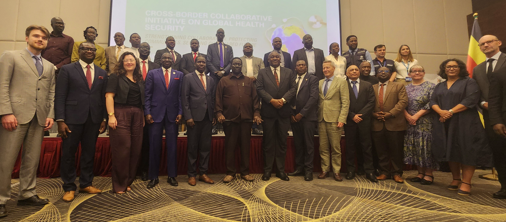
The governments of South Sudan and Uganda have signed a Memorandum of Understanding (MOU) to strengthen cross-border cooperation in preventing and responding to disease outbreaks and other public health emergencies.
The agreement, signed in Juba on Monday by the two countries’ health ministers, establishes a framework for joint surveillance, information sharing and coordinated preparedness and response to health emergencies along their shared border.
South Sudan’s Health Minister Luke Thompson Thoan Teny said the agreement moves the two countries’ health cooperation from general goodwill and communication towards an institutionalised system for rapid joint action.
“This agreement transitions our bilateral relationship from goodwill and communication to institutionalised rapid response action,” he said.
Thoan said infectious diseases do not respect national borders and that an outbreak in one country can quickly become a regional emergency, making isolated national responses increasingly ineffective.
Under the MOU, South Sudan and Uganda will strengthen real-time epidemiological information sharing, mutual notification of outbreaks, joint contact tracing and coordinated disease surveillance.
The agreement also provides for cooperation in areas including biospecimen transfer, harmonised screening at points of entry and the deployment of coordinated mobile health teams during emergencies.
Vice President Hussein Abdelbagi Akol, who oversees the Service Delivery Cluster, said the recent Ebola threat had demonstrated the need for countries sharing borders to strengthen joint preparedness.
He said pathogens do not respect checkpoints or national boundaries, warning that the shared border should not become a corridor for public health emergencies.
“Health security is national security,” Abdelbagi said, adding that the government would support measures to remove administrative barriers that could delay emergency health responses.
Uganda’s Health Minister Chris Baryomunsi said the MOU represented more than a formal agreement, describing it as a new chapter in public health cooperation between the neighbouring countries.
He said Uganda’s experience responding to an Ebola outbreak earlier this year had demonstrated the importance of early coordination and cross-border preparedness.
Uganda recorded 20 confirmed Ebola cases during the outbreak, including 15 Congolese nationals, four health workers and a driver. Eighteen patients were successfully treated while two died, with the outbreak declared contained after 73 days, according to Baryomunsi.
He said Uganda was prepared to share lessons from its experience with South Sudan and other countries facing similar risks.
Baryomunsi, however, stressed that signing the MOU was only the beginning, calling for the development of a joint implementation plan with clear priorities, responsibilities, timelines and resources.
He also proposed establishing a regional standby health workforce that could be rapidly deployed during public health emergencies, similar to existing regional security arrangements.
Africa CDC South Sudan Country Director Tolbert Geewleh Nyenswah said the agreement came at a time when countries in the region continued to face the threat of Ebola and other infectious diseases.
He said South Sudan had identified 15 high-risk counties and 22 priority points of entry as part of its preparedness measures, with surveillance and response activities organised through hubs in Western Equatoria, Central Equatoria and Eastern Equatoria.
Nyenswah said South Sudan’s revised six-month preparedness plan, running from August to January, requires more than 30 million U.S. dollars to support laboratories, medical supplies, logistics, surveillance and protection of health workers.
He urged authorities and partners to strengthen preparedness before the first case of an outbreak is detected, saying preventing the first generation of transmission remains the most effective strategy.
The two countries said the new framework would also support cooperation with regional and continental institutions, including the Intergovernmental Authority on Development (IGAD), Africa CDC and the World Health Organization.
The MOU comes as countries in East and Central Africa increasingly seek stronger cross-border mechanisms to address infectious disease threats, with regional health authorities emphasising joint surveillance, information sharing and coordinated outbreak response.

 and then