



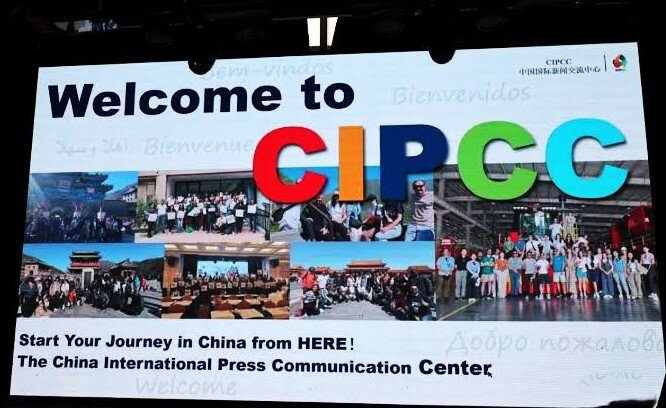
The government of China on Tuesday opened a four-month media exchange programme for 109 journalists from 101 countries, stepping up its engagement with reporters from the Global South as Beijing seeks to promote its account of China’s development and its growing role in world affairs.
The China International Press Communication Center (CIPCC) programme was launched at Renmin University of China in Beijing, bringing together journalists for training, field visits, panel discussions and cultural exchanges.
Chinese Assistant Foreign Minister Hong Lei told participants that the programme was intended to help foreign journalists gain a closer understanding of China and report on its development from multiple perspectives.
“I hope through your participation in the programme, you will become bosom friends of China, and help better connect China with the world,” he said.
Hong urged the journalists to provide “objective coverage and diverse perspectives”, while highlighting China’s economic transformation, infrastructure development, poverty reduction and technological advances.
He also placed the programme within China’s wider diplomatic push, saying Beijing stood firmly with the Global South and was seeking to promote common development and stronger multilateralism. He cited Chinese President Xi Jinping’s Global Development, Global Security, Global Civilization and Global Governance initiatives.
Meanwhile, Hong Xiaoyin, Vice President of the China Public Diplomacy Association, which oversees the programme, said the CIPCC had spent 12 years creating a platform for international journalists to “perceive and engage with China.” He added that participants should move beyond stereotypes through first-hand reporting.
The programme is part of a broader Chinese effort to cultivate closer media ties with countries across the developing world.
Earlier this year, a separate CIPCC programme brought together 98 journalists from 90 countries, according to the Lao News Agency.
Hong Xiaoyin said previous participants had helped present a “multi-dimensional” China beyond what she called a “single-sourced Western narrative”.
Renmin University Communist Party secretary Zhang Donggang said the university had trained more than 700 journalists from more than 100 countries and regions since 2014. He urged participants to use their professional judgment to document what he called a “credible, lovable, and respectable China.”
But the clearest warning against simply adopting official narratives came from the journalists themselves.
Mark Longyan, a Nigerian journalist speaking on behalf of participants, said reporters had come to China to see the country for themselves, including both its achievements and its challenges.
“As journalists, our job is not to repeat what we are told, but to observe, investigate, verify, and tell stories that help our audiences make sense of a changing world,” he said. “We cherish the type of journalism that promotes understanding without abandoning scrutiny, cooperation without abandoning independence, and friendship without abandoning truth.”
Longyan placed particular emphasis on Africa-China relations, saying China’s economic, technological and diplomatic importance to Africa made independent reporting on the relationship increasingly important.
“There is therefore a need for more African journalists to be telling African stories about China, and more Chinese journalists to be telling Chinese stories about Africa,” he said.
Nepalese journalist Su Beijing, a participant in the programme, pushed the discussion further, describing the exchange as more than a media training exercise.
He said the programme offered journalists a way to examine China’s development while also looking at the emergence of a more multipolar world and the growing voice of the Global South.
“This platform serves the Global South in advancing South-South cooperation and promoting regional integration by crafting new narratives and critically examining the imbalanced existing narratives,” he said. “Besides floods and mudslides caused by the natural disaster, there is also a flood of misinformation,” he said, urging journalists to focus on facts.
Su also highlighted China’s assistance to Nepal in disaster response and the sharing of early-warning and hydrological information, presenting the relationship as an example of the wider South-South cooperation being promoted by the programme.
China is increasingly seeking closer ties with journalists from Africa, Asia, Latin America and across the Global South.
But access also brings a responsibility for the journalists involved: to report what they see and hear independently, rather than simply reproduce the narratives presented to them.
Longyan said Global South journalists should become “authors” of the global narrative rather than merely consumers of it, calling for stronger cross-border reporting, fact-checking partnerships and professional exchanges.
The CIPCC programme is scheduled to run for four months, with participants expected to travel beyond Beijing and engage with Chinese institutions, communities, experts and officials.

 and then